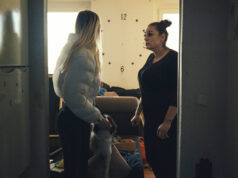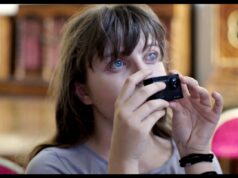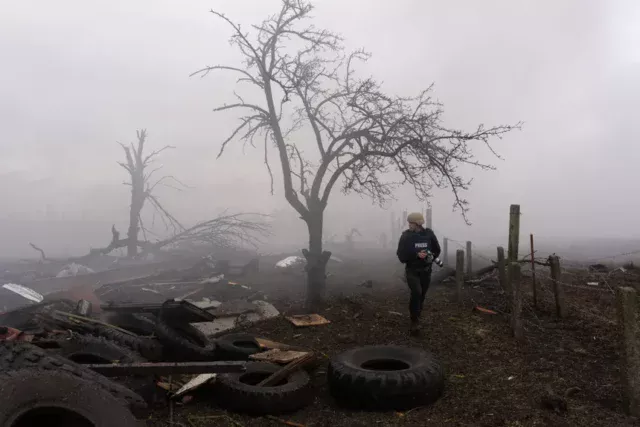
On the day he speaks to Business Doc Europe, Mstyslav Chernov is back from “more than a month” in Donbas on the front line, where he has been working on a new film. It will be the follow up to 20 Days In Mariupol, a Dutch premiere in Best of Fests and already an Oscar contender.
Chernov leads a double life. He is a filmmaker and novelist but also has “a day job,” working for news agency AP. He was in Mariupol last year when the city was under siege by the Russians who were busy laying waste to large parts of it. In the documentary, he captures horrific but unforgettable scenes of death, destruction and human suffering.
“Since the 20 Days In Mariupol film came out, I just look differently on everything I do in my daily work…I worked as a news cameraman for nine years. There is a particular approach when you are a news cameraman,” he reflects on the conventions of war journalism.
Making 20 Days In Mariupol allowed him to go beyond reportage.
“I always had a lot of questions about the profession, about human nature and about the nature of war…making this film made it possible finally to ask these questions,” the director says.
The documentary presented obvious ethical dilemmas. The director was filming many distressing moments in which people are shown at their most desperate.
“The challenges start from the process of filming. A lot of these moments are very sensitive moments…Whenever you approach people in distress, when you film people in distress, you have to do that with respect and care. You have to balance the wish to survive and the wish to keep working.”
When the siege started, Chernov realised he and his colleagues were the only ones reporting from the city. That placed a huge burden of responsibility on their shoulders,
“I have been through five wars at least and I’ve never been in a position like that, when you are responsible for giving a voice to the whole city.”
Chernov filmed much more material than made it into the final cut. “There is only so much you can put into 95 minutes of the film. Also, you have to respect the audience and be careful not to numb the audience with this emotional load the film is carrying. It is not the violence that is sometimes hard to watch in the film. It’s the emotional impact the events are having on the people who are living through that.”
20 days In Mariupol is held together by Chernov’s searching, poetic narration. Early on, he was resistant to using a voice over. He felt he could tell the story without it and filmed “hours and hours” of follow-up material with survivors from the siege, hoping their insights would carry the narrative.
“But then we realised we wanted to keep the audience inside the siege, together with people [there],” the director remembers. He therefore started looking for another narrative tool to connect all the stories of the city’s inhabitants over the 20 terrible days that the documentary covers.
Chernov always keeps notes when he is reporting. “We decided to use my perspective to tell the story. It was also a challenge to find the right tone. What I didn’t want to do was to impose any feelings or judgements on the audience by being too emotional or over-analysing. But at the same time, I needed to show care. I am part of this society. I am part of this country.”
The director worried about every aspect of the storytelling, even how close to the microphone he should be when recording his narration. “I really wanted it to be a conversation with the audience.” He also wanted to stay “as neutral as possible” in order to give viewers the space to form their own opinions about what they are seeing.
The logistics of making the documentary were daunting. The director had a satellite phone but wi-fi coverage collapsed during the siege. Often, there was no electricity. There was the terror that he might lose his imagery or not be able to get it out of the city. “I knew that every single minute I recorded in Mariupol was incredibly valuable historically and also for the people who were there.”
Early on, Chernov considered hiding the files with his original material somewhere in the city. He thought about asking civilians to take the footage out – but didn’t want to put anyone at risk. In the end, he decided to keep hold of it himself. “Fortunately, things were so chaotic when there were the first couple of days of ‘green corridors,’ that we were able to get it out.”
The director worried that audiences simply wouldn’t be able to watch a film that was so harrowing. This proved not to be the case. 20 Days In Mariupol won the Audience Award at Sundance after its world premiere there and has been acclaimed everywhere else it has screened. “I saw the film giving hope to people. “
In spite of his achievements as journalist and filmmaker, Chernov cherishes the private space of the novelist.
“Literature actually for me is more important than filmmaking and always was,” he declares. He takes great pride in his book ‘Dreamtime’ (2020). The novel describes the beginning of the Russian invasion of Ukraine in 2014 “and how the war is a collective trauma and a collective nightmare – that is why the book is called Dreamtime.”
Chernov believes writers can drill further into human nature than filmmakers. “I guess literature just gives much more depth to certain questions. War is an incredibly complex thing. It has so many layers. I guess one medium, such as documentary or fiction film, is not enough to get to the bottom…Literature is an important part of that research.” The director pauses. “Those things I can’t speak about with filmmaking, I try to speak about with literature.”