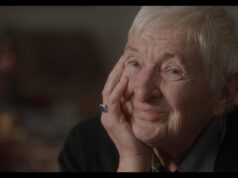
How do you depict the impact of colonisation, decolonisation, a civil war and a destructed economy in one film? Director Alain Kassanda decided to portray his grandparents, who were both born in what was then called Zaire, and lived through all of these traumatising times. The result is a deeply personal, sometimes poetic, sometimes harrowing (hi)story of oppression, revolution, betrayal, disillusionment and love.
Kassanda had tried before to get his grandfather Justin to talk about his life, but to no avail. You can’t blame the filmmaker for trying, nor his grandfather for equivocating, for his story is a fascinating, though not always an honourable, one.
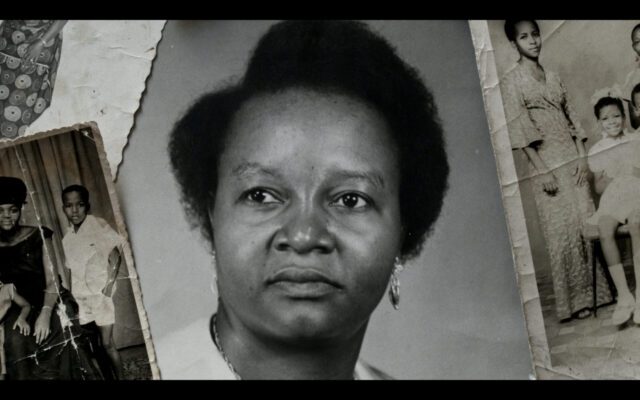
The film starts with old family photos which have been tarnished by time, accompanied by Kassanda’s musings on memories and how hard it is to tell a story you’re too close to. It is one of the threads in this documentary – how can you picture the big story when you’re right in the middle of it? And how can you see people as a whole, when they are so close to you?
Nevertheless, the maker succeeds in distilling an image of history and of his grandparents from their memories, combined with his own experience and the knowledge he has gained in the meantime.
That history begins with the birth of grandpa Justin, at a time when Belgian King Baudouin ruled this incredibly rich part of Africa. Colonisation, evangelisation and education according to Western concepts went hand in hand. Kassandra lets his grandfather tell that history, referring to a map rolled out on a table. And he then lets black-and-white fragments from those days tell the story, shot by a Belgian film crew to show folk back at home what noble work was being done among the ‘savages’.
In reality, children were kidnapped and taken to the missions in great numbers, where they were trained to be respectable employees of the white bosses. Young men were put to work on plantations and in the mines. Any form of opposition was severely crushed. Grandfather Justin tells how, for the film, the Black subjects had to play the role their coloniser had created for them: spear-jumping, practising voodoo and committing adultery until they were rescued by their overlords.
The combination of the footage with the story of the grandparents gives a complete and heartbreaking picture of that time. And also shows the utter absurdity of what has been considered normal for centuries – Western countries thousands of miles away deciding on the lives and well-being of peoples and cultures they knew nothing about.
The time of the independence struggle is also told through the personal account of Justin, who gained an important position in the ‘independent’ government of Congo, and from archive footage from that time. Independence came at a high cost – the new leaders faced the almost impossible task of making a bankrupt country stand on its own two feet. The divide and rule policy of the smart Belgians plunged the country into a civil war and a subsequent deep economic crisis.
Throughout all the events, with the history we learn in the west rimmed in deep black, the love between Justin and his Colette, to whom he proposed marriage when she was just fourteen, plays a core role. Justin’s climb up the social and economic ladder is made for her and their children, we are told. She accepts the forced role of housewife, but takes over when the political crisis makes him unemployed. She also stands behind him when he takes sides against Congo’s initial new leader, Lumumba, who represents a great, strong and united country.
The filmmaker doesn’t let his grandfather go unchallenged, and asks questions of conscience, which makes the old man visibly uncomfortable. As anyone who sees this movie should feel uncomfortable. It shows how complicated our colonial history is, how inhumane and unscrupulous so-called civilisation (built on fear and violence) was in non-western areas, and how hard it is to regain your own strength and self-confidence when you’ve been oppressed, both as a country and a human being.
France/Belgium, 2022, 89 mins
Director: Alain Kassanda
Production: Damien Monnier for L’image d’après
Cinematography: Alain Kassanda
Editor: Alain Kassanda
Spoken languages: Lingala, French