Egyptian filmmaker Bassam Mortada was still a young boy when his father Mahmoud was taken away to Cairo’s notorious and brutal Abo Zaabal jail in the late 1980s. Mahmoud had been involved in organising workers’ strikes. He disappeared overnight. Thugs barged into the family apartment. Mahmoud wouldn’t wake up at first. When he finally opened his eyes, he was confronted by men with weapons. He shouted out to his wife: “you can’t wake me up every time you see a cockroach.”
The boy Bassam was perplexed. He simply didn’t know what had happened but realised something was badly wrong by observing his mother’s reaction.
The day after the arrest, his mother still made him go to school. Bassam remembers being baffled by what had happened.
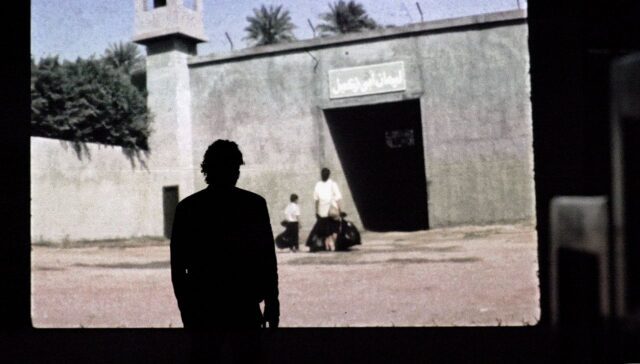
In his new documentary, Abo Zaabal 89 (screening in IDFAs’ Luminous section), Mortada looks back at just how Mahmoud’s imprisonment upturned his own life, and that of his parents.
When the director left his full-time job to start up new production outfit See Media with producer Kesmat Elsayed, he was determined to make a film about his father’s experiences.
Mahmoud was changed by his traumatic experiences in the jail. After his release, the former political activist was a quieter, more reserved figure. His political idealism seemed blunted and his memory played strange tricks on him. He was also desperate to experience the pleasures denied him for so long behind bars – to read books and buy expensive clothes he could hardly afford. He was becoming emotionally distant and there were strains on his marriage.
“I wasn’t so conscious of it [how he had changed} but my mother made me aware of it,” Mortada says. He found himself caught between his parents.
The director acknowledges that examining such painful and personal family history in the film was “very hard” but “the choice of my family was always to put the public first.” He sees Abo Zaabal as a companion piece to some of his earlier work, for example Althawra… Khabar (2012), which follows six idealistic Egyptian journalists during the revolution. As one critic has noted, Mortar’s very personal movie is about the impact of “the big history” of Egypt on the “very small history” of his own family.
The director talks of “facing” his fears that he might endure the same fate as his father.
One key part of the documentary is a monologue performed by Sayed Ragab, one of Mahmoud’s friends who had been in the prison with him. Mahmoud had forgotten that Ragab, who has gone on to become a successful film and TV actor, had been a fellow captive.
The monologue confronts Mahmoud with painful memories of his captivity.
In Abo Zaabal 89, there is also a disturbing sequence in which the director forces himself to ensure some of the same experiences as his father in the prison, for example a degrading mud bath.
“This was one of the first things I wanted to do. It is never going to be exact but I achieved some feelings of connection with my father which were important for me – and also for my father.”
Mortada researched archival material exhaustively, searching for footage of events like the Egyptian bread riots. This was “very hard” to find – and “very expensive.”
“The idea when we set up this company was to work on neglected narratives – stories of activists who have contributed to the public space,” producer Elsayed explains the mission of See Media. She adds that making the documentary was “very challenging” because “talking about history” in this way in Egypt is “very rare.” Filmmakers tend to focus far more on contemporary stories.
“We don’t shy away from difficult projects. Many times after we started the project, we were pitching it internationally. They [potential backers] were intrigued by it but they would say ‘we want to talk about today. Tell us about today,’ the producer remembers the responses she and Mortada encountered. She would try to explain that to “understand today,” sometimes you need to look back.
“It took us five years. We were very lucky we were more able to get backing from a lot of Arab funds that support independent filmmakers,” Elsayed notes of supporters like the Doha Film Institute.
There was also some German backing. The project won a Robert Bosch Foundation film prize for emerging Arab-German filmmakers through the Berlinale Talents programme. The German co-producer is Anke Petersen for Jyoti Films.
Elsayed is now based in Germany herself and has a sister company there, Seera Film GmbH.
“We rarely find co-producers who understand the importance of telling stories from our region,” she declares. “I feel that having this access here will be much better for future projects.”
The film has been invited to screen in the Critics’ Week at the Cairo Film Festival. “This is fantastic news. They really see the family story of the film and its significance. It is really a great chance for us to share this very intimate story in Egypt.”
Mortada believes that making the documentary has brought him closer to his father. “We have more things in common thanks to sharing this experience together…”
The prison itself is still standing. “But a lot of more modern prisons have been built in the past few years. Abo Zaabal is actually one of the places that will be shut down.”
Having finished the documentary, Mortada is working on two new projects. One is another documentary. The other is a fictional drama, Bassam’s Birthday, albeit one based on real events. The latter is “also set in a moment of the past that has not been explored before.” It features two political activists at a crucial moment in their lives, in the beginning of the 1980s, before Israel’s invasion of Lebanon.
Why the move to fiction? “One of the characters passed away. I want to bring that moment back to life and imagine it the way I think it happened,” the director reflects on what looks set to be his next project.