

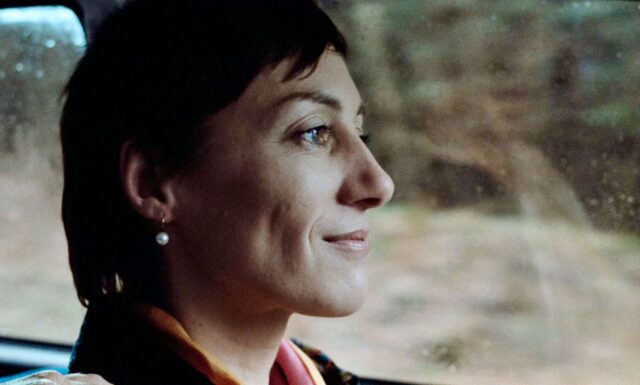
Few radical feminist filmmakers are as provocative or as witty as Helke Sander, the subject of German director Claudia Richarz’s new feature doc, Helke Sander: Cleaning House, an international premiere in IDFA’s Luminous.
Sander’s movies include groundbreaking documentaries like Redupers: The All-Round Reduced Personality (1977), about the Berlin Wall and the challenges women face during a period of political division, and Liberators Take Liberties (1992) about the mass rape of German women by Soviet soldiers at the end of the Second World War.
Richarz first met her subject as her student. Sander was a professor at the school of arts in Hamburg. Richarz was already a devoted reader of Woman And Film, the feminist magazine that Sander had founded.
“Every woman who made film in Germany used to read this,” Richarz recalls of the magazine.
As soon as she had Sander as a professor, Richarz began to turn up to all her lectures. (“Before, I didn’t go there so often,” she confides.)
After she left the school of art, Richarz took jobs on some of Sander’s films, as a driver or assistant. “Later on, I worked at the small office she has in Hamburg, but then we lost contact,” Richarz remembers.
The years passed. They were living in different places. By then, Richarz had a family. “Then we met again in Cologne. We hadn’t seen each other for 20 years,” Richarz remembers.
Sander’s film Liberators Take Liberties was being shown. “I saw her, I saw the film…and then I woke up the best morning and thought a film about her should be done!”
This was how Richarz first hatched the plan for the documentary. She wrote Sander an email proposing a film and her old professor quickly agreed.
By chance, just as filmmaking was getting underway, Sander was cleaning house, setting her affairs in order. This provided Richarz with the perfect framing device.
“I am a documentary maker and when you make a film about an older person, it is a little bit difficult to find a story. I think every film should have a story or something that you can hold onto…I am deeply into documentary filmmaking. I always love to film what people do, what they really do, not what I tell them to do.”
The director doesn’t just show viewers her subject tidying up her apartment. She also includes moments from Sander’s films and footage of some her of political protests and stunts. There is comical archival material in which she takes German media magnate Axel Springer to task. In another clip, Sander is also shown asking some baffled male cooks and kitchen staff about gender politics and sexual violence. She uses humour in sly, subversive fashion.
“This is her. She is like this in real life and also in her films. I love that.”
Pulling together the archival material was “a real, real, big task. I had so much material you can’t image, and I had to keep it all in my head, where it comes from and who it belongs to, Also, part of it was very expensive.”
German broadcasters charged high rates to license old news footage of Sander. Fortunately, clips from Sander’s movies were easier to access. The Deutsche Kinemathek, which has the rights to these films, supported the documentary. Meanwhile, some of Sander’s old colleagues and students who had private archives gave Richarz footage for free. “They knew I had a low budget.”
Sander, born in 1937, is now in her mid 80s. She remains as politically committed and as much of a feminist as ever. “Many of the themes she brought up are still relevant. They are still problems,” Richarz reflects. “When I show the film to younger audiences, many are astonished and really moved because it still talks to them. What she fights against, younger women are very interested in. Also, men are interested in it.”
One part of the documentary deals with its subject’s experiences in Finland when she was married as a young woman to Markku Lahtela, a Finnish writer. Her own family were conservative but Sander was heavily influenced by her parents-in-law. They were a progressive couple who gave away much of their money, always spoke their mind about politics and had a deep-rooted belief in gender equality.
Sander is not the type to take a backward step. “Keep on fighting, don’t give up” is how Richarz sums up her approach to life.
What is it like to make a movie in which your old professor is the subject? Richarz explains that she and Sander are now firm friends, not teacher and pupil. “When I met her first in the cinema in Cologne, it was just a joyful moment for her and for me. We were both really happy to see each other again….”
Making the documentary required the two women to spend many hours together. “We connected on an emotional level,” Richarz suggests. “I don’t feel like a student any more, no.”
Sander’s films didn’t directly influence Richarz’s own work. “But she influenced me very much by her thoughts which you can read in Women and Film, and also by her free and independent way of making films. She did what she wanted to do.”
From the beginning, Sander made it clear that she regarded the documentary as Richarz’s work and didn’t try to interfere at all in any of the creative decisions. Nonetheless, it was a little nerve-wracking to show the documentary to her. Richarz went to her house with a cut that was almost finished. “I couldn’t have shown her a raw cut because then she wouldn’t have seen what the film was like,” Richarz points out. Sander watched the movie with total concentration and was clearly deeply moved by it.
“She said that’s well done and she gave me a hug!”
Richarz made the documentary through her company Claudia Richarz Film. Barnsteiner Film has come on board to handle German distribution and will be releasing the doc early next year.





