

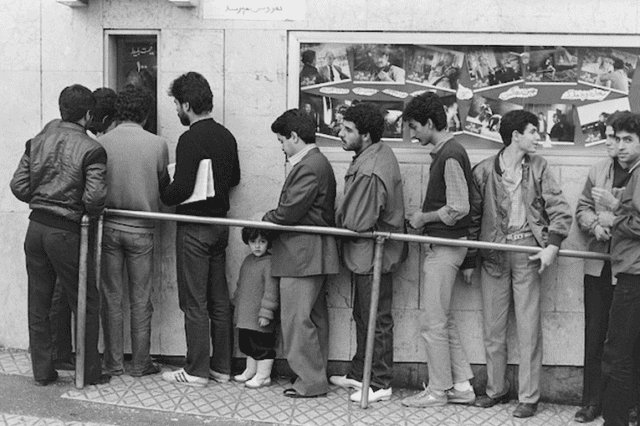
During the Iran-Iraq war, Iranian movies were melted down and the silver removed to help the war effort. This is one of the historical details included in London-based Iranian filmmaker Ehsan Khoshbakht’s feature documentary Celluloid Underground.
The film, sold by UK sales agent Impronta Films, portrays Khoshbakht’s old friend Ahmad Jorghanian, a movie lover in Iran who collected movie prints and posters by the thousands. After the Islamic revolution, these were regarded as illicit goods. Nevertheless, he kept his material hidden in basements of buildings across Tehran.
Director Khoshbakht was living in exile in Leytonstone, east London, when he learned of his Jorghanian’s death. He is still based there today.
The moment he arrived for the first time at Leytonstone tube station in 2012, Khoshbakht noticed all the Alfred Hitchcock mosaics on the walls of the tube station. Hitchcock, the son of grocers in east London, was born and brought up here. As an ardent cinephile himself, Khoshbakht saw this as a good sign. Two nights after his arrival, he was walking on the streets and realised his new home was only 100 yards from the Sir Alfred Hitchcock Hotel.
Since Hitchcock was also “crucial” to his development as a filmmaker and curator, he decided to include references to him at the beginning of the documentary. Most of the film, though, is devoted to Jorghanian.
As Khoshbakht acknowledges, he found it very difficult to think back to the times when he was still living in Iran, running movie clubs, before his exile. “This was one of the things that was making this documentary very, very hard for me, the fact that I developed an attitude for maintaining my sanity by blocking everything from the past and just not looking back at all. I couldn’t go back, so I couldn’t see these people again.”
It wasn’t just Jorghanian he wanted to blank from his memory, but many relatives and close friends. He was trying to start a new life in the UK. “I was almost consciously trying to avoid that past.”
There were also aspects about Jorghanian’s character and way of life that Khoshbakht didn’t much like. “To me, he was rude, he was loud, he was too messy….”
But as time passed, Khoshbakht realised his debt to Jorghanian. He disputes, however, the idea that he and his old friend were showing bravery by watching old movies in hidden basements in Tehran at a time when those movies were banned.
“I am reading that people are calling Ahmad and I resistance fighters and cultural heroes, but the truth is this film was made to show us as two cowards. I was thinking about Satyajit Ray’s The Chess Players all the time. It has this beautiful scene where they are sitting playing chess. In the background, all the different armies are passing and they are completely ignoring them. They just want to play chess.”
Like Ray’s chess players, Khoshbakht and Jorghanian could use their passion (in this case for cinema, not chess) to block out the outside world.
The documentary includes footage of a screening that Khoshbakht organised of new wave filmmaker Dariush Mehrjui’s The Cow (1969). Khoshbakht was denounced for showing it by a young religious zealot in the audience. The scene has an added tragic pathos now given the recent murders of Mehrjui and his wife. Ironically, the man who denounced Khoshbakht all those years ago has completely changed and now runs a coffee shop where radicals and poets hang out. The director tried to reach him to see if he wanted to participate in the documentary. “In all honestly, I still, after all these years, totally hate that man for what he did. I am not going to forgive him ever again.”
Khoshbakht filmed most of his encounters with Jorghanian in the Tehran basements which his friend turned into huge, makeshift archives. The director talks of the contrast between the chaos and the greyness of the subterranean environment and the beauty of the posters. They’re huge, colourful and have a strong aesthetic impact. They are also useful as a historical record. “The only way you can understand which films have been screened in Iran is [through] these posters. Every single poster you see there, it means that the film has been screened. These were posters sent to Iran with the specific purpose of promoting films that were meant to be seen. By indexing and cataloguing them, you get an index of the films that screened in Iran in that period.”
Cinema is Khoshbakht’s passion. He likes to joke that his life hasn’t changed since he was a small boy. He still loves to watch films and to show them to others. Alongside his work as a director, author and critic, he is the co-director of Il Cinema Ritrovato in Bologna, programming old movies and curating retrospectives, with everything generally shown on 35mm, not digital.
There is an unlikely Scottish connection to Celluloid Underground. The documentary was supported by Screen Scotland and is produced by Mary Bell and Adam Dawtrey through Stirling-based Bofa Productions.
“I was very much involved with the film scene [in Scotland] since I moved to this country,” the director points out his links with the Edinburgh Film Festival and the Edinburgh Filmhouse, but adds that he makes no claims to be an honorary Scot.
Celluloid Underground screens this week at the Leeds International Film Festival. Its director is hatching new projects and is also busy preparing for a retrospective at Il Cinema Ritrovato of the work of Ukrainian-born US filmmaker Anatole Litvak, known for movies like Sorry Wrong Number and The Snake Pit. Where did Khoshbakht first see a Litvak movie? Somehow, it doesn’t come as a surprise that it was through one of Jorghanian’s prints…





