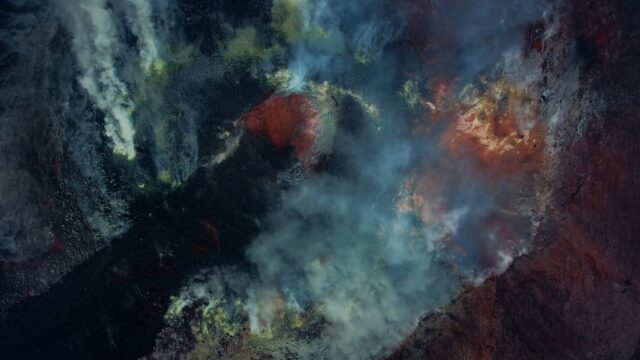
A feast for the eyes and ears, the hybrid Krakatoa, presented both theatrically within IFFR’s Harbour section and as an installation within Art Directions, recreates the volcanic explosion of 1883 which produced the loudest sound ever heard.
In Carlos Casas’ eponymously-titled film, a Javanese fisherman (Kesuma) survives the eruption, and the subsequent tsunami, ending up on a deserted island. In search of food and water, he is drawn inexorably to a cave which leads, Jules Verne-like, to the centre of the Earth, at which point the visual/sonic spectacular goes into psychedelic overdrive.
The 1883 Krakatoa explosion has taken on mythical proportions over the subsequent years. The sound was heard thousands of miles away, and the shockwave circumnavigated the globe many times. For weeks, sunsets around the world glowed in deep reds and oranges, and atmospheric pressure fluctuations were recorded by instruments as far away as London.
For director Casas, the story has very contemporary resonance, however, specifically in regards to our ecology and our climate. “The Royal Society in London [was where, in the 19th Century] one of the first international group of researchers first gathered to talk and to gather data from after the eruption, and that was considered to be one of the earliest examples of a whole planetary human endeavour of understanding what are the [implications] of one event like this around the world,” Casa tells BDE. “That was also for me so fascinating, that it was the first time that this happens. For me, I believe that it’s the very beginning of the concept of ecology – this idea that that we [all natural components and elements on the planet] are a single organism.”
“The idea of Gaia comes a little bit later – but I can trace really this moment to the beginning of the world community of humans, understanding that one phenomenon can change the whole atmosphere, the temperature, the weather and so a lot of things,” Casas adds, pointing to the general sense of stagnation there is right now on climate change, and the need for us as a species to change our behaviour. “It’s a goal to rethink our position with the planet… we have to make a kind of a sacrifice to nature in order to appease it, in order for it to become stable again, and establish an equilibrium.”
Krakatoa is a volcano that remains active. Even though the core character of Kesuma is presented within the original 19thCentury setting, the real-life Kesuma (whom we see throughout the film) survived a 2018 Krakatoa eruption and subsequent tsunami, while some of his fellow fishermen perished. Yes, director Casas confirms, the two characters are one and the same, and their fusion across time zones adds an “abstract” vibe to proceedings, he further notes. Even Kesuma’s latter-day boat/dwelling would not seem out of place within a 19th Century setting.
When, in the film, our hero begins his descent towards the bowels of the earth, he experiences a son et lumiereextravaganza, along a corridor of light and within a rich, at times deafening, soundscape designed by Academy Award-winning Nicolas Becker. The whole thing is reminiscent of the final mind-blowing sequence within Stanley Kubrick’s 2001: A Space Odyssey.
“I would consider 2001 probably the greatest film ever made…in terms of the way that it’s constructed,” says Casas, who was also influenced by other experimental works, such as the 1966 film The Flicker by Tony Conrad, which “uses black and white in a stop-motion to create this sort of rhythm and a sensation of another state of mind.”
“There’s also a lot of connections to Robinson Crusoe,” Casas adds.
In a film that features the loudest noise ever heard on the planet, sound design was, of course, a core consideration. Together with designer Becker, Casas had previously created a sound installation for the 13th Shanghai Biennale (2020-21) based on the gasometer frequency ranges resulting from the 1883 eruption. This formed a starting point for the film’s eventual sound offer.
“We then then collected a lot of seismic materials from nearly all the eruptions that exist, from Mount St Helena (US) to Pinatubo (Philippines) to the recent Krakatoa ones,” says Casas, adding that the production had a higher budget for sound than for visuals, “which is something that is not standard. It doesn’t happen often.”
Casas talks enthusiastically about “understanding the physiology of sound, and how we can work with spectator sensations” in terms of upping the ante and elevating the entire cinema experience. “My previous film Cemetery was also a deep exploration into sound. This film [Krakatoa] is a second film of this trilogy that I’m dedicating to the potentiality, to the power, of sound.”
Prior to the film’s theatrical world premiere on January 31, IFFR audiences can attend its first bow as an installation (Friday, January 30). This will entail spectators either side of a screen, seated on one side and occupying a “vibration platform,” to be kitted out with transducers and subwoofers, on the other.
“People can just lie down and get the feeling,” says Casas. “There are some moments that are totally related to the film, but of course for the [interactive] performance I really want to improvise and change scenes and…allow more space for sound and music experimentation.”
Krakatoa is produced by Carlos Casas, Elena Hill, Beli Martínez, Helena Girón, Samuel M. Delgado, Krzysztof Dabrowski and Brahmantyo Putra.