

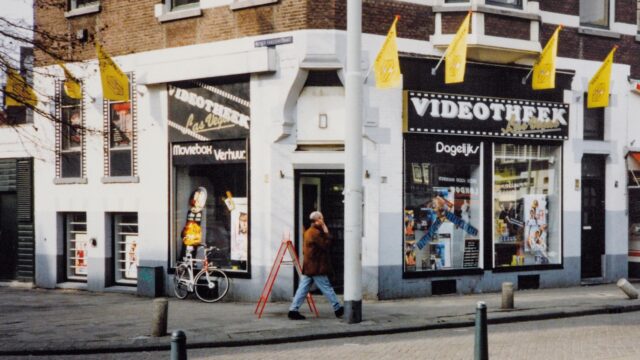
Gyz La Rivière’s Videotheek Marco, a world premiere in International Film Festival Rotterdam in the “Focus: Hold Video in Your Hands Sidebar,” is a tribute to the lost world of Dutch video stores – to a now bygone era when VHS tapes dominated leisure time in the Netherlands. The documentary follows on from La Rivière’s book ‘Home Video videotheken & video in Groot-Rotterdam’, which he wrote during Covid and which focused on video stores in the Rotterdam area.
“I really miss it,” La Rivière sighs as he contemplates the days when video outlets were almost as commonplace as supermarkets. This was a period when cities like Amsterdam, the Hague, Haarlem, Arnhem and Rotterdam had cinemas – but very small villages began to get into the movie business too by opening their own VHS rental stores. The stores attracted customers from every demographic: “rich and poor, the working class and the super smart.”
Sadly, like phone booths (another important part of everyday culture in the so distant past), the VHS stores have now been wiped off the landscape.
La Rivière himself was a member of several stores including his favourite, The Filmfreak. It was how he got his movie education. He describes the stores as “beacons of culture.” The clerks were like “librarians” who “schooled” their customers.
Another aspect of Dutch video culture explored in the film is its importance to immigrant communities. VHS recordings of football matches in Turkey would be rushed to the Netherlands so that Rotterdam-based Turks could watch them just a few days after the final whistle. Every community had its own video stores where they could rent TV shows and movies from their home countries.
One key part of the research for the book involved tracking down photos of the old video stores, most of which are now long since closed. “It was so much work to find these pictures,” he says. This material isn’t in archives but is mainly privately held – so La Rivière spent a long time sleuthing and knocking on doors. “To find pictures was hard. Maybe to find moving images will be much harder,” he explains why he didn’t immediately embark on the documentary having finished the book. Around 18 months ago, though, he decided he had to make the film.
Video store owners in the Netherlands, he points out, were ranged in their tastes and offer to customers. Some were passionate cinephiles. Others simply felt they had found a new way to make easy money. Erotic was always available. In the early days of VHS, age restrictions were very lax – so 13-year-old teenagers could watch some very scary horror.
As the business grew, the big franchises moved in. There were chain stores like Blockbuster in the US and UK and Videoland in the Netherlands. Small timers were elbowed aside.
This is the director’s fifth feature. It follows on from such earlier works as 12 –A Film about the Fret Click (2009), New Neapolis, Rotterdam 2040 and Malin TV, almost all of which have screened at IFFR. He describes himself as “an artist who sometimes makes a film,” but his movies have always been well received on the festival circuit. He tends to look for funding from arts organisation rather than from the usual film agencies. (“They don’t understand me,” he jokes.)
Backers of the new doc include Mondrian Fund, Jaap Harten Fonds, CBK R’dam and Stimuleringsfonds Creative Industry.
And, yes, he had to pay for a lot of the rights for the clips he used. It wasn’t all fair use. He spent a long time researching deep in the bowels of the Netherlands Institute for Sound and Vision, the archive centre and museum based in Hilversum. “They like the project and my style – and I can find stuff that they don’t even know exists…it’s like hip-hop, digging through records to find a sample, it’s a bit the same but with moving images.”
La Rivière acknowledges that VHS may not mean much to younger audiences. Hipsters may still collect vinyl records but not quite the same culture exists with video or DVD. In the space of just a few years, every household seems to have thrown out its DVD player and it is a long time now since VHS tapes were in active circulation. Nonetheless, some old stores, for example Kim’s Video in New York or Whammy in LA, are (re-)opening for “fans and freaks” I (as La Rivière styles the aficionados).
“If it stays this way, with all these platforms but a limited infrastructure of classic films and genres, maybe something can happen,” the director speculates that video stores may again spring up simply because fans aren’t really being served properly by the streamers.
Big-name directors would often complain about the way their films were treated on VHS. They’d be shown in the wrong aspect ratio with fuzzy visuals and tawdry art work. To the fans, though, that was just part of the charm.
“I was born in the year of video, 1976, and so I really love the ratio 4:3,” La Rivière says of the (almost) square format in which almost all movies were seen on VHS.
And, yes, he still has video VCR-machines of his own (including a model from as recently as 2016) and plenty of tapes. “The funny thing is the tapes are being manufactured again.”
Is Videotheek Marco going to be released on VHS? “That’s for sure, as a gimmick,” the director says. “I really worked so hard on it. It is so fresh finished…I have no clue what will happen to it.”The plan now is to submit the documentary to other festivals. La Rivière knows that his film is telling a very Dutch story. “But local is global in the end,” he concludes.





