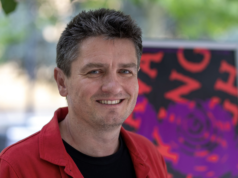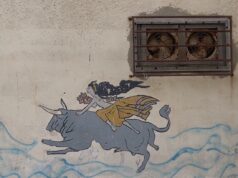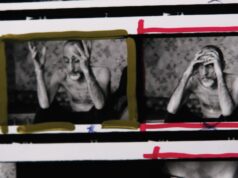
In 2016, in Berlin, the world changed for Dutch experimental artist Guido van der Werve. When cycling along a busy road he was knocked off his bicycle and propelled towards an oncoming lorry. Most people would have died, but he survived. That said, his injuries were horrendous and it was doubtful whether he would ever walk or talk again.
Prior to his accident, van der Werve had been extremely fit, and even in a coma had a pulse rate in the 30s and extraordinarily high levels of oxygen. The doctors were astonished. Van der Werve may have had distinctly non-commercial sensibilities when it came to his art and cinema, but when it came to his personal recovery he was able to channel his inner Iron Man.
Eventually, with the support of his kind and patient girlfriend Johanna (whom we meet in the film) and the help of friends and colleagues, van der Werve eventually left hospital and continued the long process of rehabilitation. And now he’s made a film about it.
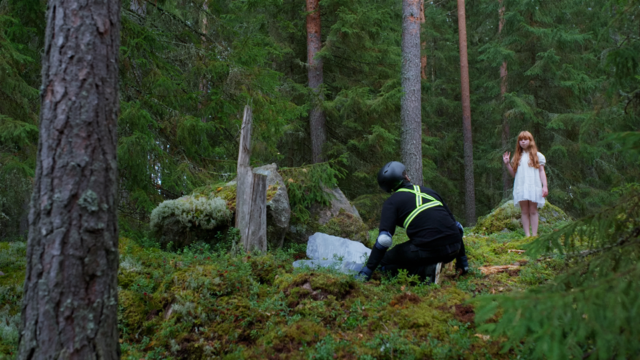
Number Eighteen is just as funny, disturbing, difficult and offbeat (and experimental and non-commercial) as the Numbers 1 to 17 that preceded it. It is also artistically audacious; whether visually in reconstructing his adolescence, conceptually as he creates an alter ego in the form of a daughter he reckons his mother would have preferred, or sonically in the top notch choral compositions that describe his idiosyncratic existence to date.
“It wasn’t easy work,” van der Werve concedes. “I was so badly injured, so at the beginning I was nothing. Then I tried to figure out what happened, as we humans do.”
“Also it was a personal quest for me because I thought that probably a lot of people on the art scene will have heard about my accident. And I think they will wonder if [I’m] still able to do something. So this is my return,” he stresses.
One character that will fascinate audiences is the director’s late father Kees whom we see in old family Super 8 archive and played by an actor (non-professional) in dramatized scenes. Many of Kees’ paintings, some of which are excellent, if somewhat disturbing, and which have only ever adorned the walls of the family home, form the chapter headings of the film.
Kees was a profound atheist (who married a devout Catholic) and a man whose humanist belief structures very much informed those of his son Guido. “One of the reasons why I had problems in my Christian primary school was because I followed my father’s path,” the director notes. There were further parallels. Father and son went to the same art academy in Amsterdam, and both had major strokes. Kees’ led to dementia while Guido’s was a result of the accident.
The director has always revelled in his status as outsider and has happily refused to bend to the whims of the audience as he embarks upon his artistic endeavours. But he concedes that producer Danielle Guirguis of Smarthouse Films made him question again and again all the artistic choices he was making in the film – and what’s more he thanks her for it.
“She was always asking me, ‘Why do you want that? Why do you want to put that there?’ And I would answer, ‘Well, I’m an artist, I don’t think verbally.’ But she kept on asking the same questions, over and over.”
Eventually the message got through and van der Werve began to see matters through a different lens. “It was good for me to go through that process. Sometimes you go to the cinema, and you just end up watching something and thinking, ‘why the hell am I watching this?’ So in that sense, it was good to have her on my side to ask me that question over and over again. ‘Why?’”
Yet as a piece of existential doc art illustrated by some great choral compositions and with love and survival at its root, the film is still quite unlike anything else out there. “It’s gotta be different, cause I’m different,” van der Werve underlines.
And who can question that statement, coming from somebody who sees the number two as yellow, assesses music as much in numerical as aesthetic terms, and who has returned from near death to tell his fascinating life story.
The article was first published in See NL, a joint collaboration between Eye Filmmuseum and the Netherlands Film Fund.