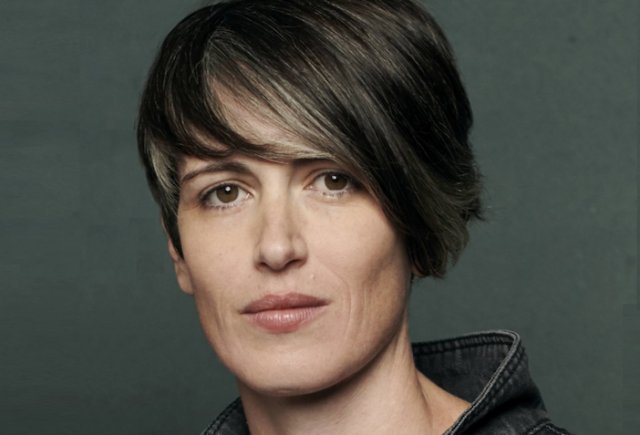
It’s 13 years since Flore Cosquer joined the Scottish Documentary Institute, which celebrates its 20th anniversary next year. Last summer, she became SDI Director, taking over from irrepressible founder Noe Mendelle. Now Cosquer is promising a new “chapter” at the organisation which has been at the heart of the Scottish doc scene for these two past decades.
Cosquer came to Scotland having worked in production in France. She started her career in drama but then went on to work for Marseilles-based doc production outfit Les Films du Tambour de Soie, run by Alexandre Cornu.
When she first arrived at SDI, Cosquer was initially involved in a co-ordinator role. She went on to run the training programmes of the Institute and oversee industry activities while also doing some producing on the side.
“It meant I was seeing everything from three different angles,” she says of the knowledge base she was building.
Since 2019, SDI has had charitable status. It is no longer directly involved in producing feature docs but is involved in making short films commissioned through its training programmes, such as Bridging The Gap.
“The reason for becoming a charity was also to attract different types of funding; to be able to receive funding from trusts and foundations and to not be so dependent on Screen Scotland which is our national funding body. They’re incredibly generous and supportive of our work but it was very important that we diversified the source of our funding,” Cosquer explains. “One of the other main reasons for obtaining charitable status was to show the world that what we do is ultimately for the public good – to make the documentary industry a fairer, more diverse one,” she adds.
The new SDI Director talks about “respecting the legacy” of founder Noé Mendelle “and the amazing work she has done.” However, Cosquer is making some changes in how the organisation is run.
Now overseeing SDI’s marketing and communications drive is Debora Bottino who joined last October. Her appointment is part of Cosquer’s drive to change the way the organisation is perceived both in Scotland and internationally.
“We are very well known to people who are interested in creative documentary, but one of the challenges when you become a charity is also to get well known and [have] your work be recognised by the people who are going to fund you. The communication effort is also on that front – it is also to appear very open. I don’t want to be labeled an elitist organisation,” Cosquer says. “We’re specialists but we are not elitist.”
SDI wants to make it very clear that it is there for everyone and to boost diversity. “It’s a fact that there is a lot more diversity in drama filmmaking…than in documentary,” the SDI Head reflects on a trend she is determined to change.
One key initiative is to ensure that at least 50% of Scotland’s documentaries are directed by women by 2025. SDI is keen to work with outfits like feminist archive activist film collective, Invisible Women, which has championed work of filmmakers with marginalised identities.
The Institute has also been in touch with local universities. There has been a concerted attempt to make it very clear to the wider world exactly what SDI does, from its masterclasses to its talent initiatives.
Post-Brexit, another goal is to ensure that collaborations are made with European partners. SDI is currently looking to work with Polish Docs “and to dream big together.” The idea is join forces on training ideas while also looking to co-produce together. It helps that there is a significant Polish population in Scotland.
Public body Screen Scotland remains one of SDI’s most significant supporters. Alongside its backing from various national and international funds, among them The William Syson Foundation, The Pump House Trust, Hugh Fraser and Awards For All Scotland, SDI also recently secured significant investment from the People’s Postcode Lottery for a period of three years. Meanwhile, it has British Council support for its “Stories” residential filmmaking laboratory which is run in cities across the world in places ranging from Benghazi to Tripoli, Rabat to Ramallah or Jakarta to Beijing, and many others besides.
SDI has plenty of recent success stories to burnish its credentials, among them Simon Chambers’ 2022 IDFA winner Much Ado About Dying, which also won the Best Pitch award at Edinburgh Pitch in 2020; A Thousand Fires by Saeed Taji Farouky, which won Best Pitch award at Edinburgh Pitch in 2018 an opened Locarno’s Critic’s Week in 2021, winning the Marco Zucchi Award; and Electric Malady (Scotland), which pitched in Edinburgh in 2015, premiered at CPH:DOX last year and was a BIFA Raindance Discovery Award nominee in 2022.
From its Bridging the Gap programme, notable recent titles include Miranda Stern’s Clean which will have its international premiere at this year’s Clermont-Ferrand ISFF; Steven Fraser’s Prosopagnosia which featured on the New York Times Op-Docs platform; Daniel Cook’s The Bayview, nominated for Best Short at the 2022 Grierson Awards; and Laura Wadha’s Born in Damascus, which won the Crystal Bear Award for Best Film in the 2022 Berlinale 14plus competition.SDI will shortly be opening applications for the Edinburgh Pitch. “We’re looking for strong visual and ambitious projects, but also films that are not the usual suspects and have not been pitched everywhere else,” Cosquer says of the event which attracts many top sales agents, distributors and festival programmers.