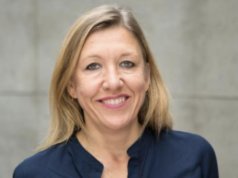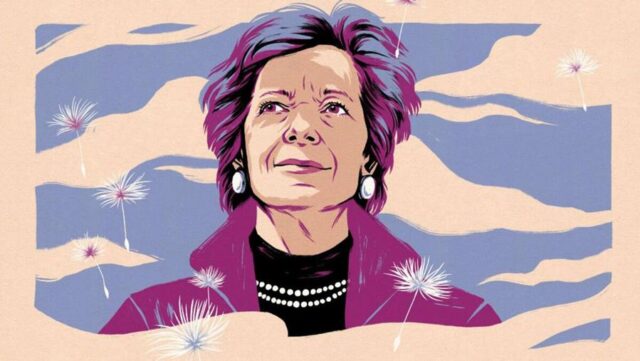
Aoife Kelleher was eight years old and at primary school in rural County Dublin when Mary Robinson was elected President of Ireland in 1990, the first woman to run for the role – and the first to hold it.
“It was quite a long campaign and quite a fiercely fought one. There was a huge level of awareness throughout the campaign that percolated down even to primary school children at the time,” the director remembers. “It was a really significant moment in Irish political life and in Irish society broadly. It really meant a lot to all the girls in my school. It was a moment where things that hadn’t been possible suddenly felt achievable…we are talking about a school with 150 pupils, really small, but even in that rural school, she [Mary Robinson] was making an impact.”
More than 30 years later, Kelleher’s new feature documentary Mrs Robinson, telling the story of the inspirational Irish politician, is receiving its UK premiere as the opening title of the Irish Film Festival London (13-17 November).
Kelleher was brought on to make the film by producer Cormac Hargaden. “I remember he said it was important to examine, celebrate and consider the impact of people while they are still alive…to have her reflect on all the eras of her life, warts and all,” the director explains why the project was commissioned now.
The filmmakers knew it “would be very powerful to have Mary’s voice and Mary’s input,” rather than to rely on archive and interviews with old colleagues and friends.
As it happened, Mrs Robinson was one of three potential projects being pitched about the politician. Robinson herself wasn’t that keen on any of them.
“I think that she was really not very enthusiastic about the idea of making a documentary…[but] she was convinced by her close personal friend and lifelong advisor Bride Rosney to take part.”
Now 80, the politician is still campaigning hard on what she considers the most important subject of the moment – climate change.
“For her, it is the defining battle of her life. She really is keen to have as much impact as she can. From that point of view, making something now rather than something retrospective made a lot of sense…she is very vocally determined that she is going to die on the job; she is not going to retire. She is going to keep going to the end.”
Robinson also remains as determined as ever to encourage “young women to take up positions of leadership.” It’s 26 years since Robinson stepped down as President but, as Kelleher notes, the level of misogyny and violence is arguably just as high as when she was serving.
“The barriers to women’s participation in politics and the public sphere are challenging now just as they were challenging then – but the challenges are different,” the director suggests. “[In 1990] there were very serious structural barriers in place in Ireland that made it very difficult for women to participate in politics…We were a society that was almost theocratic. The nature of Catholic ideology in Ireland at the time made it difficult for women to participate. It is different now, but there are obstacles…that can be similarly challenging – the personal attacks that women can face online and in the media, the focus on women’s appearance that can be quite vitriolic. That can really make it seem like the cost of entering public life is too high.”
Robinson was sure footed in how she negotiated her political pathway. She was also a very popular president. Her only obvious missteps in what was a ceremonial role came when she quit her position a few months before serving her full term. Many felt a sense of betrayal about her leaving early. She took considerable risks, for instance when she shook hands with Sinn Fein leader Gerry Adams but, like Nelson Mandela, she regarded it as a point of principle that she should speak to even the most polarising figures. As UN commissioner for human rights, she remained fearless and outspoken, ready to chastise everyone from Bush to Putin.
Having spent time with her, Kelleher admires Robinson just as much as when she was that starry-eyed little kid in the rural County Dublin primary school.
The director was startled by Robinson’s energy. Kelleher is far younger than her subject but still sometimes struggled to keep up with her.
“And there was a lot about her I didn’t know. I was surprised to learn about her early years with the Irish women’s liberation movement and the work she did there as a human rights lawyer. I really enjoyed digging into that period of her life.”
The doc, sold by Reservoir Docs, delves into Robinson’s private life. The filmmakers were given access to some very evocative home movie footage of their subject as a kid.
“Mary told us about that, and that we would be able to use that. Very few people in Ireland would have had access to a cine camera in that period, so for me that was one of the most visually exciting elements of the endeavour – being able to bring Irish family life [to the screen]. It’s a family of a certain class and there is considerable privilege but I thought that footage was extraordinarily beautiful and gave amazing insight into life at that time.”
Robinson’s husband Nick, an author, solicitor and cartoonist, eventually agreed to take part. He had been treated in very irreverent fashion as the President’s other half and he didn’t enjoy being in the political spotlight.
“He initially said I would be allowed to ask five questions and that there would be no follow-ups…but actually, when the interview took place, it was much more relaxed and there was nothing off the table.”
Mrs Robinson had its world premiere at the Galway Festival in Robinson’s presence. “She got a standing ovation and so she was delighted!” Kelleher enthuses.