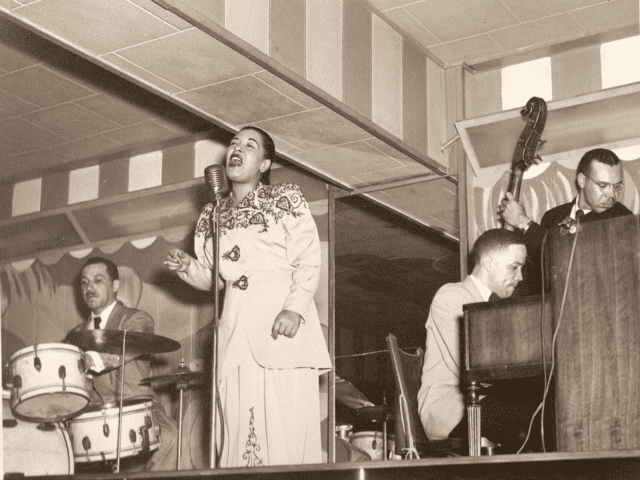
Billie Holiday (Ralph F. Seghers c/o Ken Seghers)
It was the holy grail for fans of Billie Holiday (1915-1959): the huge archive of interviews about the legendary blues singer compiled by the late journalist and author Linda Lipnack Kuehl before her untimely death in 1978.
Kuehl had been working for many years on a biography of Holiday which she never completed. Then came the journalist’s sudden death, attributed to suicide.
In 1989, her archive fell into the hands of a private collector. This extraordinary material, never heard before and featuring the voices of such figures as Charles Mingus, Count Basie and Tony Bennett, now forms the backbone of Billie, James Erskine’s BAFTA longlisted feature documentary.
The film premiered in Telluride in 2019 and was released in UK cinemas by Altitude (who also handle sales at the EFM) in late 2020. In the time since he made it, Erskine has already completed another film The End Of The Storm, about Liverpool FC finally winning the Premier League title. However, Billie is right back in the public eye, in awards contention, available to stream in the UK and still set for release in several territories.
“When we first received the tapes, they were in all sorts of order. Some had been pretty nicely recorded but some of them you couldn’t distinguish a word on them,” the director remembers of the hundreds of hours of audio cassettes. With some, the tape broke when the filmmakers tried to put them in a machine. Others weren’t properly labelled. Nonetheless, Erskine and his team were able to salvage and digitise the material.
“We had a guy in Belgium who is a wizard at cleaning up audio,” the director describes of the laborious process which resulted in the tapes sounding as clear as if they were recorded yesterday on the very best digital equipment.
Erskine remains coy about the American collector who sold the filmmakers rights to the tapes. “Barry (Clark-Ewers), the producer, was the one who tracked them down. We paid a substantial amount of money for the access to them.” The director and producer flew to New York not sure exactly what they would be getting. They paid a first option which allowed them to check the material in a studio…and they quickly realised it was a treasure trove.
Linda Kuehl had struggled with her book, producing several manuscripts without finishing it. Erskine speculates she was held back by the impossibility of doing full justice to her subject in print.
The director suggests that because Billie spoke to audiences “through her singing and unique voice, it is very hard to capture that pain. I think Linda became fanatical about wanting to show Billie’s brilliance but that was impossible to do on the page. I think that was why she found it so torturous.”
In the documentary, Erskine made sure to include plenty of footage of Holiday singing her most famous anthems like Strange Fruit and God Bless The Child. More than 60 years after her death aged 54 in 1959, the effect is still electrifying. “Part of the film is you get to spend an evening with one of the greatest singers of all time, hearing them in a way you hadn’t previously heard.”
Erskine himself started listening to Billie Holiday in the early 2000s. Like many before him, he was quickly “mesmerised.” She sounded like no-one else. “It reached your heart before it reached your head,” is how he puts it. He talks of the “emotional sense” that she gives even the most simply lyrics, “whether they are talking about pain, racism or sex.”
Why do all female singers crack up? That’s what crooner Tony Bennett asks in an excerpt included at the start of the film. Billie Holiday, like Whitney Houston and Amy Winehouse after her, led a troubled and sometimes tragic life. “I think it was important to have a man pose that question,” Erskine says of Bennett’s remark. “When you’re looking at Billie Holiday’s life, you realise one of the things driving her to the edge is that she is a woman, living in a world dominated by men.”
Holiday has often been portrayed as a victim. Erskine prefers to see her as a fighter, a black woman from a poor background who rises up through society because of her uncanny talent. “Billie understands from a very early age the transactional nature of sex and love. She also understands the transactional power of song. She doesn’t come from a background in the church…she is not singing for God. She is singing for money from the very beginning.”
Erskine has directed several sports documentaries. How does dealing with Billie Holiday compare to dealing with Jürgen Klopp, the Liverpool manager or legendary Indian cricketer Sachin Tendulkar? “The advantage of Jürgen Klopp and Sachin Tendulkar is that they are alive,” he jokes but adds, ”that can be an advantage and disadvantage to a filmmaker.”
In all the films, though, whether about music, the arts or sport, the director is exploring the nature of genius and the context in which it flourished.
Billie has had a complicated roll-out thanks to Covid. Its June 2020 US release was postponed. The doc surfaced in France in September and had a decent run. Its UK release was in November but then came a lockdown. The German release was supposed to be on Christmas Eve but has been put back to later this summer. A film which has been finished for over 18 months is therefore still finding its audience internationally…but it is winning plaudits wherever it has screened and is now an awards contender.