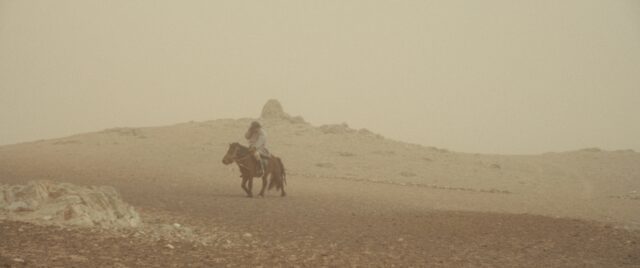
No, Gabrielle Brady acknowledges, it wasn’t easy shooting parts of her new film The Wolves Always Come at Night (screening at the London Film Festival this month following its recent world premiere in Toronto) in the middle of a Mongolian sand storm.
“It was really tough. Spring is brutal. You have Arctic winds and, of course, you have these freak storms that come on without any warning,” the Australian-British director remembers the extreme weather conditions that yielded spectacular footage – but also saw sand, dirt and dust get into their camera equipment.
The film tells the story of a young Mongolian couple Daava and Zaya who discover their herding lifestyle is no longer viable. It’s a tough existence anyway but when a monster storm hits, and they lose many of their animals, they realise that they and their kids will have to migrate to the city in order to survive.
Brady and her tight-knit crew had built themselves their own ‘ger’ (tent) and were living next door to their subjects (who were co-writers on the project).
The film is a hybrid, combining documentary and fictional elements. “It is very interwoven,” the director explains. “There was no formal script…an interviewer asked if I reconstructed the storm. Of course I can’t reconstruct a storm! The method behind it was that Daava and Zaya are real people; we had a sense of their experience…but a lot of what we were shooting was life unfolding. The whole notion of the film in a way was an experiment. We had a time and space. Inside of that, we were working with performance, fictional ideas, and at the same time, observation. We were scripting on the fly.”
If it hadn’t been for the storm, the film would have turned out very differently. Maybe the family would still be living out in the steppes, not in the city. That’s why Brady insists it is far closer to documentary than drama. Many of the key incidents – for instance Daava having to sell his beloved horse – happened for real.
Certain other scenes, such as the dream-like moments when horses run across the town, were choreographed. “This was when the horse became a more metaphorical and constructed idea.”
Brady (whose previous film Island of the Hungry Ghosts won Best Documentary at the Tribeca Festival) has a long-standing connection with Mongolia. She first visited the country when she in her early 20s (she is now 39).
“I had just left university and went to work at a TV station, so I was really young…I ended up staying two years,” Brady says of her stint on Mongol TV show, Voice Box, aimed at teenagers. “There had been a long history of imported English learning TV shows from Russia and China. The national broadcaster was keen to make something about Mongolian culture and Mongolian kids.”
The show was “very cheesy” but gave Brady her first experience of spending time with herders. “I was keen to go back and reconnect with old friends and work colleagues…”
The film’s Mongolian producer Ariunaa Tserenpil told Brady that stories about herders being forced to live in the city were “so common that we don’t see them anymore.” The fact that Brady was an outsider gave her a sharper perspective than some of the locals on what was happening in the countryside.
“Having this conversation [with Tserenpil] grew a seed of what it would be like if we made a film where we had this outsider/insider perspective – having an almost all-Mongolian crew but a non-Mongolian director. What would that look like?” Brady remembers how the project was conceived.
And, yes, she was often asked what gave her the right, as an Australian director, to tell such a quintessentially Mongolian tale.
“A lot of the work that has been made there [in Mongolia] over the years has been really extractive – crew flying in from somewhere, engaging as producers there [only] as fixers,” Brady acknowledges that not all previous outsider filmmakers have been respectful to the local culture.
“There is a lot of pain and hurt there…but at the same time I think that question ‘what gives you the right to tell this story’ is a complicated one. Even if I had been making a film about my dad, what gives me the right to tell that story? There is not a born right [but] there is a process. A lot of the work we did over the last five years was to craft an approach being really honest about the process and asking how we can create this in a way that isn’t about extractive filmmaking.”
Daava and Zaya weren’t able to attend the Toronto world premiere of the film – the Canadian government wouldn’t give them a visa. “It was on the grounds they didn’t have enough money in their back account and were at risk of overstaying their visa. It was really heart-breaking for them. For us, it was such a bittersweet moment.”
However, Daava and Zaya will be at the Ulaanbaatar International Film Festival (Mongolia) later this month. Their situation remains the same as at the end of the film. They’re still living in the city. and are unlikely to be returning to their former lives in the countryside any time soon.
The Wolves Always Come at Night has backing from BBC Storyville and Arte among others. Cinephil is handling international sales and is “in the midst of working on a North American deal.” Once that is in place, the theatrical roll-out elsewhere will become clearer.
“That’s the collective space, it’s how a film should be seen,” the director says of her determination to get her movie into cinemas.
As for her future projects, Brady is now preparing her first fully fledged scripted fiction film, Rare Birds. This is a drama set in the Daintree rainforest in Queensland. The main character is an ornithologist. “It’s a kind of psychological thriller that puts a pretty stark mirror on how is to be in Australia and to be obsessed with the idea of home ownership – I won’t say too much more!”