

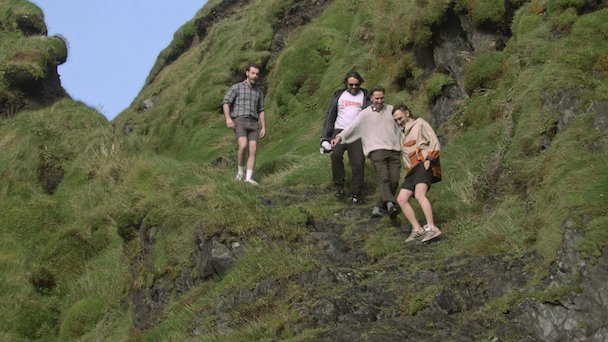
Folk music has held a deeply ambivalent place within Irish culture over the last 100 years, since the end of British colonial rule. As Dennis Harvey and Lars Loven point out early on in their feature doc Celtic Utopia (Útóipe Cheilteach), a world premiere in Locarno’s Critics Week, it has come to “incarnate the contradictions of the island: rebellion, conservative Catholicism, nostalgia for a future unrealised.”
Now, though, a younger generation of musicians and audiences are embracing the folk tradition in a positive and optimistic fashion.
This is a quintessentially Irish project but one made with Nordic support. It was produced through Sweden’s MDEMC and Ireland’s Plainsong Films. Its main backers include SVT and the Swedish Film Institute. Co-director Loven is a well-known Swedish journalist and music critic whose previous projects include Fonko, looking at social and political change in Africa through its music. Harvey is Dublin-raised but moved to Sweden in 2017 to do a masters at Stockholm University.
Harvey and Loven met through renowned Swedish production company, Story. “We were just sitting at the lunch table and we realised that we had a similar interest in music,” Harvey recalls.
When they talked about what Loven had done with Fonko in profiling young enthusiasts who reimagine folk music for the present moment, they saw strong similarities with the current Irish scene.
Initially, the duo considered making a “small radio project” about contemporary Irish folk music. They decided, though, that they didn’t want to “waste “such a good idea on an audio documentary when they could make a full-blown film instead.
Celtic Utopia features many bands and performers including The Mary Wallopers, The Deadlians, Poor Creature, Negro Impacto and Young Spencer.
Among the older figures featured is the Dundalk-based punk and poet Jinx Lennon, now 60 and regarded as a mentor and inspirational figure by a new generation of folk musicians. Among the youngest is a nine-year-old boy, Cathail O’Mhaoil who sings a haunting Irish language ballad, The Withered Old Man.
These musicians are often shown performing on the streets, in pubs, small rooms, in fields or even in churches.
“Filmed concerts are rarely very interesting to watch. We set out from the start not to film concerts but to film them [the musicians] in other settings,” Loven observes.
“We were also very conscious of trying to capture the chaos at times…I think maybe because the music is very stirring and maybe because it is quite emotive and sad, I’ve seen it presented very, very earnestly all the time. There is a lot of earnestness in this film but my experience of growing up in Ireland and being at all these sessions when people play music is a real sense of madness and a real sense of chaos. We were trying to capture that in the way we shot some of the street performances,” Harvey adds.
They had two cameras. As well as filming the musicians, they would often focus on what was happening at the edge of the frame, for instance a drunken man diving into the river, kids passing by or the eternal mayhem of a Saturday night in Dublin.
There is also some very rich archive, for instance footage of loyalist kids getting up to mischief on a bus and singing anti-IRA songs. This was shot by Swedish TV journalists who were present throughout the “Troubles” and secured some startling material.
The directors took inspiration from Peter Lennon’s 1967 documentary The Rocky Road to Dublin in which the Irish journalist portrayed the Ireland of that era in all its repression and contradictions. Another key influence was Alan Gilsenan’s 1988 doc The Road to God Knows Where, looking at the state of the country in the 80s.
“These were two brilliant films for us and we see the film as a third in this imagined trilogy,” Harvey notes.
Belfast rap band Kneecap don’t feature directly in the film although Harvey and Loven did shoot in their back garden, and they are mentioned. However, Shankhill rapper Young Spencer does feature prominently. As Harvey points out, youngsters from working-class communities in Belfast from both sides of the religious divide “have way more in common with each other than with some of the politicians who are supposed to represent them.”
Harvey, now 34, acknowledges that when he was a kid growing up in Dublin, he wasn’t into folk music. “I was just interested in anything that wasn’t Irish.” He would listen to blues, rock, metal and hip-hop instead. It was when he was away studying in Seville that the passion for folk grew. He realised that there had been an active attempt during the colonial period to kill off some of the music – and that made its survival all the more special and poignant.
Loven, meanwhile, talks of his long-standing love of Irish music. As a Swede, he couldn’t help “romanticising” the folk tradition. During the research for the film, he began to understand the complexities of the relationship between the music and the politics.
“It means so many different things. I had no idea of all these aspects. It’s a huge subject.”
Perhaps surprisingly, Swedish release plans for Celtic Utopia are further advanced than those in Ireland. Folkets Bio will be releasing the film in time for St Patrick’s Day in mid-March next year.
“It was very, very hard to get the trust and freedom to make this film the way we wanted to in Ireland,” Harvey explains why the filmmakers ended up working so closely with Nordic financiers.
However, there will be a big Irish premiere later in the year, with several of the bands in attendance.
Harvey insists that the film is upbeat about the future and that Irish society is in a far better state than a generation ago when the Magdalene Laundries were still in existence, single mothers were persecuted, homophobia was rampant and the political system seemed inherently corrupt.
“I was born in 1991 in Ireland. At that time, it was illegal to be gay. Contraception was illegal. It was illegal to have an abortion, and it was illegal to get divorced,” the director points to the gains already made. “There are still huge challenges in Ireland and so many people struggling…there are so many countries in Europe where there’s this reactionary nostalgic call to go backward to the past – but Ireland can never say things were better in the past! Look back 35 years and it was this insane, repressive place.”
One thing, though, that the film shows has never changed is the commitment to keep on making what the documentary makers describe as this “strange, beautiful” music.





