

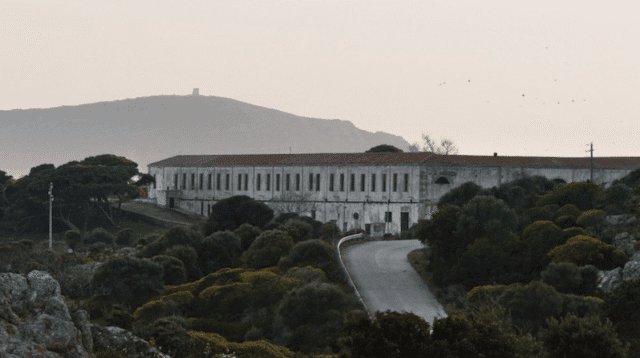
Penal colonies are a legacy of the colonial era. The British used to transport their convicts to Australia. The French notoriously had Devil’s island where they sent off Captain Alfred Dreyfus, after he was accused of spying for the Germans. Very few such places now exist, but Sardinia in Italy has three of the last active penal colonies in Europe; Isili, Mamone, and Is Arenas. There is also a fourth colony in Asinara which closed in 1998 and is now a National Park – but where the animals that the prisoners used to tend have been left behind.
These colonies are the subject of new feature documentary Nella Colonia Penale (In the Penal Colony), screening in the Critics’ Week in Locarno. This is a “film in episodes” and has four different directors, Gaetano Crivaro, Silvia Perra, Ferruccio Goia and Alberto Diana.
“We are not like a collective but we have previously worked together,” Diana explains the links between the collaborators. For example, he himself has collaborated with Crivaro on projects at research laboratory L’ambulante including the 2022 short, Urgent Letter to Colombia.
The Cagliari-based production company Mommotty had secured permission to film in the penal colonies. They brought the filmmakers together to work on the project in 2020. That, though, was during the Covid period. It wasn’t then possible to film in the penal colonies.
“At the very beginning of the pandemic, there was huge chaos and also a huge problem inside the prison because there was a lot of rebellion,” Diana remembers.
As they waited, the filmmakers did extensive research. The pandemic eventually subsided and they were finally given access to the prisons. Crivaro shot the episode in Isili. Diana shot in Arenas (now a National Park). Goia filmed in Is Arenas and Perra in Mamone.
The shoots were very different. “Every place, every prison had different rules,” Diana points out. However, the directors were all working with the same cinematographer, Federica Ortu, also a producer on the film alongside Laura Biagini, Nicola Contini and Matteo Incollu, and they tried to evolve “a common language” that would unify the film.
Diana cites award-winning Italian director Gianfranco Rosi as an influence – “an inspiration for everyone that has made documentaries in the last 10 years because he has had a huge impact.” He cites Rosi’s Below Sea Level (2008) as a film he especially cherishes.
“For me, personally, I am very inspired by documentary cinema from Spain as I studied in Barcelona at Pompeu Fabra…and every time I make a film, I think about the teaching of Marie Pierre Duhamel. She was not a filmmaker, she was mostly a mentor for many filmmakers. Unfortunately, she passed away three years ago. She was a teacher for me and also for Gaetano. She would always teach us to question everything and to be rigorous not only in terms of style but also in terms of ethics and depths of knowledge.”
Time passes differently in captivity. The directors were looking for the best ways to show this. They set out to show how surveillance works within the penal colonies. They also highlighted one key difference between the colonies and most urban prisons. The inmates here are working on the land and tending animals. Often, it’s very hard to tell them apart from their guards.
One prisoner, Mustafa, is shown as he prepares for freedom after nine years and seven months of captivity. In time-honoured fashion, he is given back his own clothes and his possessions. Equally emotional is the scene where another prisoner has a video call with his family. He notices that the old fig tree at his home has been cut down and wants to know why.
Most of the captives are migrants, not Italians. They have an ambivalent relationship with the animals they look after. On the one hand, it can be therapeutic for them to be out in nature and making food from the animals. On the other, the animals, like them, are captives.
There is a lurking undercurrent of violence. This is a very masculine world. There are no women prisoners. Some of the guards are female. There are also women working as educators within the colonies but all the inmates are male.
“But it was something also that was interesting, to have the cinematography led by a woman cinematographer inside a so-deep masculine world. I think it gives something more to the film,” Diana reflects.
In Asinara, where Diana was filming, there have been no prisoners for nearly three decades. “What remains there are the animals mostly,” he says of the wild boars and goats brought to the island when it still was a penal colony and now left behind. Guards are still there – but now they’re trying to catch and control the livestock.
The penal colonies have fascinating histories. Camorra members were incarcerated on some of them, and so were Red Bridge terrorists. Authorities still use them as somewhere to send inmates coming toward the end of their sentences and who need to prepare for a life after prison.
For the filmmakers themselves, this was a challenging experience. These islands didn’t have luxurious hotels, and so they were staying in barracks or makeshift accommodation.
Diana went to Asinara three times. On the first visit, he and his crew had a little apartment. On the second visit, they stayed in a near empty hostel that was previously a barracks for the carabinieri. This visit saw them staying in ex-prison digs now used by biologists working in the National Park.
There have already been screenings for inmates and prison warders who have responded warmly.
The four directors are hoping to collaborate again. “I don’t know in which form,” Diana says. In the meantime, they are all hatching their own projects. Gatano Crivaro has a new feature documentary that will be co-directed by Margherita Pisano and that will again be produced by Mommotty. Ferruccio Goia is working on a new doc project with the university of Bergen in Norway. Silvia Perra is developing a feature film to be made as a co-production between Italy and France.
Diana himself is working on a fictional film called Intra Montes, set in the 1930s, during the Spanish Civil War. This is being produced by Slingshot Films in Italy, Lilith Films in France and Un Capricho De Producciones in Spain.
After Locarno, In the Penal Colony will travel to other festivals (soon to be announced). The filmmakers are also planning further screenings inside city prisons where the routines are very different to those in the penal colonies, “maybe in Rome or Milan…it could be interesting to create a debate about the conditions for the inmates in the Italian prisons.”





