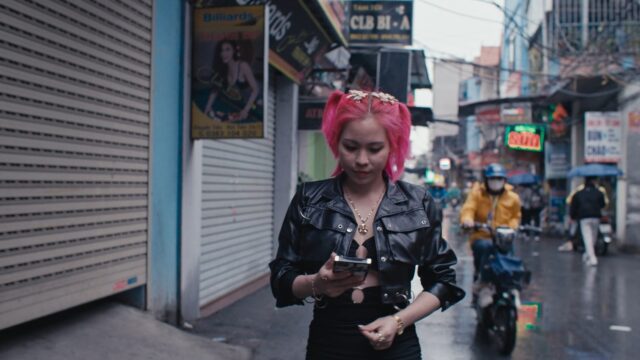
Italian filmmaker Parsifal Reparato’s new feature doc She (sold by CAT&Docs and premiering in Locarno’s Critics Week) exposes the shameful exploitation of women workers in Vietnam’s booming electronics industry.
Forced to work 12 hour shifts in sunless factories, censured for the tiniest mistakes or for having their fingernails even a few centimetres too long, these women lead tough and relentless lives, often far away from their families. Their health deteriorates. By the time they reach their late 30s, they are considered too old and are likely to be fired.
Reparato, an anthropologist and journalist as well as a filmmaker, spent years trying to befriend the factory workers. He had first visited Vietnam in 2012, curious to see what was happening in a country that was competing with China as a production hub for the giant electronics companies.
His work on the film, though, began in earnest during late 2020. At first, he had simply been making an advocacy video on behalf of trade unions. However, because of the pandemic, he ended up spending six months in Vietnam.
“I really used this as an opportunity to build up strong relationships with the workers,” the director recalls. He faced obvious challenges in getting his subjects to cooperate. This was a different culture. He didn’t know the language. Then there was the reticence and suspicion of the workers themselves. They feared that if they reveal corporate secrets, they would be fired instantly.
“In the industrial park, the workers are really scared to talk about work and about what happens in the factory.”
Nonetheless, Reparato persevered. He made sure always to “meet people with a smile; just to play on the fact that I am foreign and I cannot speak [Vietnamese]. I tried to start every conversation, every meeting like a game, to break the fear.”
During the research period, the Italian did “lots and lots” of interviews with workers from the factories. Many refused to speak to him. Nonetheless, around 80 were eventually willing to talk – and to share precious time in breaks between work days.
Before becoming a filmmaker, the director himself worked as a manager for a huge technology company in Italy. He saw at first-hand how badly workers were treated there.
“I came from a working-class family. I think when you are part of the same class, even if you speak a different language, you have the same feeling,” he notes. “When they understood that I wanted not just to tell a story about them but to tell a story with them, the project became an experience which we built together.”
The director and his research team were keen to show the soulless, dehumanising world of the factory on camera. They knew they would never be given permission to film inside. Therefore, they reconstructed the factory environment. The director then invited his subjects to spend 12 hours – the length of their shift – inside this symbolic makeshift work space.
Beforehand, Reparato had diligently collected all the stories that the workers had told him about their experiences. “I asked them one by one to help me show what had happened every day in the factory.”
During shooting in this space, the filmmakers quickly became as tired as the workers. They were standing up for 12 hours straight too.
Organising the sequence was very time-consuming. The filmmakers had to coordinate the schedules of the workers so they could participate on their day off. These workers didn’t know each other and most wanted to preserve their anonymity.
“At the end of the shooting, two of them became friends but the others stayed in their covered masks and uniforms so they would not be recognisable from each other. They were scared that they would be recognised and denounced to the factory.”
One irony noted by Reparato is that Vietnam is generally viewed as a dictatorship, under the one-party control of the Communists. Yet, when it comes to personal freedom, “the biggest problem is from the corporates.”
The workers now also have a daunting new problem. Managers of the electronics companies are turning to robotics and artificial intelligence, and trying to replace the humans, or certainly to get them doing far less.
“In 2020, yes, I cared about this topic but I was not so aware of the ‘revolution of the Industry 4.0,’” the director refers to the ‘Fourth Industrial Revolution’ brought on by AI and new technology.
When Reparato started making his documentary, his focus was on the workers and what they were experiencing personally. He realised, though, that the workers’ lives were already being transformed. “Every time in the history of the working class, the workers see what is happening in the world before the others…”
He tells a revealing story about his main character, the wife and mother who leaves her family behind in the countryside to take a job in the factory. For a month, the bosses put a robot in front of her and she was then recorded by three cameras. Day by day, as it observed her, the robot’s skills improved.
“She said that after one month, the robot could do the work that she did.”
At that point, she was moved to another department and the robot took her place. After two months, she started to fetch pieces of material for the robot. “Before, the robot brought the pieces to the human.”
It’s a chilling insight into how the workers see their own roles disappearing in front of them. “Now, the human becomes the slave of the robots!” Eventually, she was fired. At 38, she was considered too old.
As its title ‘She’ attests, this is a film about gender. The women workers aren’t just exploited by their corporate bosses but also by their husbands and fathers. In what seems to be a very patriarchal society, they’re invariably the ones picking up the burden.
“My previous feature, Nimble Fingers (2017), was about women workers. For 12 years, I’ve studied the electronics industry. If you stay outside the factory when they go in and out, you see that most of the workers are women,” the director notes.
When he asked line managers why there were so many women workers, he was told they were less likely to “rebel and protest. They are more easy to manage and control…they build a stereotype about women.”
The women “represent the weak part of society and so are more easy to exploit,” Reparato adds. It’s a grim formulation – the bosses are men and the workers are women.
She was made through AntropicA (Italy), Les Films de l’œil sauvage (France), PFA Films (Italy) and Luce Cinecittà (Italy). In advance of its Locarno Critics’ Week premiere, the documentary is already guaranteed international distribution having received the DocXChange award as part of Visioni Incontra. This award consists of theatrical distribution in cinemas on the DocXChange circuit including venues in London, New York, Toronto and Florence.
Now, Reparato is contemplating a new project in similar vein.
“I like to say that She is the second chapter of a trilogy. The first one was Nimble Fingers…the third one I hope will be a movie that will give us a bigger overview about not only Vietnam but all over the world – to tell the story of how the corporations work worldwide…I hope to show how they exploit [workers] from the US to Vietnam, from Japan to Korea. It’s a big topic,” he says with obvious understatement.