For Polish director Paweł Łoziński, what started off as mere curiosity turned into an obsession. For two and half years he interviewed passers-by from his balcony, discussing their problems, asking them what they thought was the meaning of life, inviting them to be a hero in his film. His resulting doc world-premiered this week in Locarno Semaine de la critique.
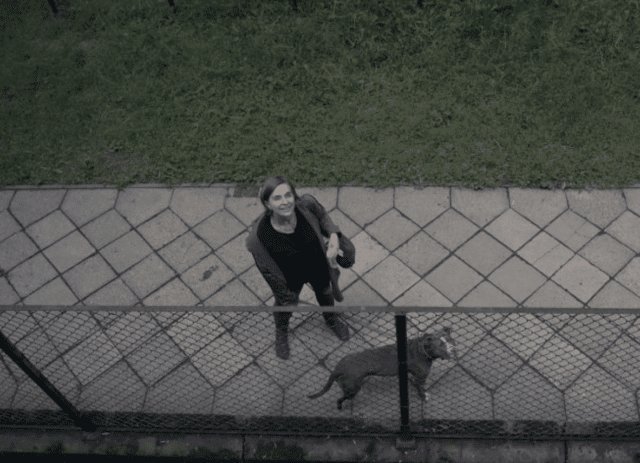
The set-up is simple, but so very human, and heart-achingly effective. Most of the time, Łoziński films from a fixed camera position, but sometimes he will track his subject as they walk down the street or even zoom in on occasion. In the process he captures a vast spectrum of humanity (he estimates he had over a thousand exchanges) with a degree of truthfulness and authenticity that is beyond the scope of most fictional filmmakers, even if some of his subjects are on screen for just a few seconds.
When placed in the spotlight people respond to the Łoziński’s probing, opening up to the filmmaker (and his camera) about stuff that is personal, intimate and fascinating. And, just as interestingly, those who choose not to open up explain precisely why. One old woman doesn’t contemplate life, she contemplates death while awaiting “a surge of ingenuity”, she says, before she brings the chat to a brisk close.
Curiosity may have been an initial driver for Łoziński in making his movie. Expediency was another. “I didn’t have any new ideas for a film. So I started to think, maybe I was a bit tired of running and searching for good protagonists, you know, going somewhere abroad for my next film,” he says. “I decided just to stop and to watch. I tried simply to prove that one doesn’t have to the chase for the protagonists. This is okay. When you stop with your camera, as I did in one fixed place, then all the world will come into my frame.”
Which is exactly what happens. We meet a new mum, delighted with how her life has changed, a man who mourns the death of his partner (his beloved “brother”), a postman who can no longer feel proud of his job, an extremely polite French embassy attaché, a woman who is happier after the departure of someone (although she doesn’t let on whether it was via death or separation), a homeless guy to whom Łoziński gives a shirt, a dancing woman who offers to decorate the director’s apartment, a small girl who only wants to discuss the ice cream she is eating, a couple who talk (light-heartedly) about the male’s infidelity, the caretaker living next door who incessantly sweeps snow from the pavement and loans money to the needy, and a man who believes that Łoziński’s film should be fiction made in the style of Czech cinema. And many many more. Even the director’s wife and daughter make an appearance on the street below the balcony, as well as the family dog Lolita.
“I started to get addicted to this process of filmmaking,” says Łoziński. “I would even refuse to eat something for lunch or go to the toilet because I was afraid that I will miss this character, this special one, this dialogue, which can make my film. You know, it was crazy of course, but I was addicted not only to the process of filming people, but to contact with them.”
“In the beginning I was the one who needed the protagonists,” he adds. “Then during the film, during the shooting, they started looking for me because they really wanted to chat with me because I was kind of the same time, part of the furniture, somebody who’s really transparent, you know, some crazy guy spending two and a half years on a balcony.”
Two thirds of the way through the film the character of Agnieszka appears, and when you meet her you are stopped in your tracks. She is an intensely shy and fragile woman, and therefore someone who thinks long and hard before she crosses the road to answer Łoziński’s request to be the “hero” within the film. She is, she explains lyrically yet with touching honesty, “a person whom I have not fully become yet. I am almost that person.” When asked what her name is she thinks for a long time, answering ‘Agnieszka’ after a prompt. Maybe this was a task that enabled her to test or examine both herself and her psychological boundaries, because this is precisely what she does for a minute or so on screen, and in the process becomes momentarily the director’s true hero.
“She was a special type of person because she’s not lying. You know, she’s telling the truth all the time. She doesn’t wear any mask. She’s like a skinless person, you know, completely honest,” agrees Łoziński. “She is a mystery, she has a mystery inside.”
The director concedes that his question as to what is the meaning of life is a “philosophical-slash-stupid” one but nevertheless agrees with a wheelchair-bound subject in the film who asks, “if life has no meaning, then why on earth live?”
“Film is not the meaning of my life, but you know, sometimes it is when you have a movie at a festival. So right now [at Locarno], this is the meaning of my life. And then it won’t be,” Łoziński offers up as an answer, before adding, “I think that contact with people has meaning, in our lives or my life, especially after COVID, when we are so thirsty to meet people, to speak with them, to simply to have a good time with them.”
Which may be why the balcony aesthetic still looms large in his artistic consciousness. “I still have my tripod and special equipment for fixing my boom. So if somebody’s interested, I need like 15 minutes to set up my camera and you know, I could be ready to shoot again…”