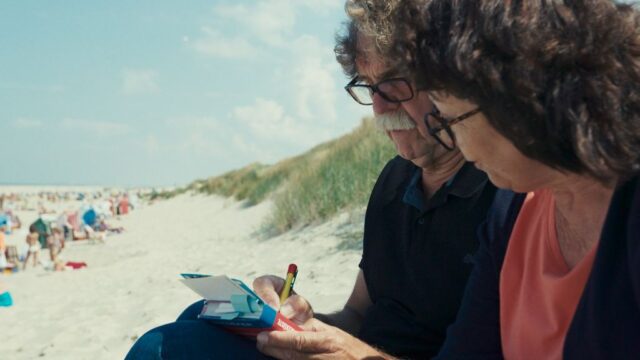
The life that German couple Ulla and Didi Högel have faced over past years seems barely imaginable.
In 2019 their son Niels Högel, one of the world’s most notorious and prolific mass murderers, was sentenced to life in prison after his conviction for 85 murders, this coming after a previous conviction in 2015 for three murders. Like his father, Högel worked as a nurse.
In His Parents German directors Katharina Köster and Katrin Nemec profile Ulla and Didi and their attempts to cope with the dreadful reality of their lives. Theirs is a blasted existence, defined by the vastness of the crimes committed by their son, of which they are reminded on a daily basis via media interest bordering on frenzy.
Ulla and Didi are kind and sympathetic, and modest, maybe at times naïve (as parents can be). Their lives are lived in a kind of uncomprehending limbo, but their focus remains trained on their son whose dreadful deeds they cannot begin to fathom.
They dutifully take his daily phone calls, visit him in prison and buy him new clothes every birthday. They grieve his absence and his empty future, but how can their grief begin to compare with that of any one of the relatives of Högel’s victims?
The filmmakers had intended to make a more general film about the parents of murderers, but when they got to know Ulla and Didi it quickly became clear that their story was unique and totally incomparable to other sets of parents.
“The subject is still associated with a great deal of shame – affected parents avoid going public and prefer to continue their lives in a certain anonymity,” the directors say of the resistance they naturally encountered in finding subjects to profile.
The lawyer who represented Didi and Ulla’s son recognised the importance of observing duty of care towards blameless relatives who must suffer for the crimes of a close relative, and so she arranged contact between the filmmakers and Högel. “In a way, they [Didi and Ulla] are also his victims. He [Högel] then put us in touch with his parents, but it took months before they agreed to take part in the filming,” say Köster and Nemec.
Eventually the directors were able to convince Ulla and Didi that they were “the first people who were really interested in their story, and not that of the perpetrator.”
“At the beginning, we didn’t even know what was possible, whether we would ever manage to film in the protagonists’ flat. We couldn’t film for many days at a time either, as it was very exhausting for the parents to have the conversations with us. They couldn’t keep it up for more than 2-3 days at a time and then needed a break and some distance from us,” they recall.
“As you can see in the film, the mother broke off filming several times. It was important to her to tell her point of view, but she was still overcome by fears repeatedly. What if people see the film, will they judge her for showing herself? She simply needed time to reconsider. Even after so many years, the truth about her son sometimes hits her like a club – she is then paralysed and can hardly breathe.”
“They are happy if they can continue to live their lives as undisturbed as possible,” they add. “It is hard enough to cope without the press. So far there have been no pictures of Ulla and Didi Högel in the press – nobody knows their faces. This film puts them in the public eye and of course, as filmmakers, we must do our best to protect them, turn press enquiries away from them and be incredibly careful when we give interviews ourselves. We are always in open dialogue with them and try to prepare them well for anything that may come.”
Köster and Nemec were also determined to protect the relatives of Högel’s victims. “We tried to inform the relatives about the filming via the WEISSER RING (the only nationwide active victim support organisation in Germany) right at the beginning of our shoot and that they could contact us at any time if they needed to. We handled the filming very transparently within the limits of data protection restrictions. When the film was finished, we of course first showed it to the protagonists and discussed at length whether all the scenes were OK for them. The second step was then to offer the victims’ relatives the opportunity to watch the film without the press and with psychological support from the WEISSER RING, in a protected setting.”
What was always clear was that this film would never provide a platform for the mass murderer. We never see his adult image, nor hear his voice, although we know he is often on the phone to his parents. “We did not want to give him any opportunities to present himself, he had enough time in court to tell his side of things and his story was also told in the media in all its facets. The parents’ story, on the other hand, has never been told,” the directors stress.
“Indirectly, of course, he is part of the story – the parents’ whole life revolves around him to a certain extent. Their daily lives also revolve around his calls and visits to him in prison; they buy clothes for him, which his father tries on for him. He is like an invisible antagonist who acts from the outside.”
Both Köster and Nemec are parents themselves. How do they reflect on Didi and Ulla’s terrible dilemma and the random/unknown factors or conditions that can lead to what they had to suffer?
“It is the worst thing we can imagine that our child, whom we raise with love and care, and hope will become a responsible part of society, incurs such a heavy debt that we cannot forgive. How would we react? Would we stand by our child? Isn’t it just as reprehensible to reject your child? These are unimaginable thoughts. You can distance yourself from partners or siblings, but not from your own child,” they respond.
“The film raises many questions: how do you bring up your child properly? Am I a helicopter mum, am I overprotective? Am I too strict? Is the child resilient enough for society and the challenges? All parents face questions like these. And we can clearly see that you cannot control everything,” they add.
“During our research, a police investigator once told us that there is always a whole list of ingredients that lead to a person becoming an offender. If you take away just one ingredient, it does not happen. Not every child who has fears becomes a murderer. Not every child who is bullied becomes a murderer. Not every child who has depressed parents becomes a murderer. You can add to the list at will. Not everything that we understand in retrospect as causes necessarily leads to the same development in every person. The protagonists are parents like you and me, who certainly did not do everything right, but did not make any big mistakes either.”
The German title of the film is Jenseits von Schuld, which means ‘beyond guilt,’ which seems a dichotomous state for Ulla and Didi, whose emotional fragility is palpable throughout. “The parents emphasize repeatedly that they do not blame themselves. This is a sentence that they carry in front of them like a protective shield. But in the end, they always deal with why it happened this way and keep asking themselves whether they did something wrong – that will probably never stop. One thing is to know that you are not guilty and the other is to feel guilty. You feel responsible for your child for the rest of your life. You identify with your family [but] the guilt remains like a shadow over the whole family.”
His Parents is produced by Isabelle Bertolone, David Armati Lechner and Trini Götze for Munich-based Trimafilm. Sales are also handled by Trimafilm.