

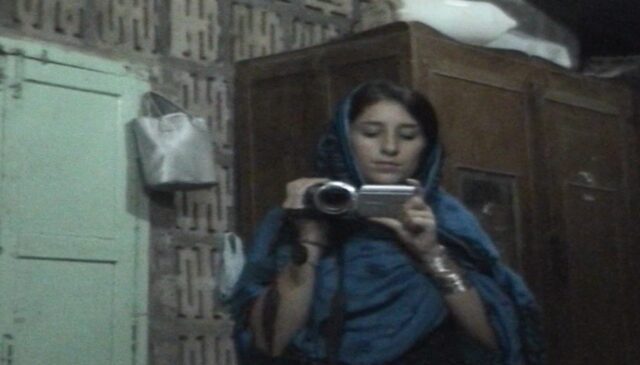
Moosa Lane by Anita Mathal Hopland
Danish director Anita Mathal Hopland is attending this year’s Nordisk Panorama in a dual capacity. She is participating in the Forum with her new project, Breaker, which is co-directed with Jens Lengerke. The documentary, about three young professional break-dancers training for the 2024 Olympics, already has support from The Danish Film Institute. Meanwhile, Hopland’s autobiographical Moosa Lane is screening in the Festival’s New Nordic Voices strand.
In Moosa Lane, Hopland contrasts her experiences in Denmark with those of her relatives in Pakistan. The documentary uses footage she has been shooting since 2005 when she first took a camera with her on a trip to Karachi.
“I think it was around 2014-2015 I started to consider if there were a story to share. I experienced an increased polarisation that I’ve been following throughout my life, often answering questions about my background,” the director remembers when she started thinking about making a documentary from what were originally intended to be private recordings.
“Filming was a way for me to be present in an unknown world back in 2005,” Hopland explains. “But following the state of the world while growing older, I started to wonder where my family’s story was represented. So I talked to my father asking if he thought it would be a good idea to look deeper into the box of tapes, and my family as well if they would be ok telling a part of their story. Everybody supported the idea, though doubting anybody else would be interested. So I started…”
She began with digital video. “My first camera. I liked the fact that I couldn’t do endless recordings, though the quality has its limits. Later [I used] two different HD cams which was a big change in terms of aesthetics. But as I filmed for so many years without the intention of making a film, I just used what I could borrow.”
Alongside the happiness, Hopland was chronicling some bleak moments in the family’s life. Over the many years she filmed them, her relatives were confronted with sudden and devastating bereavement. They also sometimes faced violence.
The director filmed the Bakra Eid celebrations in which animals were killed on the streets. “It was pretty intense. It was the first time I experienced it but I think it helped me to observe it through my camera. It all looked unreal. But along the days, I also learned that what looked brutal also had a beautiful aspect to it all,” she recalls.
“The gang war was a very difficult period to be a part of,” Hopland continues. “I’ve never been so close to the feeling of war. Nothing felt safe. So many families had escaped the area, but my family stayed in the house, and when I came with my dad, it was the first time I experienced the intense silence with daily shootouts. To this day, some still avoid to enter this part of the city though the gang war ended many years ago.”
Far more traumatic than any of this, though, was the sudden and fatal illness of Zayn, the charismatic and bright young family member who had visited Hopland in Denmark only a few months before.
“The final part of the movie was the most difficult though on a personal level. Everything happened so fast and initially I didn’t think of having it in the film. But I asked them [the family] if they thought Zayn should be a part of it, and they all said yes…but it was very difficult to grieve, cry and film at the same time. An unimaginable destiny. Still unbearable we lost him, and I’m still wondering if it would have been a different outcome in another part of the world.. I don’t know. Life can be so unfair,” she reflects.
“No-one knew anything at the time of his visit [to Copenhagen]. He was young, in good shape and a bright future ahead. Though I could see he had lost a bit of weight, I never expected the outcome. Neither did he in spite of a few visits to the doctor prior to his arrival. How can you expect something this severe?”
The director had over 150 hours of material shot over a period of 15 years to draw on. The completed film is 87 minutes long.
“During the first steps of development I started to find fragments and along the way it became clear which parts of my own experiences taught me the most. And in production I worked together with some brilliant women while editing the film – Signe Kaufmann, Sara Stockmann and Åsa Mossberg.”
Hopland wrote the deeply personal voice-over while they were in the editing room. “The poetic elements were important to give the story’s complexity room and the audience space to notice and experience life in Moosa Lane.”
The director drew inspiration from many different sources. Andrei Tarkovsky’s lyrical masterpiece Mirror “blew” her mind. She was also deeply impressed by Michael Glawogger’s Megacities. Other titles she cites as influences include Godfrey Reggio’s Koyaanisqatsi, Terrence Malick’s Tree Of Life and even the work of UK director, Ken Loach.
Producer Sara Stockmann took on Moosa Lane after the previous production company was forced to close down. “We quickly found out that we were on the same page, so I was happy to see the film continue at Sonntag Pictures and work on it together.”
Hopland is answering Business Doc Europe’s questions from Pakistan a few days before the start of Nordic Panorama. The country has just been hit by catastrophic flooding. Karachi, where her relatives live, was not directly affected. “But as millions around Sindh have lost their home, crops and future, it is all still in process and it’s serious. The increased price of food doesn’t make it any easier, together with the very unstable access to electricity,” she lists the many challenges the family currently faces. “But life here has never been easy. An everlasting struggle surviving in a third world country.”
Hopland’s Forum 2022 project Breaker, which is co-directed with Jens Lengerke, is produced by Elk Film. The film follows three break dancers on their journey towards the 2024 Olympic Games. Will they finally get recognition as professional artists and athletes?
Moosa Lane screens in Nordic Panorama Sept 24.





