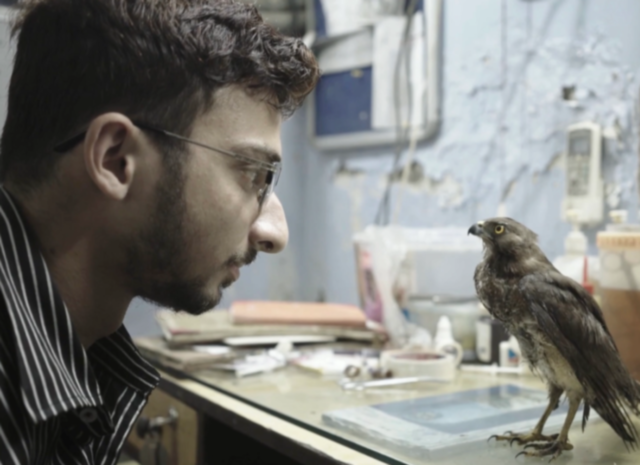
Since its world premiere at Sundance in 2022, Indian filmmaker Shaunak Sen’s All That Breathes has taken flight. The documentary, about two brothers in Delhi, Mohammed Saud and Nadeem Shahzad, who devote their lives to tending injured black kites in their bird hospital, has won awards everywhere from Park City to the Cannes Festival. Now, in advance of its launch on HBO Max in the US and Europe, and on Sky Documentaries in the UK, it has secured an Oscar nomination.
This is Sen’s second film set in Delhi, a city he clearly knows inside out. His debut feature doc Cities Of Sleep (2016) explored the challenges facing the homeless in Delhi as they search for safe places to sleep.
When All That Breathes was pitched at Sheffield Meet Market in 2020, few would have anticipated how successful it would eventually become. By then, Sen had already been working on it for many months, but Sheffield was where he found his irrepressible producer, Teddy Leifer of London-based Rise Films.
“There is no film, in a way, without Rise Films. They’re phenomenally important,” the director says of the production company whose other credits include Icarus and The Invisible War. “Teddy and I became like a pitching machine. We pitched ad infinitum…”
Ask Sen why he thinks his film has caught the imaginations of so many different audiences and he answers immediately: “I think the particular is the window to the universal.”
It is only “when you really burrow deep into the intimate and personal” that you can find subject matter that resonates everywhere. It helps, too he suggests, that the film works on several different levels: the political, the ecological and the emotional.
The documentary uses a poetic and cinematic storytelling style. “It began as an exploration of the triangulation of birds, air, humans.”
In 2019, when Sen first researched what happened to the birds, which “fell off the polluted sky” in Delhi, he soon discovered Mohammed and Nadeem. He immediately saw the cinematic possibilities in the brothers’ work. Here they were, toiling away amid “grubby industrial decay” but with “magisterial birds strewn about in the middle” of their makeshift bird hospital.
Sen filmed hand-held for the first six to eight months but decided this way of shooting “seemed a bit anxious and restless.” This wasn’t chiming with the “spirit of the brothers.” The storytelling style (he decided) needed to be more “contemplative and meditative in spirit” and less frenetic. This was where the cinematographer Ben Bernhard (best known for his work with Victor Kossakovsky) and Indian DOP Riju Das came in.
“We started a style where you are always at a slight arm’s length from the characters and it [the shooting style] is assured and steady,” Sen notes. He filled the film with “slow, languorous pans” and made sure that he didn’t venture too close to the brothers.
All That Breathes is full of revealing details about how the birds adapt to the harsh industrial environment of the city. For example, we learn that the kites collect cigarette butts and use them to keep parasites at bay.
Before starting the film, Sen was mildly curious about ornithology but had no particular expertise. However, while making it, he became “full enchanted by all things avian.” In fact, he admits, he became “obsessed.”
The documentary doesn’t focus exclusively on the kites. Sen continually includes cutaways to snails crawling across a surface or rats scurrying around on the floor. Some of these scenes were planned in advance. Others were shot on the hoof.
“We had over 300 hours of footage and so we obviously shot a lot. We shot for three years,” the director sighs as he remembers the exhaustive work that went into the documentary. He and his team did a lot of reconnaissance. The more they learned about the city, the better they were able to choreograph the nature scenes. “There was also a form and a rhythm to the shooting. That was because we had observed the animals for a while and then figured how we wanted to shoot them.”
Editing was as challenging as might have been expected, a pleasurable but painstaking process. The 300 hours were cut down to a film with a running time of 91 minutes. Sen likens the process to sculpting or trying to complete a musical jigsaw puzzle.
As for the 298 hours that didn’t make it into the final cut, “for now…they are tragically languishing in a hard drive somewhere.”
The director has a string of high level academic qualifications including a PHD. He is a scholar as well as a filmmaker. “I think the academic part of my brain is super-active before the film, before the shoot, when one is trying to ingest and arm wrestle with as many ideas as possible. And then, it has to be completely kept at bay during the shoot – and then it makes a comeback during the edit,” Sen explains. He argues that academic thinking is often restrictive. It involves “fitting things into boxes.”
His artistic instincts lead him in a very different, far more open-ended direction. “Documentary is really a radical embrace of the unscriptedness of life,” he concludes.
All That Breathes streams on HBO Max in the U.S. from 7 Feb, and on HBO Max in Europe and Sky Documentaries in the UK from 8 Feb.