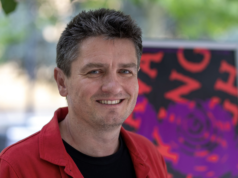
From Robbie Robertson and The Band to Alexei Navalny and his battles against Putin – it has been quite a leap in subject matter for Canadian director, Daniel Roher.
His rock doc about Robertson, Once Were Brothers, made when he was still in his mid 20s, opened the Toronto International Film Festival in 2019.
He followed it up with Navalny (2022), produced through CNN Films and HBO MAX and now in contention for this year’s feature documentary Oscar. It’s a hard-hitting look at the trials faced by the Russian opposition leader protagonist who is regarded by many as the “moral leader” of his country.
Navalny is currently languishing behind bars, serving a 9-year sentence in a Russian prison after a sham trial in 2021. His health is deteriorating as he is continually put into solitary confinement for minor infractions of prison rules.
Roher hopes that his documentary will keep Navalny’s name in the limelight.
“All of the awards and the recognition that comes with winning awards is, more than anything, a marketing exercise. In this case, what I am doing is marketing the plight of the world’s foremost political dissident who today is locked up in perpetual solitary confinement because he is the number one anti-war activist in Russia…that’s why they’re injecting him with unknown medications.”
The more space Navalny “occupies in the global consciousness,” the stronger (Roher believes) is his chance of survival.
So how did the director come to make a doc about Navalny in the first place? After he finished the Robbie Robertson film, Roher jokes that he expected his “career would blow up and flourish and I’d get all these job offers.” It simply didn’t happen. Covid intervened. Any momentum that he had from the success of Once Were Brothers was halted.
“I was desperate. I needed a job…I needed a creative outlet,” the young Canadian director remembers. He was even considering going back to college and finding a different career path.
“In a last ditch effort, I followed a hunch which took me to Europe,” Roher describes how he kept his filmmaking career alive. A producer he knew had a friend who had another friend, Bulgarian journalist Christo Grozev who worked for Bellingcat, the open source investigative journalism organisation. Grozev took him to Kyiv to work on a film project there. It didn’t go well, but Grozev introduced him to Navalny.
“It was really just a totally random glitch of the matrix,” Roher says of the circumstances which brought him together with the opposition leader that Russian President Vladimir Putin fears the most.
“Once I was confronted with Navalny and this extraordinary story, I saw my destiny unfold. I knew exactly what this was going to be. I understood that this was what I had been looking for my whole life, telling a story of this magnitude and importance.”
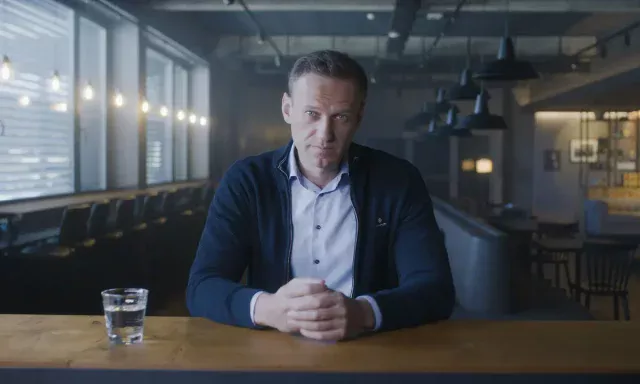
The film opens in ominous fashion with Roher asking Navalny, “if you are killed…what message do you leave behind to the Russian people?” Navalny bristles at the question.
“I felt like I had an obligation to ask that question,” Roher says. After all, this was a man whom Putin and his henchmen loathed. A couple of months before, Navalny had been poisoned with Novichok smeared on the crotch of his underwear. He had been lucky to survive. “His death was very much on everyone’s mind. The reason we decided to open the film with that was less about the question and more about the response. I asked Alexei the question and he responded by rolling his eyes and telling me, the director of the film, ‘oh no, Daniel. We are going to make a thriller. You can make a boring film later.”
The response gives audiences an immediate insight into “who this guy was.” Navalny is charismatic, funny, very opinionated and rebellious. He is also a politician skilled in the art of media manipulation. As the subject of Roher’s documentary, he was trying to control the way he was portrayed. At the end of the film, he is finally shown answering the question properly, in English and then, more fully, in Russian.
“The film ends on his smile. That was a very compelling place to leave the movie. It’s a sad story…what’s very important to recognise is that Alexei Navalny represents a little flicker of light in a very dark context. I wanted that smile at the end of the film to be emblematic of that light.”
This interview is shot in a darkly lit bar. It’s intended to give viewers the impression both that they’re having “a beer with their buddy” and that they’re listening to someone giving the equivalent to a Presidential address. “We got smoke in the air, we lit it like a Caravaggio painting and we were off to the races,” Roher says of the atmospheric look of the shot.
Inevitably, when you make a film like this, there is fall-out. Christo Grozev has been put on a Kremlin “wanted” list. Navalny is in jail. The director himself has had some disturbing experiences. “We know for sure that the Kremlin knows about our film; we know that the Kremlin has seen our film. This much is clear, evidenced by the fact that Christo has sources in the upper echelons of the Russian government who have reported directly that because of this film and the success of it, he [Grozev] was promoted to being put on this ‘wanted’ list.”
Being on the list puts Grozev’s life in danger. There are countries he can no longer visit. Roher, meanwhile, has been trolled online relentlessly and has also faced physical intimidation. There have been items on Russian propaganda TV shows in which the faces of the filmmakers have been shown and they’ve been dubbed pornographers, prostitutes or CIA agents. (As a Canadian, Roher jokes that he is “particularly offended” by the CIA references). After a screening at the Hague, he and Grozev were followed by “central casting’s Russian embassy guy.” The director makes it clear, though, that these threats are insignificant next to what Navalny has been suffering: both the poisoning which is chronicled in the documentary and his subsequent imprisonment.
Navalny’s wife and daughter also feature prominently in the film. The politician is a devoted family man. That makes his current plight all the more painful.
Roher’s relationship with his subject was “very friendly.” Nonetheless, there were clear boundaries. Roher had complete editorial control and was permitted to ask Navalny about anything including his previous affiliation with nationalists.
The two men shared a similar sense of humour and a passion for politics. They had a “healthy mutual respect” which made working together much easier.
That said, it’s almost two years since Roher last had contact with Navalny (who still hasn’t been able to watch the documentary).
The director isn’t ready to talk about new projects. He is still fixated on this one. “Right now my primary focus is just Navalny. I am not interested in making a film right now. I am interested in being an ambassador for this guy to help him survive and get through this. My dream for the future is to make a sequel to this and in that film, it’s about an election and that is the first election in the history of Russian where Navalny is running for President of the Russian federation. I hope that when we’re shooting it, we can rent a little cinema in downtown Moscow and show Navalny the first part of the film.”
Sales on Navalny are handled by Dogwoof.