

Close friends Geeta Gandbhir and Christalyn Hampton first met 30 years ago at Purchase College, State University of New York, when they were both students.
“We’ve known each other since we were 18 or 19,” Gandbhir explains when asked about their collaboration on the Oscar-nominated short, The Devil Is Busy. (Gandbhir has a second nomination in 2026, for her feature The Perfect Neighbor). “We’re friends, we’re family and we also work together.”
The short came about because producers Soledad O’Brien and Rose Arce wanted to make a film exploring the impact of Roe v Wade falling. This was the 1973 Supreme Court ruling permitting women to choose to have abortions. Roe v Wade was overturned in 2022.
“When that happened, they [the producers] came to me and we spent about a year researching a story that could really encapsulate the aftermath,” Gandbhir remembers. During this period, they came across the abortion clinic in Atlanta, Georgia, which was ultimately to feature in the documentary.
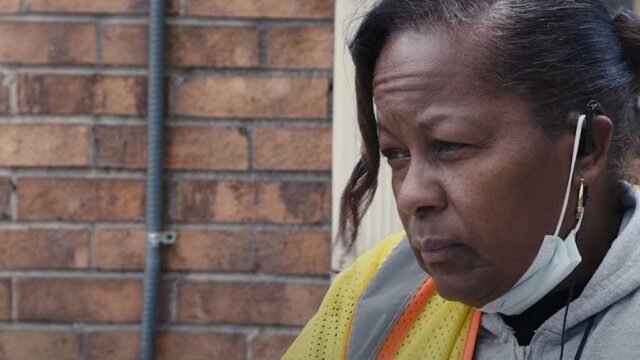
The filmmakers decided to make the clinic’s head of security, Tracii, the main focus of their story. She is the dedicated and courageous caretaker who opens up the clinic every morning, who works with security and who monitors the behaviour of the small army of angry protesters camped out outside on a near permanent basis.
“During the research process, I went and observed the clinic. Tracii was such a compelling person. Who you see on camera is who she is every day. She doesn’t change. She doesn’t mince words. She is that dynamic person,” Hampton, who herself lives in Atlanta, says.
When patients arrive at the clinic, she is the first person they meet. “She [Tracii] treated me like I was a guest and took me through every aspect. I was like, oh wow, this is a really dynamic community. You have all these male protesters outside and then you have these women, mostly of colour, who are providing health care and trying to create a safe environment for women to come and have abortion care.”
The film unfolds over the course of a single day. “We knew we wanted to make a verité doc, something that felt immersive and compelling – and we really wanted it to be representative of a ‘day in the life.’ We wanted to take people through what it means to be in the positions of the staff, the women who are working in this clinic day in and day out because they are really on the front line of what has turned into a battle,” Gandbhir states. “With many of the protesters outside, it’s like a holy war.”
“You constantly hear them in the background. They are just there. It is really a barrage or an assault. We wanted to make sure the audience felt that.”
Staff members sometimes feel they are walking a tightrope. “One false move can land them in prison….it’s incredibly high pressure.”
Tracii has a deep Christian faith. As the filmmakers note, she shares the same religion as all those furious men with their placards and tannoys protesting vociferously, and often aggressively. They’ll run up to visitors’ cars and will scream and shout. They claim they are acting in God’s name, using this to justify their intimidating, hate-filled tirades.
“She has chosen a different perspective on her faith. She believes that healthcare for women, reproductive justice for women, is a basic, fundamental human right.”
The documentary’s main focus is on the medical staff rather than the ‘guests’ (who are shot in a deliberately discreet way). Both filmmakers point out that it’s very rare to see these staff members portrayed in the media. Too often, their stories become lost in the din of the protests.
Although ‘guests’ are not interviewed, we do get to read the messages they’ve left on the bulletin board at the clinic. “Thank you for your courage and compassion,” and “thank you for keeping us safe,” are among the messages that women have written.
Late in the film, Tracii shares some details about her own heartbreaking experiences with childbirth.
“Putting it up top, it wouldn’t have the emotional impact. You wouldn’t have known her,” Gandbhir explains why Tracy’s testimony is held until close toward the end of the documentary. “One of the key things in filmmaking that I’ve learned is that you have to get your audience to care about your participants and the people in your film first before you lay on them heavy emotional details. Otherwise, it doesn’t mean anything. It’s like a stranger telling you that. But once you get to know her and you see how amazing she is, how loving she is, how fiercely protective she is of these women, then to see this vulnerable side of her opens a new door.”
The Devil Is Busy made it through to Oscar contention both by having a qualifying run and winning best Documentary Short at the RiverRun International Film Festival. HBO has been streaming the short since the autumn. There has also been “a really intense social media campaign.”
“We are living in a world where distribution is increasingly a problem…but I will say this: a short film actually, in this time of short attention spans, particularly with young people, where they are on TikTok and do not want to watch something over 30 seconds long – a short film is an advantage,” Gandbhir suggests.
Ask the two filmmakers how optimistic they are that Roe v Wade will soon be re-established and they end on a cautious note.
“I think it is a small step in a long battle,” Gandbhir says of the film’s contribution to the ongoing fight for women to recover rights over their own bodies. “The west is in a terrible backslide. It is one of many, many issues…but we have to hold on to hope. Of course we can get there again – it is going to take a while!”
Hampton says that one of the “biggest surprises” at screenings has been the emotional reaction of men to the film. At one recent event, a man stood up and talked about how his wife told him she was taking a friend to a clinic. He ignored her and “pushed it off” but when he saw the film, he understood what she was trying to tell him: “the safety issue, the vulnerability of her friend…he actually got emotional sharing the story…that’s one thing that came out of the film. He wanted to go back to his wife and say, ’I’m sorry. I didn’t listen to you.’”





