“I knew of Bianca because her parents and my parents were in the same artistic circle back in the 80s, and we had met as children,” producer Floor Onrust of Amsterdam-based Family Affair Films explains how she first came across the critic-turned-director Bianca Stigter.
Stigter’s remarkable feature doc Three Minutes – A Lengthening (sold by Autlook), the project on which they collaborated, is now a major awards contender.
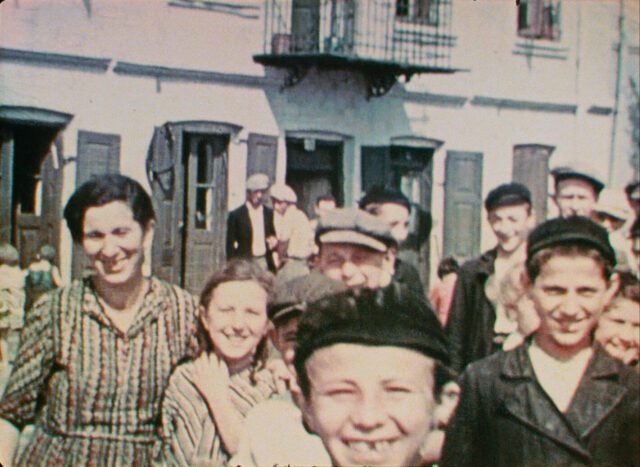
The film is inspired by US author Glenn Kurtz’s book ‘Three Minutes in Poland: Discovering A Lost World In A 1938 Family Film.’ In the summer of ’38, Kurtz’s grandfather went on an extended holiday in Europe. His travels took him to the small Polish town of Nasielsk where he had family connections. He shot a few minutes of 16mm footage here on his home movie camera. Today, the footage has an almost unbearable poignance. The town’s inhabitants were mainly Jewish. Not long after his film was shot, most of them were to be wiped off the earth by the Nazis.
Dutch critic Dana Linssen initiated the project that eventually turned into Three Minutes. Together with her fellow critic Jan Pieter Ekker, she ran a programme called Critics’ Choice at International Film Festival Rotterdam which invited critics to make films and film essays. In 2015, Stigter showed an early version of her film, then called ‘Three Minutes Thirteen Minutes Thirty Minutes,’ in this programme.
“She [Stigter] came to me with that, asking if I was interested in working on a longer version,” Onrust remembers. “I immediately said ‘yes!’ I really liked the idea. And I liked Bianca as a person – that also helps.”
Stigter’s idea was to lengthen the three minutes that had been shot in the Polish town. She knew there were all sorts of hidden stories lurking within the material. On a symbolic level, she was bringing the inhabitants back to life. “When was it, 2015/2016? We started talking about the longer version. Originally, Bianca wanted to make it exactly 60 minutes,” comments Onrust.
Stigter was already in touch with the author, Glenn Kurtz. Now, Onrust approached him too. “He was very open to the idea and wanted to help where he could with his information and his contacts,” the producer says of the US author. “He’s a very, very nice guy and very proud of the film, and very willing to do whatever he can to promote the film. He is a very good speaker.”
Stigter’s partner is the Oscar-winning British writer-director, Steve McQueen. His company Lammas Park also came on board the project. “Steve and his staff helped wherever they could with the film, also to bring it to international attention. Steve watched the edits and gave advice,” Onrust recalls.
In the original version made for IFFR, the voice-over was provided by Stigter herself. However, through McQueen, the team recruited UK star Helena Bonham-Carter to take on the narration duties.
Funding came together gradually. “In the early days, we started really small because Bianca did not have a track record as a filmmaker yet. I had not made a documentary. I had only produced fiction films so far,” the producer notes. She discovered that the film wasn’t eligible for documentary support from the Netherlands Film Fund because neither she nor Stigter had the right credits.
“So we approached it in a different way. We said it was an experimental film. [That meant] we had more liberty at the Film Fund.”
The budget remained small but the filmmakers secured some extra backing from the Amsterdam Fund For The Arts. Only during editing was the decision taken to extend the film from 60 minutes to full feature length. Around this time, Onrush approached broadcaster VPRO.
It was already apparent that this was a very special piece of work. The Venice Film Festival quickly agreed to screen it in the Giornate Degli Autori section. At this point, having first consulted colleagues and friends who worked in the documentary sector, Onrust went to Vienna-based sales agent Autlook Films. “I am very happy they came aboard. [Autlook CEO] Salma [Abdalla] is great, and her team.”
Autlook approached leading US distributor Neon’s indie label, Super Ltd, who took the North American rights to the documentary (releasing it earlier this summer). Cinema Delicatessen handled the release in the Netherlands.
“Bianca and I were in this tiny circle while making the film,” Onrust draws a contrast between the production phase, when they were largely left on their own, and the period later when several other partners joined the project. Now, more than a year after the Venice premiere, the film has just been launched in the UK [through Curzon] and is hitting the awards trail in earnest.
“It is a slow burn, identical to the making process. I think it fits us perfectly,” the producer reflects.
Now, Onrust is working on another documentary set in a similar period and this time being directed by Steve McQueen. Occupied City is based on Stigter’s book ‘Atlas Of An Occupied City: Amsterdam 1940-1945,’ which looks at life in the city under Nazi occupation. This is in post-production and should be ready next year.
“They’re completely separate in that Three Minutes – A Lengthening is based on found footage or archive and Occupied City is set in contemporary Amsterdam. But they have, of course, the Second World War as an overlapping theme. And then, obviously, Steve, Bianca and I, all three, are involved in both!”