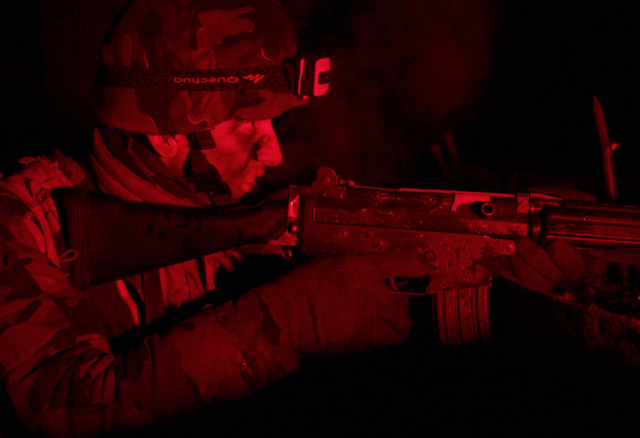
Ruben Desiere’s new documentary Echo (screening this week during the online RE>CONNEXT showcase) had its origins in Parade, a fictional dramatic feature he had been planning to make. This was an adaptation of novel which he had decided to set in a military camp.
“For this fiction film, I did research in the Belgian military and I was very struck by how the basic training was organised in a 10-week course,” the director remembers. The cadets on the course tended to be very young, between 17 and 22. Most had enrolled straight from high school.
Their training was intended to help them make “an organised transition between being a civilian and being a soldier.” At first, it was as if they were “playing” at being part of the military. However, slowly but surely, the games became more serious.
It was like a rite of passage. Always lurking in the background was the possibility of violence – but it was kept at a distance. Desiere was struck by the “abstract’ nature of the course. When he saw footage of Belgian soldiers on tours of duty in Afghanistan, he couldn’t help but notice that they still engaged in the same training exercises.
Commander Walter Van Dyck, the officer putting the young would-be soldiers through their paces, turned out to be a film fan. He enjoyed watching movies and was fascinated to have a film crew following him. “He is very conscious of where the camera stands, almost like an actor. He plays a certain role in his uniform.”
The director noticed the theatrical nature of the soldiers’ behaviour too – the constant sense they were giving a performance, or at least rehearsing for one. The longer the soldiers spent in the military, the more polished they became in their roles.
Shooting was delayed because of the pandemic. When it finally began, the filmmakers (the director himself and his sound recordist Nina de Vroome) were given plenty of time “to wander around” and to observe life in the barracks.
“The relationship with the soldiers was really good but it [the documentary] has become a portrait of the group of soldiers rather than of specific soldiers,” Desiere suggests. “You are really getting the feeling that, in this barracks, platoon after platoon is passing…”
The director pays tribute to editor Dieter Diependaele for moulding the documentary. “It is due to him that scenes become scenes.”
Echo was made through Accatone films, the company Desiere set up with producer Rasmus Van Heddeghem after his 2014 graduation film Kosmos.
“We work very closely together with a small group of Brussel-based filmmakers who support each other a lot and work on each other’s films,” Desiere says of collaborators like Olivia Rochette, Gerard-Jan Claes, Pieter Dumoulin & Timeau De Keyser.
Desiere was also one of the team that founded Belgian distribution outfit Avila. This company releases films both in cinemas and online – so that means he doesn’t have to worry about the film being seen by local audiences.
As soon as a date for the Belgian premiere is set, Commander Van Dyck and the young soldiers will be invited to watch it. “I’ve been looking at them so much during the editing and will be happy to see them again,” the director says.
Now, Desiere will resume work on Parade, the dramatic film he had been planning before making Echo instead. It won’t now be set in the military world. “I would like to film it within a militant movement,” he concludes.