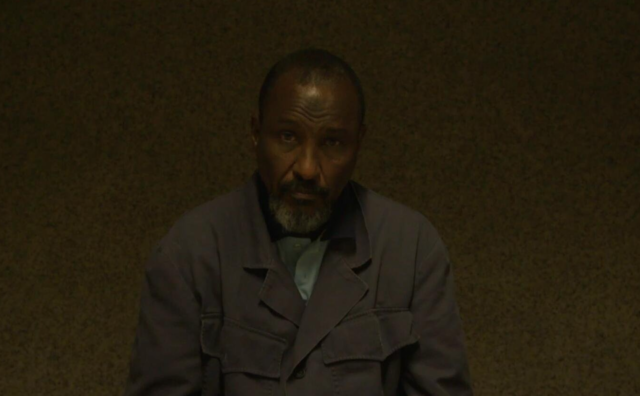
Being showcased as a work in progress at RE>CONNEXT is the documentary series Capturing The Pirate King, telling the story of the Somalians who hijacked a Belgian ship and were later arrested by the Belgian Federal Police in an elaborate sting involving a fake movie production company. It is being made through Diplodokus and directed by Lennart Stuyck.
The Pirate King in question, Mohamed Abdi Hassan, better known as Afweyne, is currently languishing in a Belgian jail. Afweyne and a colleague had been lured to Brussels to discuss making a film about their exploits. It was then that they were caught. A film has indeed been made about them, but not the one Afweyne expected.
“Of course, the story starts with the hijacking of a Belgian boat. I already followed that story. But then few years later, when it was first in the newspaper that the Belgian police caught the ‘Pirate King,’ it was mainly that which caught my attention,” Stuyck explains why he wanted to take on the documentary series. He had been sitting in the office and suggested to his colleagues that this could be a very promising project.
The first step was to get in touch with the Pirate King himself. The filmmakers approached Afweyne through his lawyer. He was open to collaborating – and very happy someone was willing to listen to his side of the story. However, Stuyck acknowledges the first encounter wasn’t easy. “He only spoke Somali so it was already difficult to talk to him.”
He was “small and a bit shy even…,” Stuyck continues, not what you expect from a celebrated “bigger than life” international criminal. It didn’t help, either, that he wasn’t completely honest.
The filmmakers weren’t sure whether they could rely on the Pirate King to tell the story on camera. However, as they did further research, they realised that there were plenty of other voices they could use, among them the police and the crew of the ship that had been hijacked.
This is one of those Rashomon-like stories in which all the characters have a slightly different perspective on the same events.
“It is true that everybody has their own kind of truth. All the other characters have their own reasons for doing what they did. The police were trying to get justice. The opinion of the lawyers was that they [the police] did it for their own personal gain, their own careers.”
Several of the police officers involved in the investigation/sting reportedly went on to more high profile jobs. The pirates themselves had their own justification for their actions – and even claimed they had no choice.
“But then again, if you hear the people on the boat, who were hijacked, if you hear their story, you [think] OK, it’s not as innocent as the pirate himself said. Everybody has their own take on what they did and what happened and who is, in fact, responsible for this entire pirate phenomenon.”
The filmmakers haven’t travelled to Somalia. “It’s mainly a talking head movie. The way we structure it is that I envision it as an ever expanding circle. It starts in this closed environment of this boat that has been hijacked. In the second episode, we take a broader view of the problem of piracy in that period,” the director explains.
In the third episode, the filmmakers look at the situation in Somalia itself, why the piracy started and what happened to all the money paid in ransoms.
And, no, this won’t be anything like the Paul Greengrass movie Captain Phillips (2013), starring Tom Hanks as the skipper. “Our story is not so heroic.”
The piracy in Somalia has almost completely stopped but Afweyne’s son is now in charge of a gang which has been trying to kidnap Belgian aid workers and journalists in Somalia in order to exchange them for his father. (If the filmmakers did travel to Somalia, they would be prime targets for the son). Besides, when Covid broke out, travel was very difficult anyway.
During RE>CONNEXT, Lennart and his team will be looking for distributors and sales agent. They’re already deep into the editing of the series. “It’s an International story in a way and for us, it would be nice if it travels around the world instead of staying in Belgium,” the director suggests.
Capturing The Pirate King is intended as a serious film but Stuyck acknowledges that some humour does creep into the storytelling.
“The tone will, of course, be serious, but when you listen to the stories, you think, Jesus, these pirates, sometimes they are like comedy figures. They do all this sort of stuff which is completely weird. There is this story of a guy who has never seen soap before and he rubs it all over his body but doesn’t wash it off. He sits in the sun and it hardens,” Stuyck remembers the outlandish elements surrounding the pirates. “There’s another story of a guy who shot his own arm because he’s high on drugs. There is a bit of a Cohen brothers vibe!”