

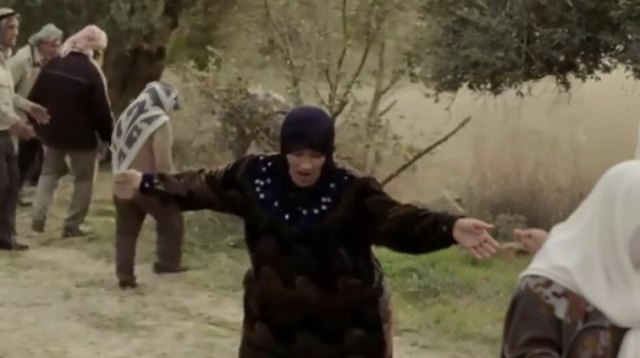
Veteran Israeli artist and director Amos Gitai returns to Venice with his latest feature documentary, The Road to Jericho (screening in Venice Open: Out of Competition). The new film is a poetic meditation on conflict in the Middle East and the diminishing prospects for peace. It draws heavily on Gita’s earlier works, including footage from such movies as Rabin, The Last Day (2015), Field Diary (1982) and News from Home (2005).
In the new film, Gitai is touching on contentious and explosive subject matter, but does so in meditative and poetic fashion.
“For me, the tone is reflective and almost a lamentation. I am not so into indoctrinated cinema, even for a good cause,” the director says. He likens himself to someone “sailing by little boat in this very toxic ocean.” His aim is always to “encourage a dialogue and mutual understanding.” He takes inspiration from works encouraging empathy, like Susan Sontag’s essay, Regarding the Pain of Others, and Mahmoud Darwish’s poem, Think of Others.
“I am very shocked by what is happening in the West Bank, by the attitude of the settlers and their savagery,” the director says of what sparked the new movie. When something disturbs or touches him, that is generally when he will be inspired to begin a project.
Gitai, now 75, originally planned to become an architect. He spent nine years studying the profession, first in Haifa and then at Berkeley in the US, where he did his PHD. One legacy of his architectural studies is his commitment to what he calls “civic” issues. He is interested in how societies operate and how people live within them.
The Road to Jericho, which is produced by, among others, Agav Films (Amos Gitai, Laurent Truchot), Laila Films (Itai Tamir), AR Content (Alexander Rodnyansky) and Gold Rush Pictures, picks up on themes the director explored in his 2017 movie, West of the Jordan River, when he wandered through the West Bank and came across a small school for children of the Bedouin that had just been established in Khan EI Ahmar.
“I was touched by it. This is a small school of about 300 students, boys and girls together – so it is not fundamentalist.”
Little money was available to build the school and the parents had been forbidden to use concrete. They therefore improvised with tyres that were then covered in earth.
Since it opened, the school has been continually threatened with destruction by Israeli settlers. Politicians called for it to be pulled down. Gitai wanted to use his filmmaking to defend the school.
Back in 1992, he had worked in theatre for the first time, staging a production of Metamorphosis of a Melody in Gibellina, Sicily, in which renowned Hollywood director Sam Fuller played ancient Roman-Jewish historian Josephus, who wrote about the Jewish revolt against the Roman occupation. The new documentary has footage of Fuller as Josephus, railing against the lies told about the conflict by people who hadn’t even been there.
“The text is so interesting, this journalistic, essayistic text which is 2000 years old and which warns us of when the zealots take power and provoke the whole Middle East. The resonance today is very strong,”
The director regards culture as “one of the only channels which is remaining to create a dialogue.” That is why he so opposes cultural boycotts. “If you block any form of dialogue, then, OK, let’s go to the next war. I think channels of dialogue always should remain open.”
Gitai’s own work has continued to circulate freely internationally in a period when many other Israeli artists have been ostracised. House, the stage adaptation of his documentary trilogy, The House (1980), A house in Jerusalem (1997), and News from Home (2005), has been put on successfully in Paris, London, Berlin and Madrid. Another of his recent productions, Golem, has also been staged widely.
The Road to Jericho includes excerpts from Gitai’s famous interview with Israeli prime minister Yitzhak Rabin not long before his assassination in 1995. “I was touched by the interview because of the honesty,” he says of this encounter. “You could never imagine having such a frank conversation with the current powers in Israel. Rabin was very simple, very sober, and also he says something about the understanding that you cannot force an agreement. An agreement has to be agreed upon. Right now, the belief is that if we don’t manage to do something by force, we should apply more force – more bombing, more killing and all this.”
Gitai views Rabin as one of the few major figures on either left or right in Israel who believed in making an agreement with the Palestinians. “In another film, I went with him both to Washington and Cairo. In Cairo, he spoke about the future of Gaza and he said if we withdraw unilaterally, the worst elements will take power; if we leave, we need to make sure that 26,000 Palestinian functionaries will get a salary, that there will be water, electricity and oxygen in the hospitals. You don’t want just victory. If you want to reach peace, you have to accommodate the necessities of the other side.”
Such pragmatism and basic humanism, he suggests, seems to be “completely lacking” among today’s Israeli leaders.
Gitai is from the same generation as current Prime Minister, Benjamin Netanyahu, who is 76. Their paths, though, haven’t crossed.
“I don’t know him…I was thinking of interviewing him but I disliked him. I think there is something dishonest, cunning [about him]. He is very capable, unfortunately. He is a very talented maneuverer and schemer, and I think he is the big destroyer of a lot in the Middle East and also of the country that I love. He is the big destroyer of the confidence that Israel will need in order to prevail, and I will not forgive him for that.”
Over the years, Gitai has interviewed many other Israeli political figures whose views he didn’t share, Ariel Sharon and Yitzhak Shamir among them. “But they had a degree of modesty and of straight talking. This is not the case with Netanyahu. He is probably the most cultivated of the Israeli leaders but that is another contradiction. Being cultivated doesn’t mean you are immune from doing very bad things.”
The Road to Jericho features footage shot only a few weeks ago of Hisham’s Palace in ancient Jericho. “After all these dramas and wars, what remains is a bunch of stones,” the director observes. “When you go to these places, you understand that these landscapes gave birth to thoughts, philosophies and religions. These landscapes are looking at us humans with some sort of reserve. It is emotional by itself, the presence of these simple deserts that have seen so many struggles.”
The Road to Jericho is produced by, among others, Agav Films (Amos Gitai, Laurent Truchot) Laila Films (Itai Tamir), AR Content (Alexander Rodnyansky) and Gold Rush Pictures. A sales agent is expected to be appointed shortly for the film.





