It’s over 20 years since British director Sophie Fiennes first encountered the maverick Slovenian philosopher, cultural theorist and movie lover, Slavoj Zizek.
In 2002, Fiennes had just directed Hoover Street Revival (2002), featuring the charismatic preacher Reverend Noel Jones (brother of singer Grace Jones). That documentary had split the critics. “Some people who were freaked out by Christianity were quite critical of it,” Fiennes recalls. “My friend, the writer Sean O’Hagan, said you know the person who would really understand this film is Slavoj Zizek because he is writing about belief and the religious impulse.”
Fiennes then started reading Zizek’s works on religion including ‘The Puppet and the Dwarf’ and ‘On Belief.’ She quickly realised that he was passionate about cinema. Watching him give lectures at the ICA and in Oxford, she also saw that he was a natural-born performer, an intellectual with a showman’s instincts.
She had the idea that he could “inhabit” documentaries in the same way natural history presenter David Attenborough “might go and inhabit the landscape.”
“As someone who never went to university, I enjoy the idea that it’s an oration of ideas and that you don’t have to be buried in the pages of a book,” the director observes of the easy way in which Zizek communicates complex ideas.
The duo first collaborated on The Pervert’s Guide to Cinema (2006), which explored movies from a provocative, playful and psychoanalytic perspective. They followed up with The Pervert’s Guide to Ideology (2012). Now, premiering in Venice Open – Out of Competition and having its North American premiere at the Toronto International Film Festival, comes the third in the trilogy, The Pervert’s Guide to Utopias.
The new documentary has taken over eight years to complete.
“Initially, Slavoj had proposed to be to make a film called ‘The Pervert’s Guide to God.’ That was the starting point but when I thought [about] it and looked at the material, I thought God is actually a bit too small!”
In late 2018, Katie Holly’s Keeper Films in Ireland received some Creative Europe support to finance the development of the new documentary.
“I had thought that having had the success with the previous films that Film4 and Channel 4 [in the UK] would come on board,” Fiennes ruefully reflects on a project which was also turned down by the British Film Institute and ultimately had no UK money in it all. Support came instead from Ireland, Slovenia, Norway and The Netherlands. The producers involved are Keeper, P Guide, SPOK Films and The Film Kitchen.
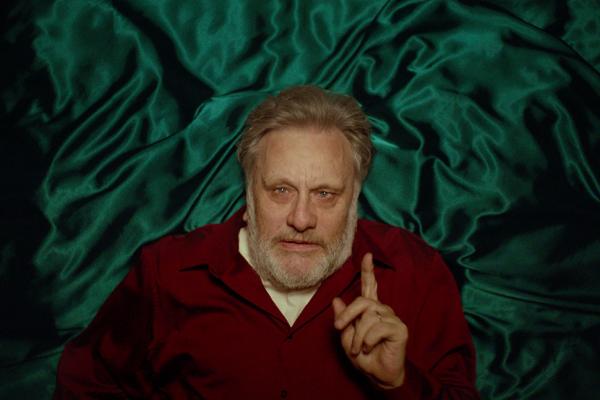
As in the previous films, Zizek gets fully in the spirit of the films he is describing by dressing up (or undressing when appropriate) as if he is appearing in them. We see him in the bath, like Kirsten Dunst in Lars Von Trier’s apocalyptic drama Melancholia, or in a fetching bonnet when describing The Handmaid’s Tale.
“I think the absurd is something he embraces,” Fiennes says of Zizek’s freewheeling approach. “It’s a reflection of him being a person who is an outsider, a free thinker – and the deadpan comedy of it is particular to him. I never know what is going to happen when I put him in those situations. I have no idea. It’s an experiment.”
The director (who also edited the documentary) always tried to ensure that there was “absolute spontaneity” and that the philosopher had the opportunity to improvise.
“We overshoot in a way that leaves me with acres of material. I always enjoy the surprise of where he takes it in that live moment. He is brilliant as an academic, delivering lectures. He has a sense of what he is trying to do with the audience. That encounter he is creating and humour is just instinctive for him.”
Rights holders of the films quoted in the documentary are generally happy to have Zizek engaging in such thoughtful fashion with their movies. “It [the documentary], encourages film viewing and thinking about cinema,” Fiennes suggests. She herself hadn’t seen some of the films that Zizek expounds on in the new documentary, among them Preston Sturges’ screwball comedy, Sullivan’s Travels, about a famous movie director naively trying to experience life on the breadline; Michael Tolkin’s dark religious fantasy, The Rapture, and the dystopian thriller V for Vendetta (whose Guy Fawkes masks have become widely used by protest groups).
Despite the humorous asides, the documentary touches on dark subject matter. An early sequence exploring the final scenes of Francis Ford Coppola’s Apocalypse Now prompts the philosopher to reflect on the “heart of darkness in human nature” and to talk in depth about war lords exploiting natural resources in the Democratic Republic of Congo.
The Handmaid’s Tale prompts him to reflect on the subjugation of women both within Islam and Christianity.
Fiennes herself showed him the news stories about Kylie Jenner’s now notorious Handmaid’s Tale Party, an event heavily criticised as being in terrible taste but which Zizek welcomes as a perfectly appropriate response to the dystopian drama. “He famously doesn’t shy away from popular culture or hold his nose at all,” she notes.
Fiennes agrees that the new film reflects an increasing wariness and foreboding which she and Zizek both share. Much of the footage was shot during the Biden presidency but Donald Trump still casts a baleful shadow over affairs. “Politically, the film is much heavier. The pessimism is not a stance. I think it is quite a good rule of thumb not just to say humans are lovely really. “
The co-production partners each hold rights to their territory. Fiennes and her team already have relationships with distributors who handled the previous two Pervert’s Guides and will be sounding them out about the third one too. “It will definitely have a long life but it is not necessarily a life that sits within the prevailing winds of the commercial film distribution and sales agent network.”
In the UK, she believes, there has been a narrowing of perspective when it comes to financing and releasing documentary.
“I think there’s a default setting in the British film establishment that you must want to be in Hollywood; you must want to be directing TV series and doc-series for Netflix. Actually, if you want to carry on taking creative risks and experimenting, that pathway doesn’t work. I look at filmmakers particularly in France, someone like Claire Simon who is in her 70s and is still making films and still being supported. It is not ageist like it is here…it is a bit of a tough path I’ve cut for myself.”
She adds that UK public service broadcasters “have abandoned filmmakers in non-fiction terms because they want scalable lowest common denominator series in formats that they can then sell.”
Nonetheless, Fiennes is “holding close” to her tried and trusted co-producers, and certainly hasn’t ruled out making yet another Pervert’s Guide with Zizek if the opportunity arises. “We haven’t got a plan but anything can happen!”