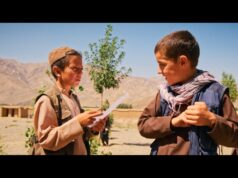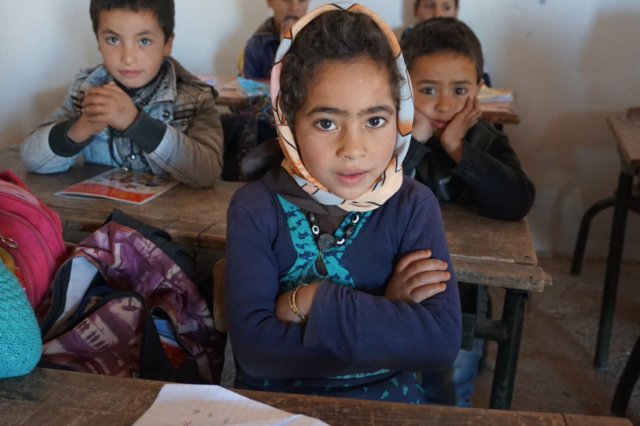
It isn’t the typical school run, at least as understood by pushy parents in the west. Kids on their way to class in Mohamed El Aboudi’s new documentary School Of Hope (international premiere in Hot Docs’ Spectrum Competition) walk or cycle or ride on donkeys for many miles across the desert.
They’re part of the Oulad Boukais tribe, nomads used to living in and travelling across vast open spaces. Now, after 15 years of near continuous drought, their traditional lifestyle is under severe threat. That is why parents are enrolling their children in a school that has just been built in the middle of the sand.
There is no running water or electricity here. When the teacher arrives to take up his position and asks for a bathroom, he is told he has the entire desert around him at his disposal.
The idea for the film came to El Aboudi almost a decade ago when he was working on his 2012 film Dance Of Outlaws. The Moroccan director discovered that his main subject, a young woman living on the margins of Moroccan society, couldn’t speak Arabic properly. When he asked her why not, she told him she had never actually been to school. When he spoke to her family, they told him they were illiterate too and hadn’t been to school either.
El Aboudi began to ask himself how Morocco as a country could thrive when so much of its population was denied an education.
“The idea started to grow slowly, slowly,” the director (who is now based in Helsinki) remembers. He first thought of making a film about education in Morocco set in one of the big cities. Then he shifted his focus “a little bit south.” He discovered the “school of hope” that features in his documentary. At that stage, there was no teacher. The one assigned the job had quit. A new teacher would be coming soon. El Aboudi realised that the teacher’s arrival could make a strong starting point for his film.
When the teacher finally turned up, he immediately agreed to participate in the documentary. “He said ‘I am with you, that would be wonderful. I am here to help these people, the same as you. You are here to help these people – so we are [on] exactly the same mission.’”
The Oulad Boukais have survived and prospered for many years without formal education. If there were plentiful of water supplies, they would doubtless continue to thrive. That’s the paradox.
“With this film, I want to show that climate change is fundamentally unjust. People with the smallest carbon footprint, like the Oulad Boukais tribe, are the ones who suffer the most,” El Aboudi says in his director’s statement. However, as he acknowledges to BDE, climate change, highly destructive in itself, is spurring on educational reform.
“First came the drought. Then, the nomads tried to find a place to settle. To settle, they should find water. That is why they settled exactly in that place. When I asked them about education before, they said they didn’t need education.”
It was hardly practical either. The nomads were always on the move. This meant teachers would have had to travel with them.
“We were living freely, we were living happy. We just don’t need it,” the nomads told him, They were fiercely proud of the freedom in which they lived. Now, with their world is under threat because of water shortages, they have changed their attitude. They look toward education to give their children a chance of another way of life.
“Without water, they don’t exist,” the director says of the nomads and are forced to go long distances to find wells.
On one occasion during filming, the small amount of water the nomads had discovered was dirty and full of clay. Another tribe had reached the supply before them. The director was told: “if you drink it you will die instantly.”
”What about you?” he asked. “We are used to it,” came the reply.
“From that moment, we thought, no, we should really bring our water with us,” El Aboudi recalls. He and his crew had to stay 150 km from the desert – and to drive to and from the “school of hope” every day, bringing all their supplies and equipment with them.
As the drought has continued, many of the nomads had to sell their livestock and work for other people or, in extreme circumstances, to leave the desert altogether and live in the towns and cities where there is a better chance of employment.
As El Aboudi explains, the kids themselves relish going to school. As nomadic farmers, their families need space. That means social interaction is very limited. For the children and teenagers, school isn’t just a chance to learn but an opportunity to socialise and play.
“They are so enthusiastic to come to school. One father was telling me once that his daughter would wake him up at six o’clock in the morning and tell me it is time to go to school,” the director says.
School Of Hope was made a Finnish-French-Moroccan Co-Production . Companies involved include Illume Oy from Finland, Bellota from France, La Prod in Morocco and Vulcan Productions in the US. The film has already premiered in festivals in Finland. Hot Docs marks its international premiere.