

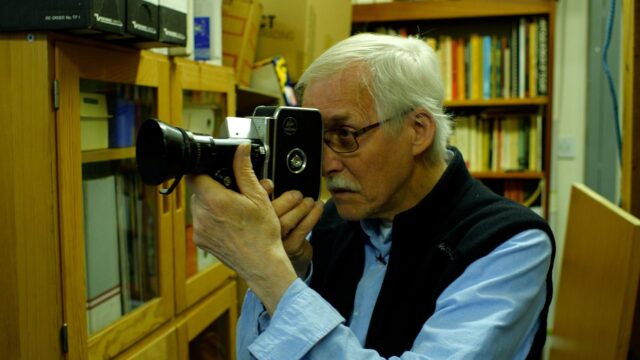
Doc Rowe doesn’t yet drive a car, Given that he is now in his 80s, perhaps he never will. If he has to go across the country, he is most likely to take the bus. Nonetheless, there is hardly a corner of the UK that the man described as “Britain’s great folklorist” hasn’t visited. From the Whitby Krampus Run, when horned demons come out in North Yorkshire, to the torch lit processions of Up Helly Aa on Shetland, from the firing of the “Fenny Poppers” in Buckinghamshire to the Widow’s Bun ceremony in London, Rowe will be there with his camera.
Rowe has spent a lifetime chronicling folk customs and celebrations across the land. Now, in The Archivist, the new feature doc from Tim Plester and Rob Curry, he’s the one whose story is being told – or, at least, the story of his fight to preserve the immense archive he has put together over the last 60 years. The film is a world premiere in the International Competition at Sheffield DocFest. It is produced by Rebecca Mark-Lawson at Tyke Films.
Plester and Curry have made some remarkable documentaries of their own over the last 15 years including Way Of The Morris (2011), about Morris dancing, and The Ballad Of Shirley Collins (2016).
More than a decade ago, when the duo were researching different types of Morris dancing, Doc Rowe helped them find footage – and that was how they first met him.
“He seemed very charming, very idiosyncratic and very at peace with his place in the world,” Curry remembers his first impression of Doc. “He clearly didn’t have any money, but he didn’t seem very fussed about it. He was someone who had found his calling.”
For his part, when Plester met Doc, he was instantly reminded of certain people from his home village, Adderbury in North Oxfordshire – ‘the young people when Bob Dylan plugged in his electric guitar, or Fairport Convention who made folk sexy in 1969. He seemed very much in that mould.”
Doc Rowe has never looked for financial reward from his work although he has dedicated a lifetime to it.
Plester and Curry took their time before committing to the documentary. “What is the story?” and “why now?” are two questions the filmmakers always ask themselves before taking on a project as ambitious as this.
“We were in lockdown when we started making it. We had talked about maybe making a film about Doc (Rowe) but then the pandemic happened and these folk events that he had spent his life recording had actually stopped happening because of lockdown,” Plester recalls. “These events that had survived hundreds of years, that had survived world wars, were not happening – and it felt like that was our story.”
The idea was to follow Rowe for a year, from the May Day when everything was cancelled to one where (the directors hoped) “everything would be happening again, not just for the film but for humanity again.”
Once the country opened up, the filmmakers followed Rowe across Britain.
Curry’s “personal favourite” of the various events they attended was the “Sedgefield Ball Game,” in County Durham.
“There is this great tradition of unstructured football games around Shrove Tuesday. You look at that from the outside and you say ‘do I even want to go to that’? It looks so violent, so intimidating, unfriendly and unwelcoming.”
This was an event where participants smashed their neighbours’ faces into the concrete with evident relish. As a southerner with a camera, Curry was therefore very nervous about what the “terrifying” locals might make of him.
“Actually, it has got a brilliant atmosphere and people were really friendly and welcoming.”
In the documentary, we hear Rowe and others talking about how one of these festivals can recharge you with energy for the rest of the year.
Sedgefield had an edge that you don’t always get at events like the Cooper’s Hill Cheese Rolling event in Gloucestershire which is now visited by tourists from all over the world – and was this year won by a German YouTuber.
Plester has a fascination with the Ottery Saint Mary event in Devon. He visited it first as a student in the early 1990s. “Witnessing that has stayed with me for decades….these people running through these tiny streets with these huge, flaming barrels of tar. As a punter, you just have to get out of the way!”
For Rowe himself, Padstow May Day is one of the dates he has most come to cherish. He first attended in 1963 and had to go straight back the following year to make sure that he wasn’t just imagining it.
The documentary offers a “whistle stop tour around the UK in 90 minutes.”
“There’s a uniformity to them, in that they speak to people’s need for ritual and belonging, but there is also a uniqueness about every single one of them,” Curry suggests of the festivals.
Another common denominator they all share is the presence of Doc Rowe. He is indefatigable in his attempts to get to these events if his health will allow it.
Plester and Curry use verité-style techniques. There aren’t interviews or narrators trying to contextualise everything. “What we focus on is not so much the information – stuff you can find on a Wikipedia page – but the feeling of what it was to be there,” Plester says. The idea is to let viewers “soak up the atmosphere.”
They don’t have fixers and they don’t do a lot of preparation in advance. Instead, they like to “drop in” on the events and “try and experience them in the moment.”
The film starts under a cloud, with the Covid lockdown, but optimism soon rises. Rowe has a huge hoard of material that he needs to find a home for. Quite apart from the movie footage, it also incorporates 20,000 pictures and 42,000 black and white negatives. “The only good thing about the pandemic is that it stopped me going on and adding to it,” Rowe quips at one stage.
Thanks to the two directors, some serious crowd funding was done, raising £60,000 to enable Rowe to digitise his material. A major British institution is also expected to provide a permanent home to all his audio and moving image recordings.
Rowe may have spent a lifetime assembling all this material but he makes his priorities clear. It’s the people who matter most to him, not the cassettes or the cans of film.
This wasn’t an easy project to finance. The directors received some seed funding from one of the producers of their Shirley Collins documentary. “But that was it. When that money ran out, it was either abandon the project or find a way to keep going.”
Plester has a successful parallel acting career (his credits range from Game Of Thrones to Worzel Gummidge) and was often away on shoots.
“It’s the most shoestring film we have ever made,” they say. “We tried every documentary fund going and nobody was interested.”
There were times when the duo couldn’t afford camera crews. Nonetheless, taking their cue from Rowe himself, they ploughed on. Now they’ve completed the film and have a built-in audience across the country, in all the places that they visited.
Curry and Plester, who make their documentaries through their company Fifth Column Films, say they have “survived” in the industry by trying to hold onto rights themselves. They do their own deals with cinema chains and broadcasters, cutting out the intermediaries.
One of the filmmakers’ other achievements is to have stayed sober throughout the making of The Archivist. Rowe himself has been known to drink 23 whiskies before lunchtime at some of the festivals he attends, but Curry and Plester remained very disciplined around alcohol.
“All these events are powerful as they are because they are social events,” Plester notes. “There is a way of routing this all the way back to Morris dancing – and the reason Morris dancing is done outside pubs is that 200 years ago, these people were farm labourers coming out of the fields of an evening. To put on their bells and do a dance, they were hoping they were going to get some free food and some free ale.”
The two directors also point out that pubs remain the hubs of many of the communities where the festivals are held.
“That’s the difference between us making a film and Doc doing it to capture the day. The rushes are peppered with Doc going, ‘would you like a drink, sure you don’t want one,’ …but if you’re trying to construct a story on the fly in an environment as uncontrolled as those events are, you can’t really drink,” Curry sighs. “Sadly you have to go back and do it the next year – which we have done!”
Rowe himself has been trying his hardest to avoid the limelight, even in a film that is ostensibly about him. As Plester puts it: “he has always been at pains to [say] that the film should be a celebration of the events, not of him. We have had to push that agenda more than probably he would be comfortable with. He would much have preferred to stay in the background. But we decided what he has done is as worth celebrating as the things he chooses to film. Hopefully, the film does both – it celebrates Doc’s achievements and the majesty, longevity and determination that the people have shown to keep these things going.”





