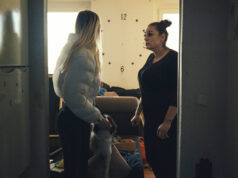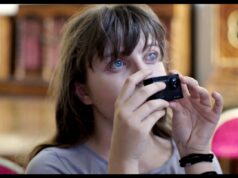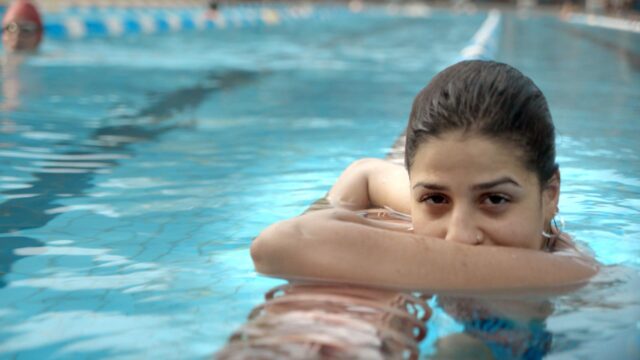
Syrian refugees Sara Mardini and her sister Yusra, both brilliant swimmers, became media celebrities in 2015 when they pulled a boat carrying other refugees towards the Greek coast, thereby saving the passengers’ lives. Since then, Yusra has competed in the 2016 and 2020 Olympics [which took place in 2021 because of Covid] while Sara became an activist and student. They were living in Berlin.
But then Sara was arrested in 2018 after returning to Greece to help rescue other migrants. Bizarrely, she and other defendants ended up being charged with people trafficking, spying and money laundering.
The sisters’ story has already been dramatised in Netflix/Working Title movie The Swimmers directed by Sally El Hosaini. Now, Charly Wai Feldman has made a documentary, Long Distance Swimmer: Sara Mardini – about Sara’s Kafkaesque experiences at the hands of the Greek legal system. The film, sold by New Docs, has its UK premiere this week in the Journeys strand at Sheffield Doc Fest.
“The moment it really hit us that we needed to make a film was when Sara was arrested,” recalls Feldman. “At that time, they [the Greeks] could legally hold her for 18 months pre-trial detention and we had no idea if she was going to get out.”
Early on, Feldman and her producers (Antje Böhmert, Anna von Dziembowska, Daniel Druhora, and Drake Burnette) had no idea what form their documentary would take. After all, it was impossible to predict what would happen to Sara. They wrote a letter to Sara in prison asking if she would co-operate with a film. She replied ‘yes, go ahead.” Her only stipulation was that she didn’t want to be shown as a hero.
When Sara was still in prison, the filmmakers considered making a straightforward current affairs-style film about the “criminalisation of humanitarian work.” However, once Sara was released and Feldman met her, the scope of the project rapidly changed. It became a much more complex, personal and open-ended story.
The trial kept on being postponed. The Greek authorities seemed determined to let the case linger.
“Suddenly, themes which we hadn’t expected [to feature] like mental health became much more prominent than before.”
Sara’s story is intertwined with that of her sister. Their mother and youngest sibling also feature.
Feldman was very conscious that Sara had become an object of fascination for the media. She didn’t want the documentary to intrude on her subject’s privacy. “She was facing such a challenge in, excuse my French, keeping her shit together that it wasn’t the time to start exploring family dynamics,” the director soon decided. Nonetheless, this is a very frank and intimate portrait of its subject.
“The first time I met her, she [Sara] was wearing a shirt which said ‘the art of eye contact’ on it. I felt there was this force of nature…she is someone very free in her expression. As a woman myself, I felt like she was very unhinged – in a positive way. She was just so free,” Feldman observes. “She was not burdened by what society might expect of her as a woman, as a Muslim woman, as a refugee. She was very unshackled from those things. That was why I felt we needed to spend the time to make this a much deeper story.”
At the same time, the director was determined to ensure the film wasn’t exploitative and that Sara felt she was in full control of how she was being depicted. “We spent a lot of time without the cameras rolling and we developed a very strong relationship,” Feldman explains how she became part of Sara’s ‘circle of trust.’ Her subject spoke frankly and freely on camera. It was up to Feldman during editing to ensure that she didn’t expose too much of her subject to the public.
“We took our duty of care really seriously. We thought very carefully about what to put out and what to leave out.” (The Syrian loves to hit the dance floor. One nagging regret for Feldman is that she has not yet been nightclubbing with Sara in Berlin. “I happened to have two pregnancies during the making of this film…and Covid [happened]. There is still an IOU hanging in the air because I did make her promise to take me clubbing.”)
Feldman was very aware that Sara has spoken about her experiences many times in interviews and public speaking engagements. “Just having her tell her story [in the documentary] would be a repetition of something she has already done and that is already out there.” The documentary therefore tries to be evocative and poetic in its approach.
“She was going through so much [but] as soon as she dived into the pool, it was like she just shed all that tension off of her,” Feldman notes of the exhilaration that Sara feels in the water. The film deals with trauma and its narrative becomes very bleak at times. Feldman hopes that the scenes in the pool will give audiences some respite from its darker elements. She also observes a contrast between the sisters when they’re swimming. Yusra, the determined, focused Olympic athlete, is “on this very clear and narrow path when she is going down the lanes of a swimming pool.” Sara, by contrast, is “a bit more chaotic” in how she makes her makes her way through the water.
“I think the media has created a lot of harm in the relationship between the two sisters. At least, that is how they [the sisters] saw it. They were very on guard about how it would be portrayed…any sisters who watch this understand that there is rivalry, tension and arguments but also an immense amount of love, companionship and support. Trying to be truthful to the more tense parts of the relationship while making sure that the love and appreciation could shine through was very important to us.”
Feldman can’t hide her dismay at the ongoing legal action against Sara and her co-defendant Sean Binder. She sees it as clearly unjust. It fills her with foreboding. The director studied international relations and politics. A lot of her fellow students have done similar work to Sara and Sean, volunteering to help refugees. She is appalled at the idea that they could face criminal charges and the threat of a 25-year sentence for doing so. “It [the film] did become a little more partisan than I thought it would.”
This has been an epic endeavour to complete. Financiers were wary to support it. Some cited “refugee fatigue” as an excuse for passing. In the end, some funders threw their weight behind the project, among them SWR/ARTE, the MOIN Filmförderung and The Malik Bendjelloul Memorial Fund. Meanwhile, human rights organisation Amnesty helped with the film’s impact release in Germany earlier this spring.
As her problems mounted, Sara suffered from depression and stress. The filmmakers were determined not to put pressure on her but found themselves facing deadlines. “We were always weighing up, ‘is the camera doing more harm than good?’ If it is, we need to back off,” Feldman says of how she always put her subject’s mental health first. “We had to be deliberate and thoughtful every step of the way.”