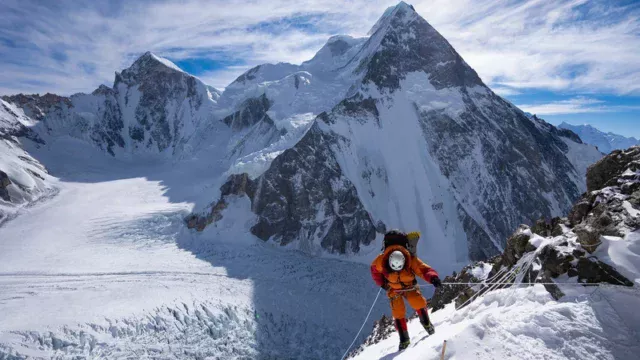
You might think that only a fool would want to climb K2, one of the world’s most lethal mountains, in the dead of winter. It’s a hard enough ascent in high summer, let alone when temperatures are at minus 50 or below, and the winds have grown so violent they’re dislodging huge rocks.
Nonetheless, as Amir Bar-Lev’s new feature, The Last First: Winter K2 (sold by Cinetic and premiering in Sundance) reveals, there was a period in 2021 when several teams at once converged on the mountain. Climbers from the Nordics, Nepal, Pakistan, and even amateurs on a package trip, all shared the same dream of getting up K2 during the most hostile period of the year. They were all motivated by the fact that a winter ascent of K2 was one of the few feats that had never before been accomplished… a ‘last first.’
Bar-Lev’s achievement in his documentary is to tell an immensely complex story in an accessible and very dramatic way. This is both an adventure yarn, a disaster movie, and a probing meditation on the motivations that made so many people put themselves in harm’s way.
The director and his crew worked on the footage for 14 months. “Of all the films I’ve made, this was the most challenging to edit…there were 60 people on the mountain – and so there were 60 stories you could tell.”
Early on, viewers might think they’re watching a film about John Snorri Sigurjónsson, the brilliant Icelandic mountaineer, and his team that includes the cheery and resilient Pakistani climber, Ali Sadpara. They’re shown preparing for their ascent, putting up their tents in base camp. They’re taking time to acclimatise, doing everything the right way. But then several other teams arrive on the scene, including a Nepalese one led by the charismatic Nirmal (Nims) Purja, one of the stars of the climbing world. Nims is clearly a man in a hurry.
“We realised early on that, in some ways, this was a classical story of survival, competition, and all the other riveting elements of the mountaineering genre, but in other ways, it was a snapshot of civilisation at this moment…and we humans bring our greatest traits and our worst traits wherever we go,” says Bar-Lev. “We treated it like an existentialist parable, like ‘No Exit’ by Sartre, and tried to tease out the parts of the story we felt were reflective of all of us.”
The 2021 K2 disaster has already assumed its place in the grim history of mountaineering tragedies. It’s not a spoiler alert to reveal that five people died. Opinions still differ very sharply over who was to blame.
“By the time we came on the scene after the events, there were a lot of very strong opinions about what had gone wrong that season. There were multiple perspectives and they were, often times, opposing,” the director remembers. “We tried to get the best representatives of the different perspectives and let them put their best foot forward.”
Bar-Lev has little time for documentaries that start with “a secret agenda…giving people enough rope to hang themselves and cutting in a clever way to make people villains or heroes.” He wanted to allow everyone involved a fair chance to represent themselves and leave it to the audience to make its own decisions about where the real responsibility for the disaster lay.
The documentary is bursting at the seams with articulate and opinionated subjects, all speaking forcefully and eloquently about that terrible night five years ago.
In the course of making the film, the director often found his own perspective changing. “It’s one of those very interesting, complex stories where the opposite of a truth is a lie but the opposite of a great truth is another great truth.”
When it came to archive material, Bar-Lev and his team had an embarrassment of riches. All the teams on the mountain arrived with their own camera equipment. The filmmakers also had the access to the “walkie-talkie chatter” at the time of the disaster.
“These days, the first thing they [the mountaineers] set up when they arrive at the base camp is often the wi-fi,” the director notes.
Mountaineering is extraordinarily expensive. It’s very unusual to be able to do it without sponsors – and to keep those sponsors happy, there may be an obligation to post on social media.
“All of that is done when you are on the razor’s edge between life and death. You’re also capturing it.”
This may be a new phenomenon of our digital age but Bar-Lev points out that the urge to chronicle daredevil adventures is as old as humanity itself. Every civilisation is fascinated by those “who’ve cheated death or who have done something seemingly superhuman.”
As became apparent more than 20 years ago, when Kevin Macdonald’s British documentary classic Touching the Void (2003) was released, the mountaineering community can be very judgmental when climbers break unwritten codes of behaviour. What happened on K2 has also clearly roiled and upset the climbing world.
One question which nagged away at Bar-Lev when he was making the film was whether top-level mountaineering was competitive or cooperative. It can be seen both as a sport, with winners and losers, and an endeavour which depends on collective action.
Polish climber Magdalena Gorzkowska, a former European and World Indoor championship 400-metre sprinter, gained notoriety when she candidly stated that everybody wanted to get to the top of K2 first. This may have been true, but experienced climbers would never admit it.
“She was kind of new to it and she said, sure, we collaborate at base camp, but once we leave the base camp, the collaboration ends and the competition begins. But that question of where on the mountain does collaboration end and competition begin becomes, in this story, a question of life and death,” Bar-Lev says.
Mountaineering doesn’t have fixed rules. It relies on a “gentleman’s code.” In the race to climb K2 in winter, the Nepalese team clearly ignored the code. Then again, Nepalese sherpas have continually been shunted to the margins when they’ve worked with western climbers on historic ascents. It’s hard to blame them for wanting some very overdue limelight.
Audiences watching the film may well be surprised that, alongside the highly professional climbers attempting the winter ascent of K2 were a bunch of amateurs on a package tour. At a key moment high on the mountain on an utterly freezing night, they turned out not to have brought their tents with them, a terrible oversight that may have contributed to the disaster that soon after unfolded.
The Last First is one of several documentaries (including The Tillman Story and My Kid Could Paint That) that Bar-Lev has made with British producer John Battsek of Ventureland. It had been almost a decade since they last worked together and they relished the chance to collaborate again. Bar-Lev points out that a younger producer, Sean Richard, initiated the project.
One irony is that Battsek wasn’t sure Bar-Lev would want to take on a mountaineering film. His partner Sarah Thomson sent the director the project deck with a note that said: “John doesn’t think you’ll be interested in this but I think he is wrong.”
Bar-Lev took one look at the deck and immediately knew he wanted to do the movie.
“This story is a no-brainer. It has got the riveting excitement of the best survival stories, but it also has a lot to say about everything from social media to racial reckoning, and questions about why humans take risks,” he explains how his own K2 obsession began, and why he thinks this could be another mountain tale that will intrigue audiences everywhere.