All About the Money may be the title of Irish filmmaker Sinéad O’Shea’s new documentary (sold by Submarine and premiering in World Cinema Documentary Competition in Sundance) but the project certainly wasn’t all about the money for its director. As the end credits reveal, her subject, American communist multi-millionaire Fergie Chambers, offered to cover the production budget and add a cash payment if she stopped it being seen. She refused. He then accepted that it would be shown.
“It was an interesting sequence of events but I do admire him, I suppose, for participating in the film, and then letting it go ahead,” O’Shea says of the mercurial Chambers. It’s not often, after all, that we get to see inside the life of one of the “0.001%” of the richest people in America, a country where, the opening credits remind us, the top 1% own as much as the bottom 90% combined. These people tend to be highly discreet and secretive, but Chambers is nothing if not open.
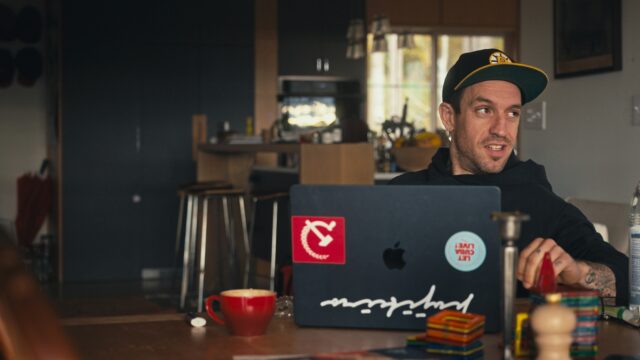
We’re used to hearing about libertarian, Trump-supporting, right-wing billionaires and “tech bros.” Chambers is a character in a very different hue. He’s a Marxist revolutionary who, in the course of the film, becomes a Muslim. He also lives without any visible trappings of extreme wealth. Heavily tattooed, he looks more like a roadie from a heavy rock band than a Rockefeller or a Vanderbilt.
Backing for the film came from Screen Ireland and Inevitable Pictures. It was produced through SOS Productions and Real Lava. Distribution plans are yet to be set.
What originally got O’Shea interested in Chambers was the Marxist community he set up in Alford in Massachusetts, a place where one of her friends went to live and work during the Covid period.
“I just did some research. I wanted to find out who was financing it, and his back story was amazing,” the director says of what she learned about the maverick tycoon. “It’s so interesting that someone who comes from one of America’s wealthiest families has decided to rebel against the capitalist system and is intent on creating a communist revolution.”
On her first visit to Alford, O’Shea was “enchanted.” This was a beautiful part of rural America with an “Edenic” quality that remained her of the landscapes in Terrence Malick’s The New World. She interviewed the residents who seemed, on the surface, to be living idyllic lives. Chambers picked up most of their bills. He also opened a gym full of communist flags and Soviet memorabilia.
O’Shea talks of “trying to be as truthful” as she could. As an outsider, she wanted to present what she observed at first hand, not to editorialise. “I didn’t want to make an authored film. It’s not what about what I think. It’s about what I have seen.”
At the same time, she acknowledges how “hard” it is to be in a documentary. “No matter what anyone says or does in the film, I feel very grateful to them because they did participate…they did work with me.”
As we learn, Chambers suffered childhood sexual abuse and was locked up in solitary confinement when he was only 11 years old. “I didn’t want to ask him about it on camera because I thought it would be a bit intrusive, so I just left it. But then he messaged me and wondered why I hadn’t asked about it,” O’Shea explains. “For him, not surprisingly, that sequence of events was very formative, and has had a massive influence on how he feels about lots of things – about the United States, about medication, about institutionalisation. Again, I truly admire him for that.”
Chambers emerges in the documentary as a paradoxical figure, powerful but vulnerable, wildly outspoken, especially on social media, but often kind and considerate in person. “It is so hard to summarise him even in 94 minutes. We could have done four and a half hours. There are so many layers upon layers. I’ve stopped filming, but his life hasn’t stopped unfolding.”
And, yes, it did take O’Shea by surprise when her subject headed off to Tunisia, became a Muslim, and invested millions in Tunis-based football team, Club Africain. By then, the October 7 Hamas attacks in Israel had happened and his followers had begun protesting against subsequent Israeli atrocities in Gaza. This landed some of them on the wrong side of the law.
The director and his subject are still on good terms. “I don’t know how he feels about me, I’ve no idea,” she reflects. “His life is just so full. There are just so many things, people and events crossing his life at all times.”
Journalists have long been fascinated by him and have written weighty profiles in publications like Vanity Fair and Rolling Stone. He is prepared to spend “lots and lots of time” with the reporters – and was equally open with O’Shea.
“We don’t agree about lots of political issues, but I can say without reserve that I really admire somebody who exposes himself in the way he has done.”
Nonetheless, O’Shea won’t be drawn on the sometimes fraught relationship between Chambers and his followers.
“Everything is in the film. I just put every perspective I could into the film. It was really important for me not to advocate on behalf of other people,” she again emphasises that this is reportage, not a documentary with an agenda. “It’s quite difficult, I think. Everyone is writing opinion pieces these days but I don’t want to write an opinion piece. I just want to present this set of incidents. Our hope is that people will come out and not really know what to think – that they feel wrong-footed and surprised. Things should feel as if they slightly come out of the blue, but then, in retrospect, that there is a sense of an underlying rationale.”
Certain episodes are glided over. That was partly because O’Shea wasn’t there to film them. She didn’t witness Chambers breaking up and then getting back together again with his partner, Stella Schnabel. Nor was she there when his involvement in Tunisian football turned very sour. (This period is covered through some of his anguished texts). Nonetheless, she observes her subject at very close quarters.
The director was immersed in the project while also working on her award-winning Edna O’Brien documentary, Blue Road. “That was such a glossy production by comparison,” she says of the O’Brien documentary. “My family thought I was crazy to be doing this at the same time. I have a small baby and I had to take him with me sometimes on the shoots.”
She adds that she was far too fascinated by Chambers to contemplate dropping the project. “I just thought it was so…interesting!”
O’Shea lets us know what her subject is reading. He devours plenty of weighty Marxist tomes but then, when he comes to Ireland, where he is now based, he steeps himself in the work of Oscar Wilde. Mary Shelley’s Frankenstein is another of his current favourites. “Fergie likened himself to me as Frankenstein’s monster,” says the director. “He was created by a system of unbridled capitalism and now he wants to master it. I thought that was such a potent concept!”