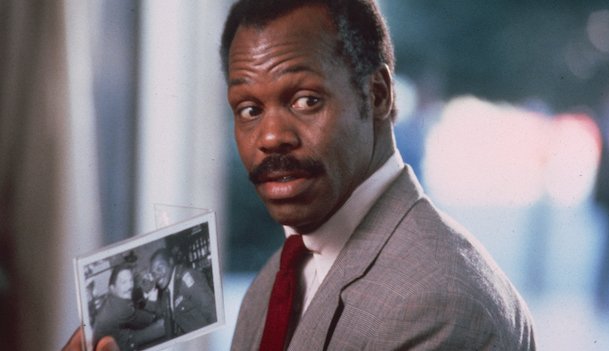
New York-based artist and filmmaker James N. Kienitz Wilkins has been collecting physical publicity slides from movies for a number of years. These stills are used in ingenious fashion in his new project Still Film (an international premiere at Visions). As the images, some of them very familiar, are projected on screen, a voice is heard on the soundtrack talking about memory, technology and cinema.
“Slides were used for film publicity or press kits up until the early 2000s. The slides I collected and then scanned for use in Still Film range from 1982-2001, the year I was conceived to the year I turned eighteen. I wanted to look at my personal history of movie exposure prior to becoming an adult,” Wilkins explains the scope of his film.
“The majority of these “experiences” were of Hollywood productions. My selection of the images came down to whether I associated a memory or feeling with a particular movie, further reduced to 140 images or the capacity of a slide projector carousel,” he adds. “The length of each image held depends on its position within an imaginary carousel going round and round, with all images held more or less equally in the second half of the movie. In the beginning, it’s associative and selective and takes some time to get going. There are a number of loops in the movie when the images (like true slides) reverse, restart, and then rearrange in their proper chronological order.”
We see images of movies from Dick Tracy to Total Recall, from Terminator to Amadeus.
Hollywood studios are notoriously protective about their IP but the director explains that he is not infringing on any copyright laws. “It is my right to use them [the images], because I am using them as intended (as promotion of the studio films, credited), using them to preserve (as collectible objects I own and scanned, so not simply “images”), and finally, using them to artistically transform according to accepted standards of fair use. No one’s rights are impeded or exploited in the production and exhibition of Still Film,” Wilkins underlines.
Wilkins’ films and videos have screened both in festivals and in galleries. He straddles the fine art and movie worlds. Asked whether his work receives a different response when shown at festivals like Visions Du Réel than when exhibited in galleries and museums (for example at MOMA) he gives a measured, thoughtful response.
“The screening at Visions Du Réel is its international premiere, so I don’t know what the response will be. I’ve noticed region matters more than the venue. Still Film is definitely an American-centric movie, and for that, I issue no apologies. It’s a movie about an individual’s perspective. I’m curious how it will work with French subtitles. I would argue that the movie is a personal documentary despite feeling like something else. It’s probably the wildcard entry in a festival dedicated to documentary work with certain expectations of what a documentary should be, or do. Of course, this type of festival is more flexible than most in the USA.”
The project was made through Automatic Moving, the independent production company that Wilkins set up around 15 years ago. The name comes from a short trick film from 1911 about a moving company that moves furniture and home decor automatically, without people. “In other words, operating without the middleman.”
Inevitably, given its use of voice and still images, the film has been likened by some to Chris Marker’s classic 1962 sci-fi short La Jetée, one of the touchstones for films that avoid moving imagery.
“La Jetée is one of those foundational art school movies, for sure, but it’s funny that many people my age and younger were exposed to 12 Monkeys first,” the director reflects on the Terry Gilliam movie inspired by Marker’s work and which starred Brad Pitt and Bruce Willis. It soon became far more famous, and far more widely seen, than the original. “I feel like there’s often a retroactive come-around in terms of exposure to art and experimental cinema, which I tried to directly address in Still Film. Like it doesn’t matter how smart you are, the slick commercial stuff will still reach you first and deeply, flow through you, make its mark early, and who’s to say that’s bad or good. I don’t make movies in response to any particular influence beyond the every-influence. I’m not committed to any tradition.”
Ask the director if he describes himself as a nostalgic person and he responds sharply. “Absolutely not. I am a sensible person with emotions and feelings about the past, but I have developed a real disgust for nostalgia. It’s very corrupting when it comes to art making, because it always fails itself (recapturing the past), and therefore manifests as fashion.”
Is he keen on conspiracy theories? The question seems justified by some of the links Still Film makes between events on screen and what is happening in the world beyond.
“Keen is a good word. I’m not sure if you’re asking whether I’m a proponent of conspiracy theories, or very interested in them as a phenomena. What passes for conspiracy theories these days doesn’t feel like theory to me — it’s all so mainstream and stupid and easily disproven, it’s just cultish religion. Proper conspiracy theories are compelling and harder to place. They need to be tested. Like what is wrong with Tom Hanks. There’s something intuitively there. It’s not a political issue — it’s simply unnatural to bear the burden of being the world’s nicest guy. Have you seen his latest movie [A Man Called Otto] in which he keeps trying to kill himself? Why does Tom Hanks need to make a movie like that, today? Look in the mirror and ask yourself this.”
The voice-over in Still Film was carefully scripted. The screenplay is 114 pages written in the form of a legal deposition.
“The purpose of a deposition is to discover evidence for later use in court. So it’s a proceeding without a judge. There are accepted rules but the proceeding can go off the rails. For me, this type of encounter is fully comic and fully serious,” Wilkins explains the ingenious formal structure he has used. This is also one of the “most edited” movies he has made.
“Each character performed by me was recorded separately (obviously) and audio edited together to create dialogue, conversation, interaction. It was tricky, yet with precedent, specifically two shorts, Indefinite Pitch (2016) and This Action Lies (2018), which I consider related projects. Also the image-less movie, The Republic (2017), which I co-made with Robin Schavoir, in terms of its polyvocal tapestry.”
The voice-over is very wide-ranging. It touches on everything from cryptocurrency to Kodak and the death of film, from Covid to celebrity culture.
“I like to make movies that reflect the times we are living in. To me, this is the enduring value and point of movies, and why it is urgent to retain independence in production in order to move quickly,” the director says.
Where does the money come from to make the work? Wilkins welcomes the question.
“I finance my projects through a complex and ever-changing admixture of grants, awards, donations, mutual aid, personal income, petty scams, and light grift. We don’t have state funding in the USA which is a blessing and a curse, cause only the Good survive. I’m just lucky I don’t believe movies need to cost as much as people think they do. If I can’t make one movie, I’ll make the next one. Some are for sale, others aren’t. I haven’t decided yet whether Still Film is for sale. It doesn’t matter. More movies will come; I’ll still film. The funny thing is that I know I could make someone else (an executive producer) a lot of money if they took the chance. But I’m not holding my breath…”
Having finished Still Film, Wilkins is now trying to get a low budget fiction feature made later this year – if he can find financiers bold enough to support him.
“Perhaps they will be waiting for me in Nyon. Perhaps I will encounter the ghost of Godard, and together, we will rattle our chains,” he jokes.