“I wouldn’t say it was exactly a carte blanche, but it was close to it,” Montreal-based director Sophie Bédard Marcotte says of the freedom given to her by backers National Film Board of Canada when she embarked on I Lost Sight Of The Landscape (a world premiere in Burning Lights at VdR this week).
NFB Producer Pierre-Mathieu Fortin had seen the filmmaker’s previous work and was keen to support her. Marcotte, meanwhile, was determined to cast off the shackles.
“I wanted to go into this film without a clear plan. My last film was a documentary but it was much more scripted. This time, I wanted to try something different and to really be open to life and what would happen. That was my hope but I’m also a control freak in a way, and so it was really challenging me…”
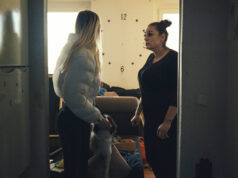
Her initial plan was simply to follow her neighbour, theatre artist Gabriel Charlebois-Plante, as he developed his latest work. They lived together in a co-op for artists in a seven-storey building in Montreal. (“The rates are advantageous. We can do art and not to be too stressed about having to pay our rent. We are managing the building and so we discover each other’s strengths and weaknesses,” Marcotte explains).
Gabriel’s approach to theatre was loose and intuitive. She knew he was a “good character” and that he was funny, charismatic and easy to talk with. He had a new project percolating based on the myth of Sisyphus, the mythical figure who continually pushes a rock up to the top of a hill only to see it roll all the way back down again.
“Obviously, life was much more surprising that I expected and it became a real challenge to actually be open-minded. His project and my encounter with him took me in directions I was not at all expecting.”
(Spoiler alert: she ended up in a relationship with her subject and they had a child together.)
“We didn’t want it to be too much at the forefront of the film just because I felt like we needed to care about other things,” Marcotte says of her growing closeness to Gabriel. She wondered if she had “made a mistake” by embarking on the film in the first place and if she had somehow been “blindsided” about her real motivations for working so closely with Gabriel. She credits editor Myriam Magassouba with helping her with “finding ways in which it [the film] could still be universal.”
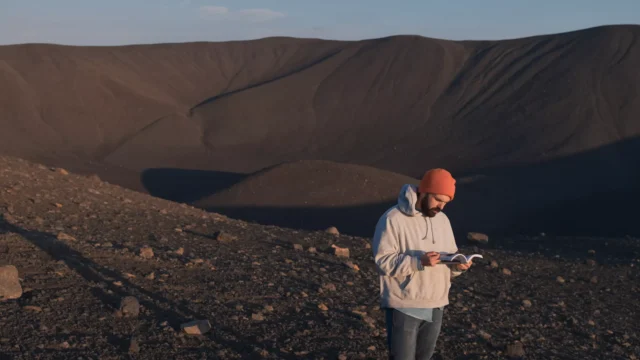
The story unfolds in 16 possible chapters. The Sisyphus idea leads Gabriel and Marcotte into geological territory – they spend a lot of time with rocks.
“For the film, we went to different places like Iceland, even Finland and the north of Quebec. I wanted him [Gabriel] to think about rocks but in landscapes that would allow me to construct my film. I couldn’t only film him in his apartment, thinking about his play. Those scenes became useful for his play as well. Our works became so related that it became hard to separate them – and that was all because of rocks.”
On a personal level, the couple were also growing ever closer. Even so, Marcotte kept some boundaries in place. “I was still the director of the film. That never changed. And he was always going to be the subject of the film. That was important to me because I feel like I lost control of everything but I knew that I could come back to this film and finish it the way I wanted it to be finished.”
The baby was born in 2023, still several months before Gabriel had finished his play.
“At the beginning with Myriam, the editor, I didn’t even tell her about the love story because I wanted it to be about the play and I wanted to stay professional. I didn’t want it to be about me or love. That was not the film I had in mind…but then we realised that the film had a life of its own and that we had to be open to what was in the material, what was in the rushes.”
The filmmaker and the theatre director remained respectful throughout of each other’s artistic visions. “He really trusted me. That was really a great part of our collaboration. I was able not to worry about what he would think of his image because he trusted me with that.”
Throughout the film, we see Gabriel in different situations. Marcotte shows him having his fortune told by one of the neighbours. “It was not a serious scene but was really useful to reveal things about his character.” In a break from working on the play, he is also depicted on his back, tinkering with his car, trying to fix it in time for a journey. But, no, he’s not a trained mechanic. “He’s self-taught…he is really interested in mechanical work but obviously he still has some struggles…for me, it was fun to see him struggling in many different ways, really concrete ones and really abstract ones.”
Marcotte herself gradually comes out from behind the cameras and turns into a protagonist in her own film – and she has her Tarot cards read by another of the neighbours. (The editor was fascinated that so many residents in the co-op seemed to be amateur fortune tellers and encouraged Marcotte to feature them more prominently).
Now, Marcotte is hatching new projects. One of the most advanced, which has the working title Le Milieu, is “more of a personal film,” about a very close friend who is quitting her life as an artist in order to go back to school. “Art is really tough. It is hard to find meaning but also to live off that…I am interested in how we keep doing our things when the world is burning!”This is the director’s second time in Nyon. She was at VdR with her 2019 film, LA Tea Time. “I love this festival,” she enthuses. “It’s the perfect size and it’s so nice to meet people in the same mindset who see documentary as an art form. It’s a great festival.”