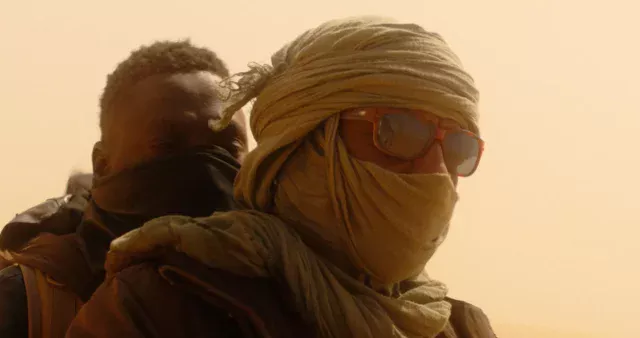
Roland Edzard’s rugged new feature doc Mountain Of Gold (a world premiere in Nyon) begins with a few lines of text: “In 2015, smugglers discovered the Tchibarakaten gold vein on the border between Niger and Algeria…the Central Sahara Gold Rush began.”
The French director takes us into the heart of that gold rush. The characters in the film are “re-enacting their own story.”
“It was a long process to meet the people and to make them [agree] to be part of the film,” he tells BDE.
Edzard, who spent part of his childhood in the Algerian Sahara in the 80s, was venturing into a world where, as he puts it, “it was difficult for white people to go.” On his first trip, he was dressed as a Tuareg so the colour of his skin wouldn’t be visible. He discovered misery and deep poverty but that wasn’t what he wanted the film to be about.
“I met this boy, Moussa, after two weeks. When I met him, I felt I had found the way to do the movie…even if you are poor, you can have big dreams. He was speaking a little English. I met his friends and all his world. I told him I would be coming back with a bigger camera and more people to do the movie.”
Nonetheless, when he first returned and tried to shoot, his protagonists told him, “we don’t have time for a movie, we need to work.” That was why he ended up giving them contracts and paying them as if they were actors. However, they were going about their business in exactly the same way as they would have done if he hadn’t been there.
At the mine, the gold diggers and the film crew were sometimes venturing up to 50 metres underground. “I was with the camera and after 20 metres, I was totally tired. I had to go up again…so we decided to do this [scene] in a smaller mine, only 15 metres [underground],” he gives an example of how the re-enactments worked in practice.
On another occasion, the director’s assistant didn’t want to go underground with the miners when they were carrying dynamite – so this scene was also later staged, above ground.
Then there was the moment in the camp when the miners were about to fall asleep and Edzard asked them about women. “It’s not really re-enactment. They are speaking about their own lives,” he says of the responses he orchestrated.
Everything that is re-enacted, from the discovery of gold to the tense moments when the water ran out, is based directly on real incidents which had happened shortly before.
At one point when he wasn’t actually on-site shooting, one of the gold diggers died. “I was not there but they explained to me how it happened. I asked them to re-enact this scene…”
At another moment, a fight breaks out. “I saw a fight but from far away…I was not with the camera at this time. I understand it [the fight] is about the water. There is someone who steals the water. OK, it is growing in my head and I asked them, can they do it [stage the fight again] for use for the camera.”
The miners were “happy to do it.” Edzard gave them “simple instructions’ and then said ‘action.’ The subsequent violence seems very real.
Edzard has made fictional films in the past, among them The End Of Silence which premiered in the Cannes Quinzaine in 2011. Ask if he regards Mountain Of Gold as drama or documentary and he gives a clear answer.
“The movie in itself is a documentary because it is real people in a real situation and it’s real life,” he states. “But it’s a documentary that I did like fiction…I didn’t want to explain but to be inside [the story]. I can say it is done like a fiction [film] because I say ‘action’ and I say ‘cut.’”
The director explains that everybody at the mine participated in the movie. He didn’t bring any outsiders. His protagonists were already there. He didn’t understand their language and so had no control over what they said. “I had a translator who explained me after the scene what they were speaking about.”
Moussa and the others may have been miners, not actors, but they quickly adapted to the presence of the camera. They realised they were telling a story drawn directly from their own lives. It helped that their memories of the fears and hardships they had endured were still fresh. There were times when the lines between fiction and documentary became very blurred indeed. For instance, at one point, the military really did steal the water from the miners.
“The reality of their lives was changed by my presence,” the director suggests of the way that scenes intended as re-enactments actually ended up happening for real.
Edzard dedicates the film to his film to his architect father “who raised me in the Sahara.”
“He died at the moment I was finishing the movie. I didn’t have the time to show him the finished movie. My father – people remember him, the Tuareg people. I have an adoptive brother who is a Tuareg. My childhood taught me how to live a very simple life in these conditions. For me, it was not so hard.”
Shooting conditions were as arduous as you might imagine. “There was the sun, the dust…it was hard. [But] it was very exciting,” the director, who was also doing the photography, remembers. He was using a heavy camera. There was never any sense he was trying to shoot on the sly. Everyone was aware that he was there.
Mountain Of Gold was produced through Geko Films and Wrong Men. Edzard himself is now contemplating another Sahara-set project, about the “first time the white people come to the Sahara and confront the Tuareg people…I want something like a Western but this time it is fiction, real fiction!”