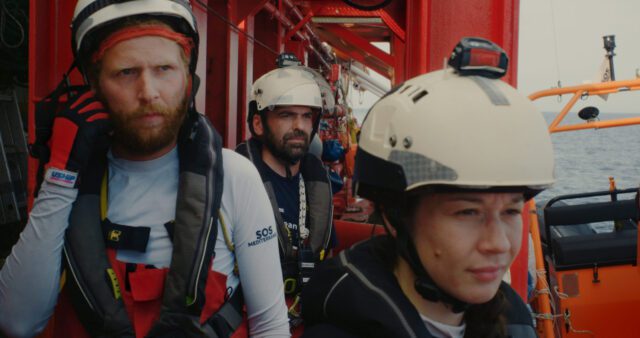
The Ocean Viking has often been in the news in recent years. It is the ship chartered by humanitarian organisation SOS Méditerranée to rescue migrants fleeing by sea from Libya. It has been impounded, harassed by Libyan coast guard vessels and criticised by European politicians – but it has saved countless lives.
For six weeks French filmmaker Jean-Baptiste Bonnet accompanied the ship, and his voyage is the subject of the feature documentary Save Our Souls, a world-premiere in the Grand Angle programme of Visions Du Réel.
“I was thinking that this boat is the first place where people who try to cross the Mediterranean Sea meet Europe,” the director reflects on what led him to make the film.
Bonnet was the producer as well as the director of the film (made through his company, Habilis Productions). He was also doing all the shooting himself. He didn’t have a sound recordist, relying instead on a microphone on his camera. What’s more, the filmmaker negotiated with SOS Méditerranée for over a year in advance of going aboard.
“They knew quite well my project, my position. I think I was well accepted by the crew. We spent a long time [together]. I trained with them on [how to carry out] the rescue processes. We lived very closely altogether in a small space. It was about 30 people on a not so big boat.”
The Ocean Viking was built in 1986 and is showing signs of age. Its cabins are tiny. Nevertheless, there was room for Bonnet. “This crew knows very well how to live on a boat,” he says of the NGO members when they’re at sea. “It’s like a community. I was quite well accepted.” The NGO works with The International Federation of Red Cross collecting testimonies from the survivors. They are advised on how to lodge their asylum claims.
Bonnet’ shooting style is observational and discreet. Early on, he shows the crew members spending lengthy periods looking at the horizon through their binoculars, trying to spot a boat carrying asylum seekers.
“I come from photography. I’ve been trained as a photographer and I’ve been a cinematographer. It’s true that I like this position – to be in the middle of a scene as an observer,” Bonnet explains his approach. “Maybe I am discreet but my camera is not so small…I don’t try to hide or anything like that. I am there. It’s very important, of course, to make sure the people you are filming have agreed to be filmed. Once I have this agreement, I film quite freely. They can always tell me that I should stop. That allows me to be quite close to them.”
Getting “close” was also a matter of necessity. With the wind and the waves, the ship was very noisy. If he wanted to hear what his subjects were saying, Bonnet knew he couldn’t stay too far at a distance.
There were some hair-raising moments along the way. At one point, a Libyan coastguard ship threatens the NGO workers. “They shot in the air with Kalashnikovs. It was very aggressive. They were really close to us. I didn’t have so much time to be afraid, and I felt quite safe being on a European boat – but that was a bit naive from my point of view.”
The incident happened in international waters and the behaviour of the Libyans was “totally illegal” but it’s not too difficult to imagine that these actions may be repeated in the future. One day, the director suggests, “one crazy guy” could easily overstep the mark. “They [the Libyan coastguards] are more and more aggressive,” he underlines.
The Ocean Viking may be relatively small but it is still equipped with food, medicine, clothing and lifejackets for those who are rescued. “This NGO is very well organised. The food and lifejackets are in boxes on the top of the boat.”
On the mission that Bonnet films, 92 asylum seekers were welcomed on board from their overcrowded dinghy. There were nine women among them. The women had their own living quarters and Bonnet wasn’t allowed to film there. “That’s why we don’t see so many women in the film.”
Having the survivors on board changed the routine. These survivors were very willing to share details about the often horrific experiences which led them to flee their homelands.
“I never asked ‘could you tell me where you come from.’ They came to me, or to crew members. They wanted to tell their stories because this was the first time they could do it.”
In the documentary, Bonnet uses “a linear narrative, the most natural choice.” He follows the chronology of the voyage.
“We know what is happening. This film doesn’t tell new things…this is not news,” Bonnet adds of continuing European indifference to the plight of the asylum seekers.
Once the survivors disembark, the link with the Ocean Viking is broken. “The role of the NGO is to disembark them in a safe port in Europe. But then another journey starts and we don’t keep [any more] contact.”
Bonnet has worked as a script doctor on both fictional and documentary movies. He has collaborated on movies by some of France’s best-known auteurs, Jacques Audiard and Arnaud Desplechin among them. He decided to create his own company in 2020 to push his own films and quickly discovered that he enjoyed producing as well as directing. “I love doing these two roles,” he says.
International sales on Save Our Souls are handled by Andana Films. The doc was made with the support of France Télévisions (25 Nuances de doc), the SCAM Brouillon d’un Rêve Scholarship, the Normandy Region (writing assistance, development assistance and production assistance), the CNC and Procirep-Angoa. The film has its world premiere at Visions du Réel.
On early Saturday evening, the director took a walk through Nyon with Elliot Guy (SOS Méditerranée) and “the audience just behind us, following us, with earphones.” This, then, was a change to the usual festival press conference routine. “I’ve never done this before,” Bonnet confides of the ‘walking interview.’