

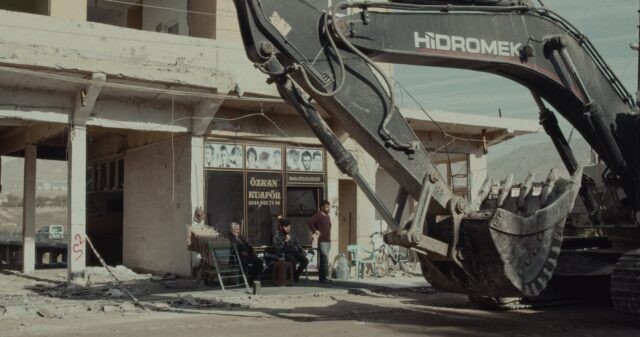
As Burak cuts the hair of the male townsfolk, occasionally girls too (although he is not used to cutting long hair), the bulldozers are outside his establishment, removing the pavement, razing the town to ground level.
Shepherdess Rengin meanwhile is preparing for a move to a new town higher in the hills, above the line of flood water that will soon engulf her home.
The decision by Turkish authorities to build a dam in the Kurdish region around the 12,000-year old town of Hasankeyf is irreversible. It is also devastating for the townspeople as ancient traditions and ways of life will be eradicated in one fell swoop.
On the face of it, the town to which they are relocated may offer larger houses and gardens, but it is designed along stark and uniform lines and, as we see when the film returns to the region one year later, there is nothing to remind the new residents of the culture they left behind. Everything they once held so dear is now gone.
“These are strong words, but we are talking about cultural genocide,” co-director Natalia Pietsch tells BDE about the devastation suffered by the town’s inhabitants.
Taking to Business Doc Europe in 2024, Polish producer Katarzyna Kostecka of LARMO stressed how, “while presented as modernization, it’s a calculated erasure of the Kurdish identity.”
Protagonist Rengin, also in Nyon for the film’s world premiere, sums it up further. “Our whole life is gone. Our childhood, our culture and every memory is gone and they won’t come back. It’s a big, big loss for me.”
What type of film did directors Grzegorz Piekarski & Natalia Pietsch initially set out to make? Certainly not a political one, Pietsch stresses, until the political implications of the situation hit home. The area is populated exclusively by Kurds and Arabs, the ethnic groups directly affected by the flooding their homeland.
That said, Grzegorz Piekarski emphasises how the people of the town approached their dilemma in sanguine fashion, which in part informed his and Pietsch’s approach to the film.
“Some serious subjects are often are told in a very serious and heavy way. But when we met the people in Hasankeyf, we realized how they are dealing every day, it’s not heaviness. They’re searching for some lightness and sometimes even humour. So in making the film, we didn’t wanted to make it black, black, black, black, but just to show that there are also other colours, and where it’s possible to also show some lightness.”
Of course, a great irony is that the grimness of the story – the demolition of a town, the relocation of the people, the flooding of a homeland – paradoxically makes for visually engaging cinema. How do the filmmakers reconcile this?
“It’s difficult. It’s maybe a little bit in the way that I originate from cinematography. Even if the story is sad and dramatic, this is how you perceive the world,” Pietsch says of her instinctive sense of aesthetic. “This is something that you cannot get rid of even if you want to.”
“Maybe it’s a kind of paradox, but when you see the world through the camera, you have something between you and the situation and it makes it easier to be in a situation,” adds Piekarski. “I think it would be harder for us to be without the camera. Somehow it helps us with emotional management.”
That said, after the flood waters came, so did the emotional trauma of displacement. The sense of loneliness in the new town was palpable, as was an increasing sense of depression as people assessed a new life without any cultural markers. Also, the new townsfolk were forced now to live within a community of folk they don’t know. As we see in the film, the place resembles a ghost town as people remain inside all the time, a far cry from their former bustling existence.
“People for generations were [previously] living next to each other and it’s natural that you have a neighbour who is your friend,” says Pietsch. “Then because of the fact that the new houses were [allocated] by lottery, you lost your previous neighbours, you lost the connections, and the people started to feel really, really lonely.”
“Every house had its own soul,” says Rengin of life before the flood. “It was different. It was beautiful. But now in new Hasankeyf everything is same. For me it’s like a dystopic movie.”
Rengin’s father, also a shepherd, could no longer work as there was no land to work on, and hence the family had to sell its sheep and goats – its livelihood.
Pietsch emphasises the obvious political undertow. “It is a very clever way to make people dependent…The houses maybe look new, more modern. You have a bathroom and toilet inside… but now they have no job. They are totally dependent on the government. So it’s a very clever and small tool of a dictatorship.”
How did the filmmakers share duties in telling such a complex story? “I think it started in a very intuitive way because at first we were thinking that I would be director and Natalia would be cinematographer,” says Piekarski. “But the longer we worked together, it seemed that I’m becoming cinematographer as Natalia is becoming the director as well.”
“And also as we are a small budget movie, we went often alone,” adds Pietsch. “Sometimes we go two of us and sometimes it was only Greg or only me going to Hasankeyf. So it’s natural that both of us had to do cinematography and sound because there was no other person.”
“So if you ask a question about how we direct in terms of being a team leader, there was no team, it was just us,” she signs off.





