What makes Alexander von Humboldt an especially intriguing figure for Svatek is the parallels between their lives. “That drew me deeper and deeper into the research rabbit hole. He called himself half-American, he’s German. I am half-American, half-Austrian. We have the same birthday. We are both gay men, travelling [widely]…”
Brooklyn-based filmmaker G. Anthony Svatek first heard the name ‘Humboldt’ when he was a kid growing up in Austria. Back then, he knew little about him other than that he was a scientist. It was much later, in 2015, that Svatek, by then living in New York, read the best-selling biography, The Invention Of Nature, and became hooked.
“That got me interested in him…and made me realise that he had a massive influence on western history and science,” the director says of the man who has inspired his new feature documentary, Humboldt USA (premiering in the International Competition in Nyon, before its North American premiere at the Museum of the Moving Image’s First Look).
There was a time when Alexander von Humboldt (1769-1859) was among the most famous people in the world, as celebrated in his own way as Napoleon Bonaparte, His name was “everywhere” because he was so well-known. Streets and parks were named after him. There were statues of him everywhere from Berlin to Chicago to Venezuela.
What makes him an especially intriguing figure for Svatek is the parallels between their lives. “That drew me deeper and deeper into the research rabbit hole. He called himself half-American, he’s German. I am half-American, half-Austrian. We have the same birthday. We are both gay men, travelling [widely]…”
This is an essay-style documentary with a playful, poetic voice-over in which Svatek uses Humboldt’s story as a way of exploring contemporary environmental issues. One of the scientist’s most famous quotes, cited in the film, is that, “everything is interconnectedness.” Taking this as a starting point, Svatek asks searching questions about the relationship between technology and nature in contemporary society.
“I thought the strongest way to do that is in the form of a love letter from me to him, showing him what is left of his vision of an interconnected world and how technology has totally changed this idea of a holistic ecology that he proposed.”
Elements about Humboldt took the filmmaker by surprise. “As happens with people, when you get to know them better, things pop up that you don’t expect.”
For instance, the scientist was a forward-thinking radical – but he did work (at least indirectly) in the “service of these colonial powers that he was criticising all the time throughout his writing. He was both benefitting from them and criticising them.”
During his six-week trip to the United States, Humboldt met Thomas Jefferson but “stayed silent” about the “enslaved people” the US politician kept on his plantation in Monticello. There may have been diplomatic reasons for this, but he was always calling for others to speak out against injustice.
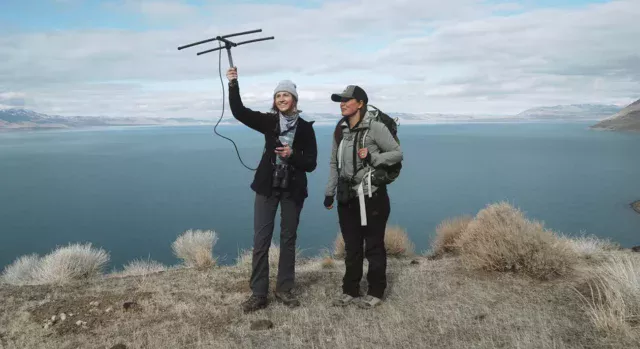
In the documentary, Svatek showcases three places in the US that all still bear the “Humboldt” name. He follows modern-day scientists and engineers in the Humboldt Redwoods trying to train AI to interact with trees that are thousands of years old and potentially to learn from them. There is footage from the Nevada Desert of Humboldt County where attempts are being made to reintroduce bighorn sheep. Another strand of the film follows Buffalo residents protesting against the massive highway that has been built over the Humboldt Parkway, a tree-lined street that used to be one of the city’s most cherished green spaces.
“I just don’t believe in technology saving us. That is not how I think we are going to get out of this mess,” the director states. “That being said, the storyline in California with the engineers who are trying to develop an AI-system based on ecology and that connects technology and nature directly…I find that really fascinating.”
The redwood trees are huge. “They’re extremely imposing,” the director agrees. “Anyone who has seen them describes them in their own way as having an overwhelming presence. I personally find them quite intimidating and a little eerie…being in the presence of these trees that are massive and thousands of years old, you really feel like you’re being watched, and you are being sensed.”
The film includes archive footage of several of the trees being cut down. Seeing the giant sequoias being felled seems almost like watching an execution. “It’s all in the name of progress and enrichment of the nation. That was a topic Humboldt was criticising and correctly identifying as harmful to communities and the climate. He was one of the first people to propose that humans could create climate change through the destruction of forests and emissions of gases in the atmosphere.”
Svatek accepts that Humboldt’s climate change ideas couldn’t be thought “all the way through,” because he was writing in a period before fossil fuels became the western world’s source of energy. We are now, (the director notes) “on the opposite end of this massive, industrially technologically-driven change that has absolutely altered both the planet and our relationship with the environment.”
The film includes some remarkable shots of helicopters airlifting bighorn sheep back into Humboldt Country (where they once used to thrive before their numbers were “decimated” by disease, hunting and livestock farming). The local tribal community and the state wildlife department are now trying to bring the sheep back – but it isn’t easy.
“To me, as somebody who lives in a very urban environment, it feels extremely foreign and strange and I wanted to throw viewers into that scene without knowing what to expect and how to understand it,” Svatek says of the “very odd” images of the sheep dangling underneath the helicopters before being dropped onto the desert. The director talks of the “violence and absurdity” that sometimes goes hand in hand with conservation efforts. Environmentalism, he points out, sometimes involves “doing this really, hard, dirty kind of difficult work that is often violent too.”
The director began work on the documentary in 2019. Support came from a range of sources including, among others, the Ford Foundation and the Maysles Documentary Center.
“It was very much a DIY endeavour. Early on, my producer Elijah Stevens [from Space Time Films] came on board. We really pieced it together over the course of many, many years.” Svatek moonlighted as a collage artist and sold some of his work to help fund the movie.
The film is now expected to travel widely on the festival circuit. Svatek will then look to bring it “to the communities where it was shot.” Distribution will follow.
“As conceptual as the project is, I do feel it is very accessible, humorous and humanist as well,” he says of a project which looks bound to jog memories about the continuing significance of the now-forgotten man who was once the most famous scientist in the world.