German journalist Ulrich Tilgner, now in his late 70s, is a near legendary figure with a generation of German and Swiss TV viewers and newspaper readers. As a war reporter, he has covered many wars and revolutions. He is an outspoken figure too – someone prepared to confront raw and uncomfortable home truths about the bitter consequences of US and European interventions in the Middle East and elsewhere.
In Edgar Hagen’s new film, The Roots Of Madness (screening in National Competition at Visions Du Réel), the filmmaker accompanies Tilgner on a journey back to Afghanistan, Iraq, Syria and beyond.
“He is a child of ’68. He was born in 1948, after the war,” Basel-born director Hagen notes of what drives Tilgner, someone who grew up in the period when US support had helped bring prosperity and democracy to post-Nazi Germany.
In the late 60s, Tilgner was a student when a fellow student Benno Ohnesorg was shot dead by the police during protests against the Shah of Iran’s visit to Berlin. Unlike some of his associates, he wasn’t radicalised by the killing but he was nevertheless determined to work out what was going on. This led him as a young man to visit Iran for the first time. Thus began his life-long fascination with the Middle East. A decade later, in 1979 during the Islamic revolution, he made his first film, Schah Matt.
“The special thing about him is that he always tried to understand the people, not only the politics,” Hagen observes of the journalist’s humanistic, ground-level approach to his work.
Hagen first met Tilgner by chance a decade ago when Hagen was staying near Locarno, working on a script, and the revered journalist (who was then working for Swiss TV) turned out to be a near neighbour.
This was around 2015, a period when Hagen was trying to make sense of the unfolding refugee crisis in western Europe.
“It was not a plan to meet him but when we started talking, I asked him about the summary of his experience and what he had seen in the Middle East. We entered in a very interesting discussion.”
This set in motion the events that eventually led to The Roots Of Madness.
“It was always clear that this would not be a portrait of Ulrich Tilgner.” Hagen makes it clear the real subject of his documentary is not the reporter, but why so many people have become refugees. Tilgner helps him explore this question.
Going to the Middle East together was a way of finding “the missing pictures” – a chance to understand the roots of the refugee crisis and why so many people were desperate to leave the region in the wake of war and western invasion.
Their travels took them first to Jalalabad in Afghanistan. That was in 2017/2018, before the US forces left. It was dangerous to go there. “Islamic State was present and the Taliban had been fighting with the Americans.”
The main filming, though, was later, in 2022. Hagen argues the chronology is not the most important factor. He wanted to make a film about the “patterns,” and the way the same experiences recur.
Hagen had fixers in each country they visited. He had to sort out visas, a considerable challenge in itself. When he and Tilgner went back to Afghanistan, after the US departure and with the Taliban returned to power, they were warned that they would be there entirely at their own risk.
Tilgner felt a “profound connection” to the Afghan and Iraqi people. He wanted to bear witness to the suffering they had endured. As Hagen notes, he is driven far more by compassion than by egotism.
In the documentary, Tilgner reconnects with certain figures he hasn’t met for 20 years, among them the heroic Dr Eman, who was still working in a hospital in Baghdad but keeping a very low profile. He also discovers facts about the battle for Fallujah that showed events there in a new light.
“I realised that in the western reporting, everybody was in Fallujah was a terrorist,” Hagen says. Even Tilgner was wary about visiting such a volatile area but when he meets some of the inhabitants, they give him a very different perspective on the conflict. Hagen also eventually found some archive material shot by Iraqis. (Almost all of the material seen in the western media was shot from the perspective of the US army.)
Over his years as a journalist, Tilgner had become increasingly critical not just of western behaviour in the Middle East but of the US and European media’s stance. That was one reason why, in 2007, he was in open conflict with his bosses at German broadcasters and with the German secret services (whom he felt were trying to control him).
This wasn’t an easy project to put together. In the end, the financing came almost entirely from Swiss sources. The expected German backing fell through – partly because commissioners remained wary of Tilgner.
“The idea was to co-produce with Germany but I realised that I had to produce this film on my own,” Hagen states. He decided that if he was, for example, crossing the Syrian border by night or visiting remote and dangerous places, he needed to take the responsibility himself.
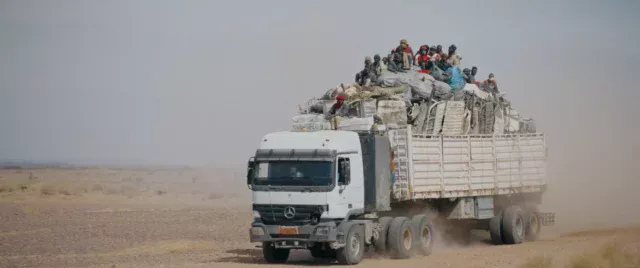
In Niger, one of the production managers was Aïcha Macky (a leading Nigerian filmmaker in her own right whose credits include Zinder and The Fruitless Tree). “Aisha was recommended to me. We very easily made contact and she understood completely what we were trying to do.”
In Iraq, their local fixers engaged a famous TV actor as a driver. This meant that whenever the filmmakers had to pass checkpoints, security forces would ask selfies or signatures and then wave them through.
“The big question today is how is it possible that we are giving up the values that are the basis of our well-being,” Hagen reflects on the continuing cycles of violence across the Middle East and beyond – and the refugee crisis they have sparked as people look to flee war torn and impoverished countries.
The project was first pitched at Visions Du Reel in 2018. There was some controversy then over western filmmakers telling stories about the experiences of Iraqi, Afghan, Syrian and African refugees.
“For me, it’s interesting to come back to Nyon with this film. I realise that the programming team like the film…[but] the first discussion we had at the pitch in 2018, people were saying please don’t come in our countries and that we will tell our stories ourselves,” Hagen remembers. “I think we have to tell this film from a western perspective, from a self-critical perspective. We have to go there to see the mess that was created. We have to do this work…it’s a painful process but we need this understanding of ourselves.”