Ghost Town (screening in official selection in Vision Du Réel) joins the growing ranks of documentaries and docudramas set in taxis. The setting is Kamaishi, a small Japanese town where the locals haven’t been able to exorcise memories of the devastating 2011 tsunami. As we discover, the catastrophe still dominates the conversations and even the dreams of the local people.
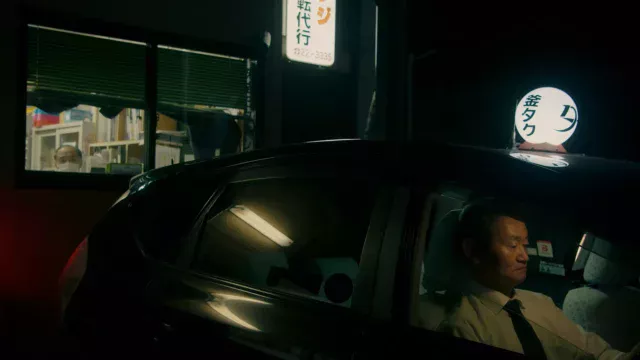
British director Katharine Round came to Kamaishi after reading a newspaper article about taxi drivers picking up passengers who, strangely, turned out not to be there. Her film was shot in late 2024, working with one of the town’s main taxi firms and following residents’ trips with specially rigged cameras while she followed in a car behind.
In their conversations, the many different passengers often appeared to be picking up on exactly the same themes, talking in intimate detail about their memories, dreams and their feelings of profound loss and yearning.
“My main thing was ‘let them get in and have a normal taxi journey and we will only really get involved if they say something we need to pick up on a bit more,’” Round describes her operating method. “What was very beautiful about the conversations, which we were filming over a period of time, was that it became this process of expansion where the stories moved around these different people and spaces. It was a really fascinating process for me just to observe the tales being told, re-told and built on.”
At times, the conversations touch on a sense of the uncanny.
“I had a very open mind when I was filming,” Round replies when asked how much credence she gave to the passengers’ ruminations on the paranormal. “It’s a really fascinating idea that you pick up a passenger who wouldn’t be there…it’s this idea of presence and absence and, of course, of the long tail of trauma – and these are all things that are very interesting to me as a filmmaker.”
When the filmmakers were in Kamaishi during pre-production, meeting the drivers and passengers, no-one talked about ghosts. Once the filming began, though, there was often a strange, spectral undertow to their conversations. “I think I realised just how western my thinking [is]. You got very, very aware of your unwritten assumptions that underline your own mentality…there is a very beautiful way of seeing the relationship between the living and the dead, and it’s not necessarily about debating the existence of ghosts – it’s about having a bit more of an expanded version of life and death and how you relate to it.”
In the west, ghosts are seen primarily as objects of dread. The Japanese perspective is very different. They’re regarded as benign and sometimes even playful. “The number of different kinds of spirits and ghosts in Japanese culture is vast,” Round notes.
In the confession booth-like atmosphere of the cab, the passengers use poetic language about their intimate memories of the disaster. They also discuss their dreams.
“I think taxis are a fascinating space. It does enable you to talk about almost anything,” Round suggests that this openness between driver and passenger can be found anywhere in the world. These are “time-limited journeys” in which people who may never see each other again are thrown into a close but brief companionship.
There was no guarantee the conversations would rise above the banal. “That was my big fear – that people would get into the taxi, go to the local corner[shop], pick up a loaf of bread and that would be that.”
One of her key collaborators was journalist and filmmaker Shiori Ito, who was involved in advising, translating and fixing, and also appeared on camera as one of the passengers – ‘The Visitor.’ (Ito’s own documentary, Black Box Diaries, has shown all over the world).
“I don’t speak Japanese beyond a few basic phrases…it was mainly Shiori. For most of the conversations, we would sit next to each other and she would literally speak what was being said. I would write it down.”
At the end of the day, Round would send transcriptions to a colleague back in the UK who would correct them and put them into the English. That meant she quickly had a “map” of what had been said during each journey.
Alongside the taxi journeys, the film also includes footage of wild deer gathering at night-time in the streets and outside the old power plant.
“The deer was something that nobody mentioned to us at all in the many years we were working on research for this film and getting to know the drivers and their lives. But then the minute that we turned up to the town, it was like, hang on, they were everywhere! No-one had mentioned this entire town has beautiful deer wandering around the city centre. Certainly, in the first few days we were filming, it felt like everything we did, they were there.”
Some regard the deer as “messengers from the gods.” Others point out that the town is quieter since the disaster and so the deer are less fearful about coming down from the mountains. “Of course, we filmed them…it is very striking, really fascinating to me, how that wrote itself into the film.”
In Kamaishi, like everywhere else, taxi drivers are predominantly male and skew older. The firm had one female driver, but she didn’t want to be in the film. What’s more, the town doesn’t seem to have traffic jams or angry divers. “It’s certainly not London,” Round agrees. At night, roads are empty. That means the journeys seem stress free.
The drivers are soulful, reflective characters, always ready to listen to their passengers’ stories.
“They definitely all have quite distinctive personalities. I felt they were all fascinating in different ways…they were likeable, warm people.”
Some have had difficult pasts. Others might be solitary figures getting over the break-up of relationships. Round acknowledges they could easily have found it “quite strange” to be collaborating with filmmakers from the other side of the world but “there was something in it [the film] that they really embraced.”
Ghost Town received backing from University College London (where the director is a lecturer in ethnographic and documentary film), Tohoku University, Al Jazeera English and The Great Britain Sasakawa Foundation, that supports cooperation between the UK and Japan. “Like any other independent film, it was piecemeal funding. We got to each stage and then raised funding to get to the next stage,” is how the director describes the financing process.
“It was a bit of a labour of love for all of us,” she continues. “From an very early stage, it was always really a core idea that we were going to work within the taxi space.” The director and her cinematographer Jamie Quantrill experimented with different cameras and lenses, eventually opting for small sized equipment (“the Blackmagic equivalent of GoPros”). These cameras weren’t hidden but weren’t obtrusive either.
“The conversations were completely spontaneous,” Round says of the intimate and often surprisingly lyrical stories shared by the passengers as they travelled around the deer-filled town. “What was being shared was beautiful. There is no other way to say it, I thought it was absolutely incredible.”