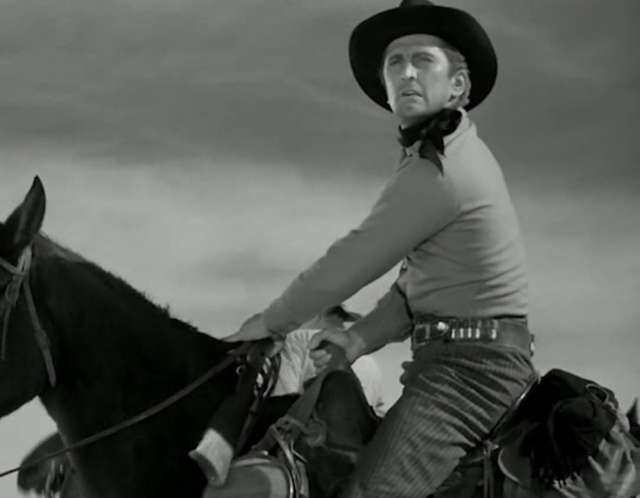
US film director Raoul Walsh made close to 150 films, and Argentinean director/film professor Nicolás Zukerfeld, who teaches at the Universidad del Cine in Buenos Aires, has seen a great many of them, he tells BDE. But there was something that Walsh may or may not have said which became an obsession for Zukerfeld, and which he was determined to get to the bottom of…
The first part of Zukerfeld’s new film There Are Not Thirty-six Ways of Showing a Man Getting on a Horse (a European premiere at Visions du Réel this week) contains snippets of dozens of Walsh movies, mostly westerns. He offers a prolonged montage of cowboys, cavalry officers and native Americans leaping, clambering and falling on or off horses. There are also scenes from other Walsh films of characters walking through doorways.
The title of the film (and surely the most intriguing at the festival) comes from a remark that the late, great director allegedly made. Whether the director actually did say those words remains open to debate. Its original source remain highly ambiguous. Both Walsh and the many film historians and critics who’ve written about him had a strong taste for embellishment. Neither were they keen on footnotes. They often seemed to be working on the principle famously enunciated in The Man Who Shot Liberty Valance (1962), a late western from Walsh’s rival John Ford – “When the legend becomes fact, print the legend.”
Nevertheless Zukerfeld became obsessed by the phrase. Before making his film, he hadn’t seen that many of Walsh’s films beyond well-known favourites like They Died With Their Boots On and one or two others. However, he quickly became a Walsh devotee.
“The thing that interested me in Raoul Walsh was that kind of transparent, invisible language that he has…and that is different from [the language of] John Ford or Howard Hawks, who are the popes, the masters or the fathers,” Zukerfeld says. “Raoul Walsh has some kind of mystery for me, some kind of mystery language. That is why I became an admirer.”
Zukerfeld’s original idea was to have his documentary composed entirely of footage from Walsh’s films. Then, he decided also to investigate the mystery behind Walsh’s phrase about the numerous ways a man can be depicted mounting his four-legged friend. This puzzle takes up the second part of the film.
“I realised that the investigation had to be in the film, so I decided to make a two-part film in three chapters” Zukerfeld remembers. He talks of the “dialogue” between the first part of the film, which uses only found footage, and the second part, which is based around a verbal account of the investigation and which he likens to the “B side of a record.”
“There is a narration going on, an eccentric narration,” Zukerfeld says. One of his inspirations was Canadian artist and cinephile Guy Maddin’s The Green Fog (2017) which uses found footage from old TV series and movies shot in San Francisco to re-interpret Alfred Hitchcock’s Vertigo.
Many of Zukerfeld’s former students have now watched the film. They have told him that it makes them nostalgic for his old classes about classical cinema.
The film professor currently has another project on the boil, a fictional zombie film which will have actors and classical narration – and will therefore be the polar opposite of its predecessor.
When Zukerfeld was preparing his film, he used to type the phrase “there are not 36 ways of showing a man getting on a horse” into search engines. Nothing would ever show up.
Now, if you put those same words into a computer, you will be directed straight to links about Zukerfeld and his film. By a nice irony, he himself has therefore become the main authority for information about a quote that Raoul Walsh may never have actually made.