

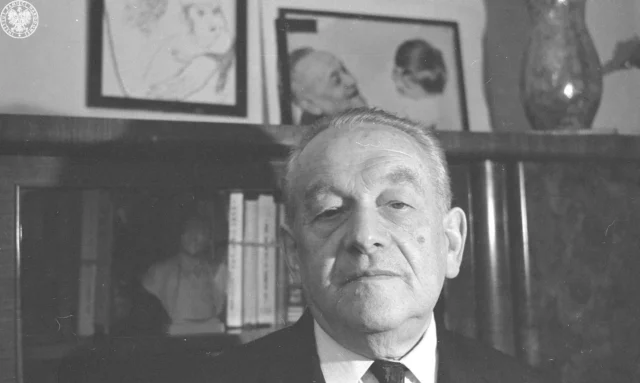
When Polish director Tomasz Wolski was working on his 2020 film, An Ordinary Country, which depicted Polish society from the 60s to the 80s through the distorted prism of secret service surveillance footage, he came across the name Leopold Trepper.
“I didn’t know who this guy was,” Wolski says of the former Soviet military intelligence officer who became the main protagonist of his new feature doc The Big Chief, a world premiere in Burning Lights Competition at Visions du Réel.
A French TV crew had filmed Trepper, then aged 70, in Poland in the early 1970s but all their footage had been confiscated without being broadcast. Now, Wolski had found this footage and had also discovered further details about Trepper’s extraordinary life story. He was a spy and former war hero who had later fallen foul of the regime. In particular, it appeared the fact he was Jewish counted against him.
“For me, what was really interesting was that he [Trepper] had had to deal with all the consequences of war. He had to deal with the major events and movements that happened in Europe in the 20th Century, like fascism, Stalinism…”
Wolski admits that even after spending seven years working on the new film, he is not sure that he fully knows or understands Trepper. “I am not sure about him. He was the chief of the biggest spy network during World War Two…when you deal with spies, you don’t know who you deal with.”
There were things about Trepper that didn’t add up. In the war years, he was based in France and Belgium (he had been sent there in the late 30s to set up the so-called “Red Orchestra” spy ring) but his French wasn’t that strong. In his use of the language, he still made mistakes. His cover was running a raincoat company.
Trepper was providing vital intelligence for Stalin and the Soviet Union about Hitler’s plans. His information helped the Soviet forces make the right decisions during the Battle of Stalingrad.
The Gestapo caught him in 1942 and the Red Orchestra was dismantled. At this point, Trepper began serving as a German consultant, giving such unreliable advice to the Nazis that he remained helpful to Moscow. But he was never tortured and somehow managed to escape.
Had he betrayed former friends and allies? After the war, Trepper was accused of treason and spent 10 years imprisoned in Russia. Then Stalin died and “things changed very quickly for the better.” Back home in Poland, he was provided with an apartment and a salary and became President of the Association of Polish Jews. His family grew. He had children and grandchildren.
Then, in 1968, the wheel of fate turned against him again. After 10 tough but happy years, as he put it, “tragedy returned.” Anti-Semitism revived in very ugly fashion. His son, who had been a prominent professor, was suddenly removed from his post and offered a job as a janitor. Poland was keen to get rid of its Jews. Many left the country but Trepper was forced to remain. Whenever he filed a petition to join his children abroad, his request for a visa was continually rejected. His every move was followed by the Secret Police.
Foe director Wolski, this was a fiendishly difficult story to untangle. It was difficult to corroborate Trepper’s stories. There were many conflicting names and dates.
“I cut this story for three parts to somehow simplify it but at the same time not to tell it in a very conventional way.”
Ask Wolski about Polish anti-Semitism and he replies that “it is a very complicated issue. Actually, there are not so many Jews left in Poland because this 1968 anti-Semitic campaign was the last stage of this movement that started after the war. About 200,000 Jews left [Poland] from 1945 to the 1970s. At that time, when Trepper would have liked to leave and his family was forced to leave, they were the last ones who really believed they could live in Poland as Jews. After this campaign, in the beginning of the 70s, there was a point where this was not possible.”
A French committee wanted to help Trepper get out of Poland. Only after a concerted protest campaign on his behalf was the former spy allowed to leave for Israel in 1974.
The Big Chief is one of a number of recent documentaries in which Wolski has raked over the ashes of recent Polish history. In follows on from An Ordinary Country and 1970 (2021) and A Year in the Life of a Country(2024). In all this work, he talks of trying to “open new chapters.”
“I am looking to show the history [of Poland] from different perspectives. With An Ordinary Country, we could see the point of view of the Secret Service and how they saw Poland at that time. The same somehow with 1970 – mostly documentaries about those events were about victims [but] I wanted to look through the eyes of the perpetrators, the people responsible for the tragic events. The Big Chief is also a surprising point of view. In Poland, we think all the Jews were forced to leave – not many people know there were Jews who really wanted to leave but they were not allowed to. Also, Leopold Trepper is somehow a person who was erased from our history. I am constantly checking the books about war, about the anti-Semitic campaign in 1968 – and there is no such guy as Leopold Trepper in those books. For some reason, he is unknown.”
Like much of the director’s recent work, The Big Chief is archive based. Wolski sighs as he contemplates the many challenges he faced in securing the material he needed. His previous films were based largely around footage kept in Polish archives but, on this one, he was also dealing with big international institutions and some asked for eye-watering amounts – as much as €12,000 per minute. After the pandemic, prices rose even higher.
“It’s harder and harder to work with international archives,” the director notes. Many of these archives are used to dealing with filmmakers who want only a few seconds of footage, not with directors like him who construct entire movies around that footage.
It helped, though, that Wolski has such a close bond with fellow filmmaker, Sergei Loznitsa. He has helped edit several of Loznitsa’s movies. Loznitsa watched the film and gave comments. His producer and partner Maria Choustova helped Wolski secure archive material from the Netherlands. When Wolski was looking for footage of Stalin’s funeral, the Ukrainian auteur was also a big help. He had had made a film, State Funeral (2019), on that very subject. Atoms & Void, the company run by Loznitsa and Choustova, is one of the production companies behind The Big Chief, working alongside Kijora Film and INA.
The Big Chief is scheduled to show at the Krakow Film Festival later in the summer. In the meantime, Wolski is already hatching a fiction project called The Hungry Gap, about Poland in 1947, and another feature due to shoot this year called The Incident.





