

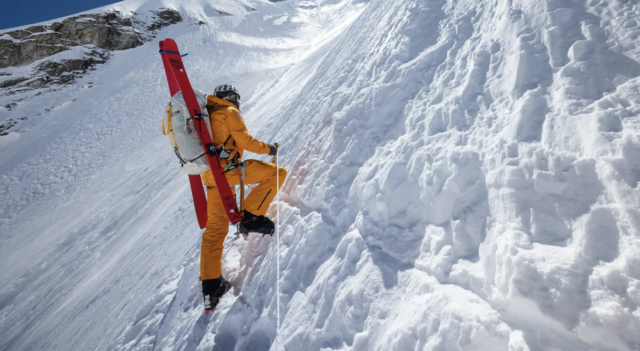
Early on in Everest: The Other Side (the latest National Geographic-backed film from Oscar winning duo Elizabeth Chai Vasarhelyi and Jimmy Chin), Vasarhelyi asks Chin, as well as climbers Jim Morrison and Hilaree Nelson, a fundamental question. The trio are planning to ascend Everest by the daunting North Face route, accessible only through China, and then Morrison will ski down the way he came.
“Why do it?”
“I am fascinated by these extraordinary athletes who, especially in this time of AI and social media, still [have] this essential human quality which is this audacity to dream,” Vasarhelyi explains to Business Doc Europe what she thinks drives the mountaineers. “Also, you have to couple it with this grit, determination and perseverance and almost craziness to do the work.”
“Why I started making this film is that I was interested in the lives of these individuals, I was very interested in what that experience is like for a woman.”
The film (a world premiere in Venice and also screening in TIFF) reveals the huge personal price climbers sometimes pay for embarking on expeditions like this, during which the smallest mistakes can be fatal and where there is little protection anyway against sudden freak storms or avalanches.
“You can shape and define your fate to a certain degree. We all think that as humans we get to decide everything. We don’t,” Chin reflects. “There is only so much you can control.”
The climbers know that what they are doing is not that significant on the scale of things, and yet, when they are on the mountain, nothing else seems to matter. They put their commitments of their families and communities on hold, spending months at a time away from home.
Viewers who watch the movie without knowing the backstories of the climbers are likely to be shocked by what unfolds here. It’s hardly a spoiler to say that death and tragedy are involved. At the same time, the expedition is clearly cathartic – a way of dealing with the traumas.
“The challenge of this kind of project is that it is so personal,” Chin suggests. “You feel the weight of your obligation to one of your best friend’s stories, telling it the right way. I feel an obligation to my dear friend Hilaree because I am putting a film out in the world that is her legacy.”
There were times when the emotions became so intense that Chin stopped thinking about the film at all. He pays tribute to producer Shannon Dill for sending a crew ahead of him when his main priority was to help a friend find a missing partner.
It’s a point of principle for the filmmakers that, as Vasarhelyi puts it, “when you are dealing with activities that have such risk, you cannot prioritise the needs of the film over the needs of the participant.”
Vasarhelyi points out how they stay in touch with the subjects of their documentaries. “We’ve remained in each other’s lives which is really hard,” she says.
It helps that National Geographic (with whom they struck a first look agreement after Free Solo) are so supportive. “I now realise how lucky I am to work with the same two female executives, Carolyn Bernstein and Courtney Monroe, making seven films over 10 years with two incredibly ambitious professional women who are also parents.”
This was a documentary with a very lengthy gestation. “Seven years,” Vasarhelyi says of how long it has taken to complete the project. The Covid pandemic made it impossible to enter through China and the expedition had to be put on hold. (Chin adds, though, that the Chinese authorities were “amazing to work with on this; they’ve been so supportive of the project.”)
In 2006, Chin had been part of a US ski descent of Everest with Kit and Rob DesLauriers. Last year, he summited Everest the day after his 52nd birthday – and believes he is a more “efficient” climber than when he was a younger man – and he is better at dealing with stress.
Chin’s ability to compartmentalise is evident. At one stage, there is a crisis with a team member who is badly injured but Chin still remembers to call his daughter on her first day at school.
“I attempted the direct North Face of Everest when I was 28. I was in really, really incredible peak form at the time but it was my first Himalayan expedition…I didn’t have the experience that I gained in the next 25 years,” he reflects. “You really can’t take the place of experience.”
One detail not included in the new documentary (but which may eventually warrant a film on its own) is that, in 2024, Chin and his colleagues discovered the boot belonging to Sandy Irvine, the British mountaineer who had accompanied George Mallory on the ill-fated 1924 Everest expedition.
“It’s a great story but it just didn’t fit. This is the whole thing about making movies…every second had to compel you to the next second. While it is so thematically pertinent – about love and loss and ambition – it just couldn’t fit in this movie,” Vasarhelyi explains why Irvine’s boot had to be left out.
And, yes, it was an old hobnailed leather boot. “I am sure they had a few layers of wool socks on.” Chin adds that he looks on those earlier generations of climber as “being so much tougher across the board. We think we have it pretty rough if we are sitting in a long-haul economy seat next to the bathroom. Their expeditions took a year!”
In Everest: The Other Side, when the climbers reach the peak, that’s only part of the mission accomplished. A solo Morrison then faces the daunting challenge of skiing back down it again.
“I will say this is absolutely the most challenging film I have ever made. It’s arguably one of the most dangerous and difficult climbs on the planet, the direct North Face,” Chin notes, citing the altitude and the sheer technical difficulty involved in decision-making “at above 28,000 feet.”
“When you’re getting in those kind of circumstances, you only have so much bandwidth to think about filming. Most of it is reserved for staying alive, or climbing, or breathing – the normal things. I am mentally prepared for that but I will say that on this trip, I was 20 ft below the summit and all I was thinking about was that I had drilled the shot-list into my head…I am just making sure that when I get up there, I am super-efficient with what we are shooting. I was thinking about it, thinking about it, but as I came to the summit and was looking on the other side, I completely lost it. I started sobbing. I was totally unprepared for the fact I would actually be emotional.”
For a minute or more, Chin “just broke down” and couldn’t pull it together. But then it was back to business, He was Morrison’s climbing partner and so was double-checking his boots and binding. Once that was done, he got to filming as Morrison set off gingerly on his skis.
Everest: The Other Side will be released in cinemas after its festival premieres – and this will include IMAX screenings. “You’ve never seen this part of the world this way,” Vasarhelyi observes of the film’s visual grandeur. “I will never climb the North Face of Everest but I have been there because of this footage and material. Jimmy is the best in the world to do that…when you see this material, you understand the scale, the breadth, the jeopardy…”





