At the beginning of the pandemic Michele Aiello was granted permission to take his camera into the general hospital of Brescia, Northern Italy, close to Europe’s then-Covid epicentre. His subsequent doc My Place Is Here chronicles the terror, the love, the bitter sadness and the bravery that he witnessed. He talks to BDE.
Forty days seems such a portentous number, especially in Catholic Italy. Michele Aiello was allowed to bring his camera into the general hospital in Brescia on March 26 and he left on May 4, forty days later, the final day of (first) Italian lockdown. He had sent written requests to other Northern Italian hospitals but it was Francesco Castelli, the head of Brescia’s Infectious Diseases Unit, who responded.
“He was the one who understood that this story should be told and he convinced the chief of the hospital to let me,” explains Aiello. (Castelli appears early in the film advocating for final patient/relative contact before the inevitable death of a patient.)
What spurred Aiello to make the documentary, world-premiering in Grand Angle, was the steady leak of Covid-related stories from the hospitals. “I felt I had to fill those stories. I imagined at the beginning of the pandemic that in a way people would [eventually] have forgotten those tragedies that were occurring in the hospitals. This idea pushed me to realise this story,” say Aiello.
Initially he was going to be for there for a week, but he soon realised that he needed to follow the staff and patients for longer, to develop a “narrative arc.” He needed access to other wards, not just the Infectious Diseases Unit, including Intensive Care. While the hospital situation seemed to him relatively calm at first, the number of Covid patients began to grow alarmingly. And like hospitals and medical institutions all over the world, the Brescia hospital was having severe difficulties accessing adequate PPE.
In the case of patients who died, Aiello’s film never shows their faces. We read the terrible situation by observing the gestures and movements of the doctors, and from what we hear on the audio over the insistent hiss of the aspirators. “It was one of my worries to be too much violent with the images about telling a story in which people are struggling for life,” the director points out.
The mid-section of the film is both upsetting and remarkable as we simultaneously observe the suffering within the hospital, but also the kindness, efficiency and devotion of the hospital staff.
We are continually aware of the suffering in the hospital environment and hear of it anecdotally. One terrifying story is of a mother who hid her Covid symptoms in order to visit her 20-year old autistic son in hospital. She eventually sought treatment but died within two days.
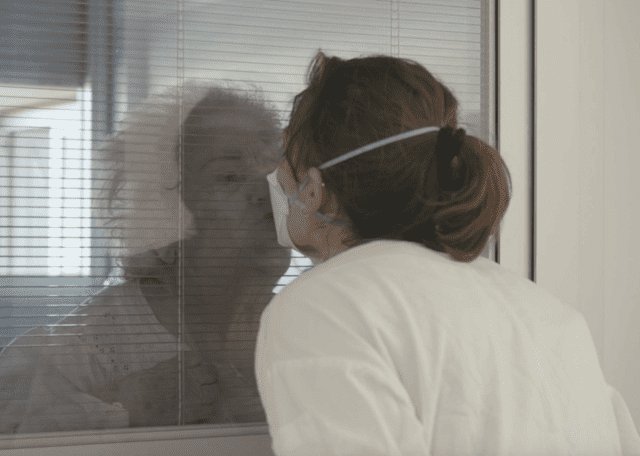
There is hope, of course, and that comes in the stories of three survivors, a young woman whose sister is a doctor in the hospital, and two older people, Franco and Giusy. Giusy is particularly engaging as she communicates animatedly with everybody and presses kisses against the glass window of her private room. What’s more, one should be prepared to bet that in the history of documentary, no Italian love song has ever been as movingly performed by Giusy’s husband via mobile.
“She [Giusy] always says to me – I call her once a month – she says ‘you were lucky that you found me. I asked you to film me’. And it’s true,” says Aiello. “We were following some nurses at night and we were passing by her corridor and she approached us beyond her door asking us to interview here, so we began to film her.”
Not surprisingly, given the need for Aiello to wear heavy duty PPE, the project presented consider technical difficulties when filming.
“You sweat a lot and you don’t breathe naturally,” says Aiello. “While you are filming it is difficult to focus the image. I had my glasses and then I had the protection and then I had to watch in the viewfinder.”
“I could have brought a bigger camera but I decided to bring a mirrorless Panasonic GH5 that a rental studio gave us for free for one month,” he adds. “This little camera allowed us to enter more freely into the rooms….but then there was the whole process of sanitisation, going back and forth between home and the hospital.”
Another problem was sound, when he was shooting alone in the ward wearing protection. “We put a microphone on the mirrorless and we were filming and I wouldn’t know how well it was coming out, but in the end there was great work by the sound designer Massimo Mariani, so we were quite satisfied.”
There is also room for a little gallows humour in the film as a doctor watches one of the hospital cooks chopping garlic for the evening meal. “Garlic may not kill the virus but at least it guarantees social distancing,” she says.
Aiello says he never wanted to present the doctors and nurses as heroic, (although one is nevertheless struck by their extreme levels of selflessness and dedication to care).
“No, I wanted to tell the story of ordinary workers who are involved in an extremely exceptional situation, not to tell the story of heroes and angels,” he says. “I wanted rather to tell the story of people who have to stay human in a situation that is not human.”