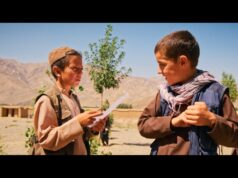
In her new film Zinder (screening in competition in Visions du Reel and in Change Makers at CPH Dox) Aicha Macky looks at gang culture in Niger from the inside. She explains her doc to Business Doc Europe.
Born in the city of Zinder herself, Macky is from a similar background to her protagonists, the muscular, macho, motorbike riding characters such as Bawo and Ramsess. But unlike them, she has had an education and has built herself a brilliant international career as filmmaker, academic and women’s rights campaigner.
Her subjects are stuck in Kara-Kara, one of the most violent and impoverished neighbourhoods of Zinder. Jobs are scarce. For many, the only way to eke out a living is through smuggling petrol.
“I was born and bred in Zinder but actually I never went in Kara-Kara before I had the idea for this film eight years ago,” Macky explains.
There is a paradox at the heart of the documentary, sold by Andana Films. Almost all its subjects have knife scars and the marks of old bullet wounds. They’re very violent men who’ve lived tough lives and yet, when they speak to the documentary maker, they come across as polite, sensitive and intelligent.
“Yes, they are violent. Yes, they did commit crime. But once you show interest in them, they’re just humans,” the director reflects. “Also, the whole point was not to make a film about them but a film with them.”
For Macky, the first challenge was winning the gang members’ trust. When she first approached them, they both tested her and tried to impress her. They showed her their knives and machetes to see if she would be scared. Once, when they were smoking pot, they blew smoke on her. However, when they realised she was not there to “steal their image,” their attitude changed. Her status shifted from that of an outsider to a “protected guest.” They let down their guard and clearly found it comforting to confide in her.
“You really have to understand that Zinder stands about 100km from the Nigerian border and from one of Nigeria’s biggest cities, Kano, which is a Boko Haram hub. All the economy in Zinder relies on exchanges with Nigeria whether it’s food, clothing or anything else,” Macky explains.
“That is why I had a real urgency to understand and to give a voice to this youth.”
Some of the gang members have seen an early cut of the film and were very moved by it. One told her that it was the first time he had felt “dignified” and that he couldn’t imagine before watching it that he and the other gang members could be “presented as anything other than [as] criminals.”
“I made this film to show their situation to the world but, first of all, I made this film for my own country,” Macky says. The director is working hard on an impact campaign for the film in Niger. She hopes to show it on buses and in villages and small communities across the country while organising debates about the subjects it raises. Given that Niger, a country close to 25 million people, has only a handful of cinemas, a more conventional distribution plan is simply not an option.
On one level, the director acknowledges, Zinder can be seen as a companion piece to her debut documentary The Fruitless Tree, which deals with the issue of infertility in Niger.
“Definitely, it [Zinder] shows a great amount of testosterone with these guys, but women are really there in the film in a very strong way,” Macky observes of the strong female presence in the documentary. As she spent time in Kara-Kara, the gang members began to confide in her as if she was their “big sister.”
Zinder was produced by Clara Vuillermoz through French production company, Point du Jour – Les films du Balibari, Macky’s own production company Tabous, and German outfit Corso Films.
“We met eight years ago in Senegal and it was a bit like love at first sight,” Vuillermoz says of her collaboration with Macky. “I produced The Fruitless Tree and we really tied very strong bonds.”
The new project received support from the IDFA Bertha Fund and the Sundance Documentary Fund.
“There are not many directors in Niger. There are not many stories from Niger. I think the big international funds were really sensitive to the fact it [Zinder] had this great access and also to this great amount of work that we did all together to develop it,” Vuillermoz notes.