There are warmer, easier places to make documentaries than Siberia. This, though, is where intrepid Belgian independent director Liesbeth De Ceulaer headed to make her bold new documentary/drama hybrid feature, Holgut (a joint world premiere both at Visions du Réel and at CPH: DOX). She knew that if she went to Yakutia in eastern Siberia as the permafrost was melting, she could find the bones of ancient animals including mammoths.
“I started working on the project in 2013 but even already before that, I got very much fascinated by the idea of extinction and [the role of] human interference in animals going extinct,” De Ceulaer explains of what took her to such a remote and frozen corner of the world.
The director was keen to examine the role climate changed played, and continues to play, in the disappearance of certain animals. She wanted to find a place where evidence of extinction was in plain sight. That is why she headed to the Siberian tundra.
De Ceulaer points to the irony: global warming helped the mammoth go extinct thousands of years ago. Now, global warming is the main reason why bones of the huge creature are re-emerging. Scientists have dreams of cloning mammoths. Opportunists think they can make huge fortunes by selling the animals’ tusks.
“I wanted to show how the disappearance of animals influences human life. While we have all this news about these animals going extinct, I still feel this great need (in society) for this natural and wild world. We, as humans, are part of it, and we need it,” De Ceulaer further elucidates her themes. When humans lose the natural world, she adds, they always risk destroying parts of their own identity.
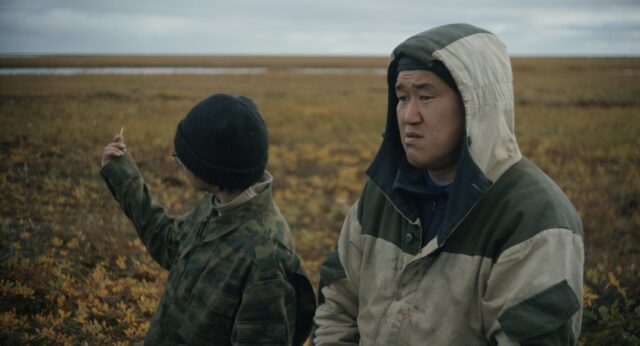
In the film, the director tells the story of two brothers, villager Roman and his much younger city-dwelling sibling Kyym as they come together to hunt for a rare reindeer, another creature threatened with extinction. Roman is well versed in the ways of the wild. Kyym is less experienced, with “soft city hands”, but picks up hunting skills quickly enough.
De Ceulaer had originally intended to work with tusk hunters. However, in a village she visited, she met a Siberian man who was a passionate cinema lover. He became her “fixer,” helping her find the two brothers.
Holgut straddles the lines between documentary and fiction. The brothers are very close to the characters they portray. (“They’re not actors. They’re real people living there.”) There was nothing fake about the journey after the reindeer they went on. In working with them, the director talks about “creating a frame in which reality can come to its fullest.”
De Ceulaer shot Holgut in the summer of 2018. “It was mentally and physically pretty challenging,” she remembers. “We had to work with fixers and translators because I don’t speak the same language. During the filming, we were very lucky that the weather was very nice…we didn’t have any storms.”
Conditions were certainly far better than when she earlier visited Siberia as part of her research during the dead of winter – when temperatures often slipped as low as minus 45 degrees. She had brought warm clothes but, even so, the time she could spend outside was very limited. If you ventured too far from your house or car, you might risk freezing to death.
Even in the summer, it wasn’t exactly balmy.” The more north you go, the more cold it gets. And yes, the landscapes are indeed littered with bones and teeth from the extinct animals.
There are several reasons for the three-year delay between the shooting of Holgut and its festival premieres. De Ceulaer had another project to finish first, Victoria, which she directed alongside fellow Belgian directors Sofie Benoot and Isabelle Tollenaere – and which premiered in Berlinale Forum 2020, going on to rack up seven awards at festivals worldwide. She also returned to Siberia in 2019 to record extra voice-over material. Holgut was almost completed last year but the Covid pandemic hit, delaying the process yet further.
Prague-based outfit Filmotor has taken on world sales duties for the film which was produced through leading independent Belgian outfit, Minds Meet. As well as International Competition at Visions du Réel Holgut is in NEXT WAVE competition in CPH:DOX.
During the first lockdown, De Ceulaer worked on a TV documentary, I Will Wait For The Day And The Night, about the effects of Covid on Belgian retirement homes. Now, she has “a new project boiling inside of me” but won’t yet disclose details. One sad coda to Holgut is that the scientist featured in the film who hoped to clone the mammoth, Dr Semyon Grigoryev, died suddenly last summer. However, De Ceulaer has sent the documentary to the other Siberian participants.
As for the vexed question of whether she is directing documentary or fiction, De Ceulaer explains she doesn’t think in these terms. “I see myself more as a coach of a team who sets out a plan. The real stars, and the people who create the real movie, are the characters themselves.”