Being right is not the same as being convincing. I have little issue, on the whole, with trusting the intentions of the main subjects of Christian Frei’s documentary Blame, three scientists who studied Sars and Covid-19 and ended up in the crosshairs of a geopolitical blame game.
Singaporean scientist Linfa Wang, Zhengli Shi of the Wuhan Institute of Virology and New Yorker Peter Daszak of the NGO EcoHealth Alliance come across as dedicated researchers and good friends, who have been studying the coronavirus in Chinese bat populations together for decades.
But cinema, as we all know, is an empathy machine – the simple fact that they seem like nice people is no argument that they’re right.
And the only real argument that Frei does put forward for disbelieving the so-called “lab leak hypothesis,” according to which the Covid coronavirus originated in the Wuhan laboratory, is the repeated statement that there is “no evidence”. A statement, made by him and his three protagonists who, however well-intentioned and scientific they may be, are clearly not impartial.
Why not interview some other well-respected authorities, be they scientists, journalists or politicians? Looking back now at the handling of the Covid crisis with the explicit aim – as Daszak keeps reminding us – of trying to prevent the next epidemic, would be very timely indeed. Instead, the film states at the outset that it’s going to stick to the perspective of the three scientists – only then to avoid diving deeply into their own scientific, social and personal convictions.
In fact, most of the information doesn’t come directly from them, but from Frei’s voiceover, sometimes accompanied by alarmist musical cues and with hardly any references or footnotes. Again, he may be right one hundred percent of the time – but without clear sources to back up his claims, that’s impossible to verify. On a subject as contentious as Covid, just saying what you think, as a non-specialist who looked into the matter, is a weak position to take. Even if Frei has indeed “double-checked and triple-checked” the accuracy of his information, as he told Business Doc Europe – we all have an uncle who used the exact same argument just before launching into another conspiratorial rant – you still have to argue the case, provide the sources, and counter the criticism.
Also, more than once, Frei tells rather than shows – or is ‘telling the telling’ (because all this is mostly about debates anyway) instead of ‘showing the telling’.
The most striking example is when Chinese independent journalist Jane Qiu, invited by Frei to join him and Daszak at a Thai retreat (where Daszak can escape the endless barrage of accusations and death threats that have been hurled at him and his family after right-wing politicians began accusing his EcoHealth Alliance of collaborating with the Wuhan lab in engineering the virus), argues with Daszak about his handling of the situation. This is the first time Daszak has been directly challenged by a sympathetic character. Frei tells us about it, but shows very little. If he had somehow missed filming that moment, he could have later questioned Qiu on camera about her journalistic reservations. But he doesn’t.
When Qiu expresses concern about being used by the film for naive “propaganda” for the “natural origin hypothesis,” which states that the virus was transmitted to humans from wildlife (most likely live animals at a Wuhan market), the documentary finally allows some of the more reasonable criticism surrounding these debates to emerge – and immediately comes alive. But Frei quickly lets go of this narrative.
Similarly, he shows only a few fragments of the Select Subcommittee on the Coronavirus Pandemic hearing, where Daszak is grilled about his involvement with the Wuhan lab, and the EcoHealth Alliance – which loses its funding shortly afterwards. It’s drama, it’s theatre, and it makes explicit many of the (often ridiculous) claims Daszak is fighting against – but Frei replaces most of it with his slow, soft-spoken and repetitive voiceover.
This documentary could easily have been edited down to a standard ninety minutes – maybe even sixty. Frei mostly just keeps repeating there is no evidence for a lab leak and that it’s hard to fight against big geopolitical conspiracy theories. And when he does show something more specific and concrete, such as a death threat note that Daszak receives, he doesn’t really explore their impact on his life or work beyond the surface level.
And this is what the film keeps doing: it mentions things – the scientific research, the media attacks, the geopolitical response to the global epidemic – without really analysing them. Within a roughly chronological narrative, very little actually happens. There are researchers who get blamed for Covid and who can’t really defend themselves. This we hear again and again. Even when Shi is at one point prevented by her superiors from cooperating with Frei’s film, there follows no further consideration of the Chinese government’s Covid policy, and the room it leaves for doubting Shi’s freedom to speak openly about her work at the Wuhan lab.
You may have noticed that I mention Daszak more than the others – in the course of the film, he becomes the main character, and focusing on his position and character from the beginning (including his debates with the Chinese journalist and at the congressional hearing) might have made for a clearer narrative. It’s also Daszak who provides the documentary’s most powerful statement, summing up its main position: “Blaming the other. This need for someone to blame. We see this with every single outbreak. We saw it with the Black Death, [the] plague, we saw it with HIV. Covid will cost trillions [of] dollars to [the] global economy. But are we gonna stop the next one? Well, I don’t see that happen. We haven’t really progressed from medieval times.”
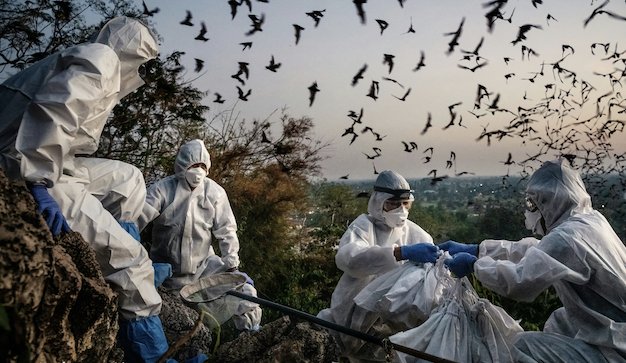
A montage sequence combining bat caves, sunset-seeking influencers and spiritual interventions, set to choral music, signals another, more impressionistic approach to the subject, which the film could have benefited from more; including the “bat POV” drone shots, flying over the terrain and through houses and a pig farm as an infected bat might have done.
As it stands, the film is timely but disappointing. And even more disappointingly, considering just how timely it truly is, the film ends with medical conspiracy theorist Robert F. Kennedy Jr, who wrote a book called The Wuhan Cover-Up and who has stated that “SARS-CoV-2 is certainly the product of bioweapons research,”,being promoted in February 2025 to Secretary of Health by President Trump. And even though the film ends there, the story certainly doesn’t: just a few days ago Trump installed TV doctor and co-conspiracy theorist ‘Dr Oz’ as the Administrator for Medicare and Medicaid, continuing his political crusade against science, facts and reason – all at the risk of endangering all of our health.
Switzerland, 2025, 122 minutes
Director Christian Frei
Production Christian Frei FilmproduktionenProducers Christian Frei
International sales Rise and Shine
Script Christian Frei
Cinematography Peter Indergand, Filip Zumbrunn
Editing Christian Frei, Magnus Langset
Sound design Florian Eidenbenz
Sound Dieter Meyer
Music Marcel Vaid, Jóhann Jóhannsson
With Linfa Wang, Zhengli Shi, Peter Daszak