

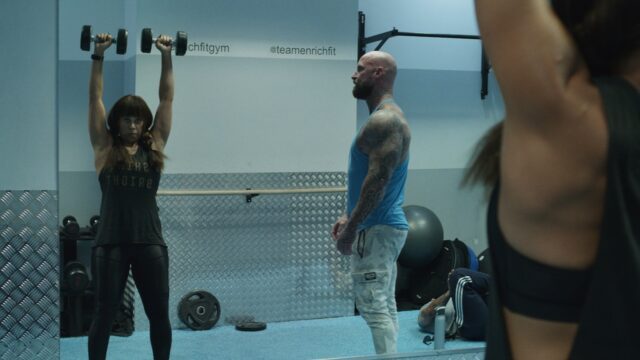
“We have taken some hits,” a weary-looking stuntwoman sighs early on in Elena Avdija’s debut feature doc Cascadeuses (Stuntwomen), an international premiere in IDFA’s Luminous section. The film, sold internationally by Andana, recently won the Focus Competition at the Zurich Film Festival.
The documentary depicts a world in which women are punched, shot, thrown out of cars or carriages and run over as a matter of course during their daily work.
The director was born in Kosovo. Her family moved to Switzerland when she was 2 years old. She grew up Swiss but moved to Paris for her Masters degree, living there for six years. After her studies, she began to work as an assistant director on documentaries. She first conceived her Stuntwomen project a decade ago, when she was still a student. She realised then, though, that she would have to be patient.
“I knew this was a documentary that would ask for infrastructure and money. I knew I could not do it by myself with a small camera. I knew it was pointless to try even,” she recalls.
As she waited to make her feature debut, Avdija directed two other smaller documentaries, “guerrilla-style, without money.” The first, D’ici ou de là-bas? (2013), travelled widely on the festival circuit. “It gave me a bit of hope that maybe, when I grow up, I can do real features!”
While she did the other work, Avdija was still thinking about how she could make Stuntwomen. She accepted that she needed a producer but wasn’t sure how to find one. After returning to Switzerland in her late 20s, she began to establish herself in the industry there, getting further jobs as assistant director. All the time, though, she was pitching the Stuntwomen idea.
“The search took six years,” she says of her quest for backers. Eventually, she came together with Agnieszka Ramu, an exec-producer at Bande à Part Films (for whom Avdija has also done some work). Ramu liked the concept and managed to get the rest of the team at Bande à Part (including the well-known filmmaker Ursula Meier) to back it.
The director speaks of her “fascination with what is happening in the shadows” of film sets. Stunt work intrigued her. “Stunts are always supposed to be invisible. If you can see the stunts as they are being made, it means the magic is not operating.”
Historically, stunts have been “a man’s world.” As the interviewees in the documentary remember, there was a long period when female stars in action scenes would have male body doubles. “We had this question, who are the few women who do this job and what are they facing in their lives.”
Avdija began to research the stunt world, meeting some of the artists. “When we started to investigate, we went in thinking, ok, it’s a man’s world and that’s interesting – but not interesting enough for making a film. But then when we started to talk about the body, the fact that you cannot protect yourself like your male fellows because they have blue jeans and you have skirts, then it started to get interesting.”
Avdija was fascinated by the “representation of violence” and the kind of roles the stuntwomen were always asked to play. “You know, when they start to work in that field, they don’t really have consciousness of those issues,” she says of the gender debates. The women are too busy learning their craft, getting as fit as possible and trying to land jobs to talk about gender discrimination.
The profession isn’t glamorous. “It’s non-stop work of getting back on your feet,” the director describes the resilience required to survive in the stunt industry. “You have to pretend you’re not hurting. You have to keep going.”
In spite of the sexism running through the industry, it is not as if the male stunt artists and coordinators are treated that much better than their female counterparts. They also are obliged to follow orders. “They’re not deciding the locations. They’re not deciding the costumes…they’re not the decision makers.”
As spectators, Avdija suggests, “we have a weird fascination” with screen violence. “We like to see the female body hurt, we like to watch that…the problem is there.”
The film has three main protagonists, all at different stages of their careers. Virginie Arnaud is one of the doyennes of the business with credits stretching back more than 25 years. Petra Specher has some impressive credits, from Independence Day: Resurgence to Minority Report. Estelle Piget has done stunts for The 355 and TV’s Notre-Dame.
Arnaud and Avdija have known each other for 10 years now and are “really good friends,” the director points out. “She doesn’t really like to be shown [on camera]. She is a private person and a bit shy,” the director says of the veteran stuntwoman. However, Arnaud was talked round by the director who convinced her of the historical importance of the project.
“Petra [Specher], she is more used to being the centre of attention. She says it herself, she is more of a show business woman,” Avdija notes. “She is used to the attention. For her, it’s a good platform to tell the world that she exists. I think it was a win-win for both of us.”
Part of the doc is shot in the US. Avdija follows Petra’s acting classes and shows some of her stunts.
The film has had one unexpected side effect. “Everyone in Switzerland who needs a stunt calls me now,” Avdija jokes about how she has become the main contact for any Swiss producers planning action sequences.
Making the doc has changed the director’s attitude about genre. “Now, when I watch action movies, I really look forward to the stunts,” she says. “I think, oh, wow, this is cool. I can read the scenes. I see the choreography. I see the risks…”





