

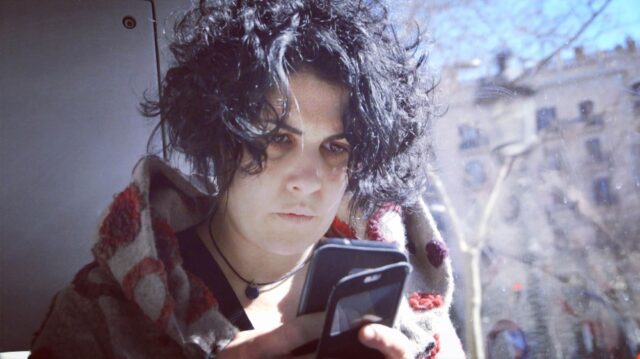
Anna M. Bofarull’s new feature doc Rebel (a world premiere in Thessaloniki’s Open Horizons) has been almost a decade in the making. The incident at its core took place in 2017 when activist Marta Torrecillas was assaulted by Spanish police officers on the day of the unofficial referendum on Catalonian independence. Footage was filmed of her being manhandled and dragged down the steps of a polling station. At the time, Marta thought her fingers had been broken.
Marta’s personal data was then hacked by right wing sympathisers. She was subjected to a horrific barrage of insults on social media where she was accused of lying about her injuries. For those opposed to Catalonian independence, she became a symbol of duplicity and bad faith. It was clear, too, that she was a victim of extreme misogyny.
“That I cannot understand, how human beings can use the worst words,” the director says of the more extreme insults hurled at Marta. “I understand you can have discussions about political topics, but not in that way. It was something irrational and uncontrolled.”
Bofarull herself had been in a polling station in Barcelona on October 1st 2017. “I saw Marta on my phone…I saw her video. I was very touched by her story because although it was her, it could have been me or any of the other women who had been in polling stations on that day, trying to vote.”
A few weeks later, Marta and the filmmaker met for the first time. They lived near to each other in Barcelona. Bofarull already felt indignant at Marta’s victimisation. It seemed as if the entire mainstream media had turned against her.
“I decide to approach her and propose, if she was OK, I would tell her story, follow her with my camera and see what happens.” Marta quickly agreed. She had been subjected to huge amounts of abuse and harassment and saw the documentary as a chance to put across her “own point of view.”
Bofarull accepts that the issue of Catalan independence splits opinion – and that people get very heated about it. Nonetheless, that didn’t lessen her shock at the personal attacks on Marta.
The director was determined to use a different approach to that of mainstream news outlets (who had taken a viral video and then created a false narrative around it without bothering to speak to Marta herself.)
After the assault, Marta couldn’t move her fingers and was in extreme pain. When she went to hospital at the end of the day, she discovered they weren’t actually broken – but that doesn’t change the fact she was assaulted. The problems arose when she gave interviews afterwards and talked very frankly about what had happened. The public reacted with fury and the Spanish media dubbed her a liar.
“As a filmmaker, I was trying to understand and get some information that was not there when you just watch it [the video] once.”
Spanish law made it hard for Bofarull to use footage without the permission of the other people who featured in it. It therefore wasn’t easy to depict the media harassment. However, the documentary includes plenty of examples of the social media abuse Marta endured, such as all the curses and threats on WhatsApp.
This may seem like a quintessentially Spanish story but it wouldn’t have been made without Slovenian support. When Bofarull first started pitching it, or even mentioned the project to people she met, the response was often the same. “Ah, the woman who lied…”
Spanish backers were reluctant to support the documentary. They would say that it wasn’t a proper story or that it wasn’t worth telling. “There was a huge taboo regarding this topic.”
Bofarull was startled to discover that when she pitched the project abroad, everyone seemed to understand and appreciate the idea, but when she came back to her own country, she encountered rejection.
That’s why Rebel was eventually made as a Slovenian/Spanish co-production, through Rok Bice’s Cvinger and Bofarull’s own company, KaBoGa art & films.
The director believes that her subject found it “cathartic” to participate in the documentary.
“The fact that I was following her, and listening to her, it was helping her somehow. Of course, I am a filmmaker but I turned also into her friend. We trusted each other,” the director reflects. “But for me it was complicated, because I knew that making this film would expose her again.”
At first, after the incident at the polling station, Marta remained active politically, attending protests, often with Bofarull by her side. “But then with the PTSD, it really changed in the sense that she was very depressed. She didn’t want to show it.”
Bofarull was determined to protect her subject’s mental health. “Being close to her but respecting her well-being was super important,” the director says. “That’s why I decided to use my voice in the documentary as a character, commenting on a lot of things.”
As Marta’s story reveals, the wheels of justice in Spain grind very slow. Finally, one week before the non-pregnant Marta was due to give birth, she got her day in court in 2022. That was already five years after the incident at the polling station. Not that the judge seemed keen to punish those who had been abusing her. Most got off with tiny fines at worst. The police officers didn’t even have to answer for their behaviour. They were nearly all given amnesties.
Rebel is “a local story” but its director believes it has a universal resonance. It is touching on topics – political freedom, women’s control of their bodies, police brutality, social media and online victimisation – that have a resonance everywhere. Bofarull’s hope now is to find a sales agent and Spanish distribution as well as further festival play.
“I think this story can have a broad audience in Catalonia especially,” the director suggests. After all, half the population voted in that referendum in October 2017, and many still feel hurt and resentment about the way they were treated. Marta, though, arguably suffered more than any of them, and all because she wanted to exercise her right to vote.
“My main question was what happens to Marta…she was used and all the information is there,” the director says of the brutal treatment of her subject (who won’t be attending the Thessaloniki premiere.) “She is now having another kind of life. She is now a mum. Also, I realise that me and the documentary remind her of a bad moment in the past…I can feel it somehow that this is a part of her life she wants to cut off.”





