

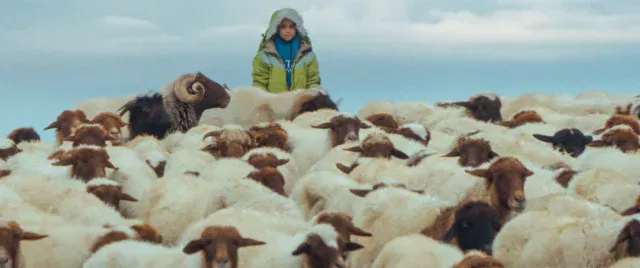
Jérôme le Maire has lived in Morocco, in an isolated palm grove in the middle of the desert, for half the year, for over 20 years. That’s how the Belgian filmmaker stumbled on the subject for this new film, The Price of the Sun (Du soleil et du plomb), screening in International Competition in Visions Du Réel.
“It was from my own window that I first saw enormous machines raising clouds of dust on the horizon. My research revealed that the world’s largest renewable energy plant was to be built on this collective land – land that until then had belonged to no-one in particular, and yet to everyone,” le Maire says.
In the documentary, he is looking in particular at how this massive renewable energy complex affects the life of a small Berber tribe. “I focused on a long-term, precise, and intimate observation of these nomads and the values they cultivate, as they found themselves confronted with the arrival of an inevitable event that would lead them toward an unexpected future.”
The Belgian director had quickly realised he wouldn’t be able to produce a documentary about the impact of the power plant he saw from his window, because everything “was moving so fast.” Construction had already begun and it looked as if he was out of time. However, he subsequently learned that another power plant (six times larger than the first one) would soon be built a day’s journey from his home, and still in the middle of the desert. He hurried to this site and met the tribe that had lived there for centuries,
“As we talked, I realised they were completely unaware of what was about to happen on their land. No one had come to warn them that they would inevitably be displaced,” le Maire remembers his own high anxiety about the nomads’ predicament. “I was quite worried: the solar power plant would transform the desert into a giant mirror; hundreds of wind turbines would also be erected. Eventually, there would be no more birds, insects, or vegetation – the very elements on which the nomads depend for their livelihood as herders. But nomads live in the present, always on the move, always ready to help. And they saw my worry, and it was they who began to reassure me!”
For several years, the filmmakers followed a handful of individuals from this nomadic tribe, trying to adapt to the new life that had been brutally imposed upon them, far removed from their ancestral values. These nomads were forced to settle down, compelled to sell their herds and, as a last resort, to become miners.
“In less time than it takes to complete the construction of the renewable energy complex, this millennia-old ecosystem was disintegrating before our very eyes,” the director laments. He points to a paradox. This was a renewable energy complex, constructed to boost “sustainability” and yet it was, in fact, destroying an ancient way of life.
The Price of the Sun was a highly ambitious undertaking. The idea was to film over at least five years having already done a year of location scouting (before filming) and then spend a year on post-production (after filming). “We therefore had to convince financiers to invest in a project whose results they wouldn’t see for another seven years. It was a challenge.”
A co-production was put together between four main partners: Clin d’œil Films (Flemish Belgium), Iota Production (French-speaking Belgium), Les Films d’Ici (France) and K Films (Morocco). “Each of these companies sought support within its own ecosystem,” the director says.
The shooting style evokes both Sergio Leone epics and even the work of David Lean and Stanley Kubrick. There are lots of widescreen images of imposing desert landscapes.
“The film is shot in Cinemascope, the musical score features the oud and viola, and the image processing is undeniably a nod to the Kodak film of the era,” le Maire, a fan of 2001: A Space Odyssey, explains.
“The parallels with the Wild West and the gold rush are, unfortunately, all too real and undeniable,” he adds, pointing to the theme of the “conquest” of the territory by the “white cowboy/workers” and to the poignant scenes of the nomads putting up their tents for the last time. There may not be horses roaming freely – but there are donkeys.
How did the director win the trust of his subjects?
“The secret to making this kind of film is taking your time. Taking the time to introduce yourself. Who am I, and what am I doing in this region? What can I do for you? Before saying what I want to film, I listen to what these people have to say. Where they’re coming from….” he says.
“The first time I went to this desert, I was with my wife, who loves these regions of southern Morocco. Another time, I was with my daughter. To gain someone’s trust, you have to offer an exchange. I show you who I am, and you show me who you are. Then, we talked about the power plant. The tribe had their opinion. I had mine. We talked a lot about what was happening around us. We were trying to make sense of it all. We were trying to understand each other.”
The nomads quickly understood that le Maire was less interested in the power plant itself than he was in the delicate ecosystem in which it was going to be built.
The documentary was filmed over six years, from 2019-2025. Locations ranged from the high desert plateau of Midelt, in the abandoned village of Sidi Ayat, and in the old Ahouli mines – still active, though now exploited illegally. “What began as a film about the construction of a solar power plant gradually became something far more complex—a portrait of a silent dispossession and the quiet erasure of a way of life.”
Having made the film, its director strikes a philosophical note about the pros and cons of renewable energy. “It has as undeniable potential for positive change. The values associated with it are respect for the planet and the common good – this is obvious for the sun, but what about the Earth?” he asks. “It is quite surprising that, after filming the day-to-day development of a flagship renewable energy project for several years, we struggle to find the underlying values.”
“The wealthier one is, the more energy one consumes. This is an indisputable fact and our starting point,” le Maire continues. Now, it has become absolutely vital to take energy-saving measures, both individually and publicly. We absolutely must consume less. This is the only lever that guarantees 100% positive effects for the planet and the common good. Clean energy doesn’t exist. It’s sold to us as such so that we consume more and more, without a qualm. But we have a responsibility in this…when you use Artificial Intelligence, when you charge your electric car, or when you flip a light switch in your living room, someone on the other end of the line will be impacted by that consumption. It’s not about guilt, but about awareness and responsibility!”
After Nyon, the film will travel on the festival circuit. And, yes, the Berbers will soon see it too.
“We’ve already started working on an impact campaign. At the local level, our goal is to help this nomadic community find a dignified place in the world into which they have been thrust. In very concrete terms, we are working on the idea of helping them build houses around the new school built in the middle of the desert. At the international level, the film will serve as a basis for debates and conferences on the real impact and the social and territorial challenges of renewable energy worldwide,” le Maire ends.





