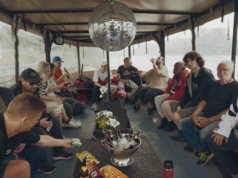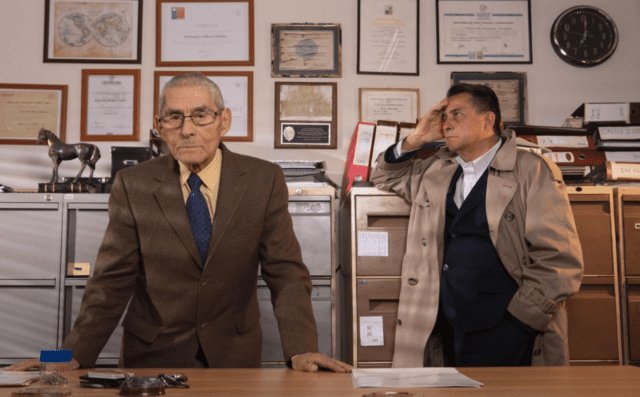
In a few days, Best Documentary Oscar nominee Maite Alberdi will be setting off from Chile to Los Angeles for this year’s Academy Awards, held on April 25. She will be joined on her journey by 83-year-old Sergio Chamy, the protagonist of her documentary The Mole Agent. He’s the one who goes undercover in an old people’s home to investigate whether some of the patients are being badly treated.
“We are in a strict lockdown in Chile but the government has made an authorisation to travel for a super small crew – me, the producer and Sergio,” Alberdi tells Business Doc Europe of her plans. “I thought that he (Sergio) would not want to come because of the pandemic and everything ,but he told me ‘it is the first time I have ever taken a plane in my life.’ And then he told me: ‘it’s the last adventure of my life and I really wanted to do it’.”
There are Covid protocols to observe and the Chileans will have to observe a period of quarantine – but they’re determined to be there, on the red carpet.
The Mole Agent isn’t Alberdi’s first film featuring older people. For example, she also enjoyed considerable success with her earlier doc Tea Time (2014), about five elderly ladies who’ve been meeting for tea every month for 60 years.
“For me, it’s a topic that I am obsessed (by),” Alberdi declares. “We usually, in our society, speak about old people as a general group, a sociological brand. I have been seeing that there are so many ways to be old, so many possibilities, so many stories, that I cannot make only one film about that.”
In her films about old people, Alberdi has also been determined to avoid the usual traps of showing the silver-haired protagonists as weak, vulnerable and dependent. “Of course, it [their fragility] is a part of it, but it’s not all of it – and it’s not all the time.”
The director, 38 herself, asks why “we can’t see the beauty in ageing.” She sees it as her responsibility as a filmmaker to convey this beauty – and suggests she might now go on to make as many as ten films on the subject. One inspiration is her grandmother, with whom she used to live, and who featured in Tea Time. The grandmother was “super sick” but still always found ways to enjoy life.
The Mole Agent, she continues, is completely different to Tea Time, even if they both have old people as their main characters.
The two films, though, are linked. When she was preparing The Mole Agent, the earlier film helped open doors for her. When she approached retirement homes for permission to film, the administrators would always have seen Tea Timeand would be disposed to help her.
In the doc, Sergio is working on behalf of a private detective who has been hired by a family to investigate whether their mother is being mistreated in the home. Alberdi films his investigations. The owners of the home think she is making an observational documentary, and have therefore already given her access.
The Mole Agent borrows some of the storytelling devices from old film noir and detective movies. “It’s the kind of film that I always loved when I was 17 and [when I] studied cinema theory,” Alberdi says of the genre. As a teacher and former film critic, she has intimate knowledge of old movies like Otto Preminger’s Laura and Orson Welles’ The Lady From Shanghai.
“I love mostly the aesthetic and the radical style. My desire as a documentary filmmaker was [to ask] why we can’t take some stylish references of the fiction film,” Alberdi says. She refuses to accept documentary as an “isolated” genre and argues that docs can come in just as many shapes and shades as dramas. She describes her own Oscar-nominated film as “a drama, a comedy, a film noir, it’s an observational documentary…reality has those mixtures.”
The Mole Agent found its form in the editing room. Alberdi and her team shot 300 hours of material. It took a year and a half to winnow down the material to its 84-minute running length. The main challenge was combing the detective story elements with the human comedy as Sergio encountered all the other old folk in the retirement home.
As she contemplates the many months spent on post-production, Alberdi compares documentary makers to sculptors. “We have a rock, that is reality,” she says. The trick is to hammer and chisel away to shape that rock.
What has the director done with the 299 hours or so of material that didn’t make it into the final version? She talks of making a separate short film with some of the footage. “I killed a lot of darlings but I was pretty sure that was the story I had to tell.”
Yes, it has been strange campaigning for Oscars in the middle of the pandemic. The Mole Agent wasn’t just in the frame for the Best Documentary Oscar (for which it has been nominated) but was also chosen by Chile as its entry for The Best International Film award.
“The Mole Agent is not a studio film. We don’t have a big streamer behind us. It’s a really independent film,” Alberdi points out. In normal years, her little doc might have been squashed by the bigger movies with bigger marketing budgets. However, she believes that the awards campaign has been more “democratic” than normal this year. She may not have had the budget to throw swanky screenings and cocktail parties in LA for Academy members but with cinemas closed, everyone has been in a similar situation, forced to campaign online. She has also been helped by lobbying on her behalf from celebrated fellow Chilean directors like Sebastian Lelio and Pablo Larrain who’ve already had Oscar success with their dramatic movies like A Fantastic Woman, No and Jackie.
“We have managed with small resources, something that was impossible in the normal context,” Alberdi says of her Oscar nomination as she prepares to pack her bags and head off to LA for the big night.